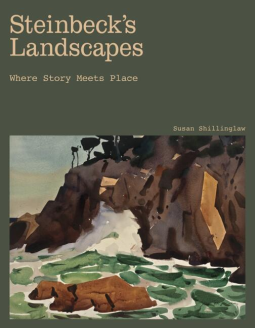
Steinbeck's Landscapes
Where Story Meets Place
This title was previously available on NetGalley and is now archived.
Send NetGalley books directly to your Kindle or Kindle app
1
To read on a Kindle or Kindle app, please add kindle@netgalley.com as an approved email address to receive files in your Amazon account. Click here for step-by-step instructions.
2
Also find your Kindle email address within your Amazon account, and enter it here.
Pub Date Sep 8 2026 | Archive Date Sep 8 2026
Talking about this book? Use #SteinbecksLandscapes #NetGalley. More hashtag tips!
Description
From one of the foremost scholars on the subject, comes our most in-depth look at John Steinbeck as a writer deeply connected to the natural world.
Among the many reasons that John Steinbeck has reached the highest tier of the American literary canon is what we have come to understand as his prescient progressivism: human dignity in the face of industrialization, a celebration of the migrant laborer, and support of the poor and working class versus the owning classes.
His vision as a writer was also fundamentally ecological, looking at man and nature holistically. To understand people, Steinbeck insisted, you must appreciate the environments they inhabit: the local trees and flowers, soil and rocks, invertebrates and frogs. Always in Steinbeck’s books natural and cultural histories overlap with an animating spirit of place.
Steinbeck’s Landscapes is the first major work to focus on Steinbeck as a predominantly environmental writer. It highlights the places that the Nobel Prize–winning author cherished and explored throughout his life and examines the iconic stories they inspired. We learn how the Salinas Valley of his youth shaped East of Eden; how, in Cannery Row, the improbable diversity of human life washed together in a tight community not unlike a Monterey tidepool; and how, in The Grapes of Wrath, various human connections to land and soil inform every page of Steinbeck’s monumental novel.
The result is a new and fuller understanding of Steinbeck and his work, arguing that the resonant power of his prose owes much to this writer’s keen and abiding sense of place.
About the Author: Susan Shillinglaw, Ph.D., is Professor Emerita of English at San Jose State University, where she taught American and Western literature for 37 years. For 18 years she was Director of the University’s Center for Steinbeck Studies, where she edited a newsletter and organized several international conferences. In 2013 she was honored as SJSU President’s Scholar. From 2015-18 she was Director of Salinas’s National Steinbeck Center.
Advance Praise
“An enthralling portrait of the places that shaped John Steinbeck and his work. Sumptuously illustrated, Steinbeck's Landscapes pairs the author’s beloved homeland with the books from which it is inseparable. An affecting and deeply evocative book.”—William Souder, author of Mad at the World: A Life of John Steinbeck
“John Steinbeck is lucky that fate selected Susan Shillinglaw to tend the garden of his legacy. She has listened to the wind in the trees, and felt the dirt underneath the feet of his characters. She has eaten the mushrooms on the ground and touched the squirmy intertidal critters of his heart’s home. This is a lovely and wise book because no one knows Steinbeck’s world better than Susan Shillinglaw.”—John Straley, author of Big Breath In and former Alaska Writer Laureate
“Susan Shillinglaw has peered into the Steinbeck legacy through so many lenses that she has redefined the legacy of his lifework. Through her eyes, you will see Steinbeck in an altogether distinctive light. ”—Gary Paul Nabhan, author of Water in the Desert: A Pilgrimage
“Steinbeck’s Landscapes captures Shillinglaw’s own love of place and of this author. Passages from texts are meticulously chosen and surrounded by images of California’s history and landscape—an almost magical place of great beauty.”—Barbara A. Heavilin, Editor-in-Chief, Steinbeck Review
“Steinbeck’s Landscapes is at once travel narrative, literary study, and intimate biography—richly imbued with the colors, textures, and spirit of the California terrain, and the far-flung places beyond it, that shaped the life and imagination of John Steinbeck . . . an essential read for scholars, admirers, and anyone seeking to understand Steinbeck more deeply."—Katie Rodger, editor of Ed Ricketts’s letters and essays: Renaissance Man of Cannery Row and Breaking
Available Editions
| EDITION | Other Format |
| ISBN | 9781643260044 |
| PRICE | $35.00 (USD) |
| PAGES | 284 |
Links
Available on NetGalley
Available to Buy
Buy on BN.com Buy on Bookshop.orgBISAC Codes
Average rating from 4 members
Readers who liked this book also liked:


Amisha Padnani; New York Times
Biographies & Memoirs, Children's Nonfiction, History




Publishers Lunch
General Fiction (Adult), Nonfiction (Adult), Teens & YA


Dean Norris; Joe Layden
Biographies & Memoirs, Entertainment & Pop Culture, Nonfiction (Adult)

Lori B. Davis
Health, Mind & Body, Parenting, Families, Relationships, Self-Help