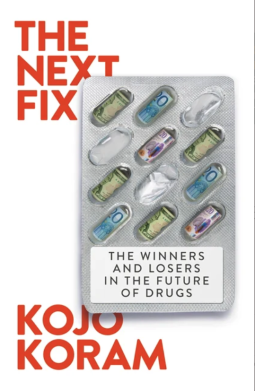
The Next Fix
The Winners and Losers in the Future of Drugs
This title was previously available on NetGalley and is now archived.
Send NetGalley books directly to your Kindle or Kindle app
1
To read on a Kindle or Kindle app, please add kindle@netgalley.com as an approved email address to receive files in your Amazon account. Click here for step-by-step instructions.
2
Also find your Kindle email address within your Amazon account, and enter it here.
Pub Date Jul 28 2026 | Archive Date Jul 28 2026
Verso Books (US) | Verso
Talking about this book? Use #TheNextFix #NetGalley. More hashtag tips!
Description
From America’s plantation-turned-prison known as Angola in Louisiana to the psychedelic boom of Silicon Valley, The Next Fix tracks a seismic shift in global drug policy. Kojo Koram—legal scholar and acclaimed author of Uncommon Wealth—travels across five continents to examine how criminalized substances are being rebranded as commodities in a new billion-dollar industry. Legal cannabis dispensaries now trade in what once led to life sentences.Psychedelics have become fertile ground for biotech.But for all these developments, prisons still swell with underprivileged users and addicts, and enforce-ment falls hardest along lines of race and class.
This is not a polemic for or against legalization. It is a powerful, clear-eyed reckoning with how we got here—and what kind of future is taking shape in a world addicted to economic “fixes” every bit as much as it is troubled by drugs. Combining reportage, political analysis and vivid personal testimony, The Next Fix tells the untold story of drugs, capitalism and inequality in the twenty-first century.
Advance Praise
"Koram is an unrivaled translator of legal complexity into vivid prose, and The Next Fix is no exception. This book provides a bracing look at one of the deadliest interactions: what happens when you mix drugs, prohibition, and the forces of global capitalism"—Atossa Araxia Abrahamian, author of The Hidden Globe
"Koram tells the stories of those whose lives have been destroyed by the drug war and the heroic efforts to replace it with a system of care and economic transformation. It is both a prescription for a better future and a cautionary tale of the power of capital to up end that vision"—Alex S Vitale, author of The End of Policing
"A lucid and compelling guide to the new territory in which yesterday's banned substances are today's wellness aids or pharmaceutical miracles . . . The Next Fix argues persuasively that we stand at a crucial inflection point where we have a chance to replace the monopolies and exploitation of the drug trade with regulatory systems that promote local supply chains, compassionate healthcare and global justice"—Mike Jay, author of Free Radicals
"Koram is a fantastic scholar, here he continues to show how many common assumptions about drug use and law enforcement simply cannot be understood but through the lenses of class, race and empire. It is only once we account for such things that we can make sense of what otherwise might seem like completely contradictory, even illogical, policies, ideas and applications. Kojo's case is clear and to my mind irrefutable"—Akala, author of Natives
"An eye-opening and often shocking tale of all that's wrong with how we govern drugs, who is deemed illicit, and what harms those choices wreak on the lives of ordinary people around the world. It also shows us that things don't have to be this way. A must-read for anyone who's ever questioned the war on drugs and their new, legal markets"—Rosie Collington, co-author of The Big Con
Marketing Plan
- Library marketing campaign
- Digital marketing campaign
- Print and digital advertising
- Indie bookseller mailing
- Library marketing campaign
- Digital marketing campaign
- Print and digital advertising
- Indie bookseller mailing
Available Editions
| EDITION | Other Format |
| ISBN | 9781804294123 |
| PRICE | $29.95 (USD) |
| PAGES | 320 |
Available on NetGalley
Available to Buy
Buy on BN.com Buy on Bookshop.orgAverage rating from 2 members
Featured Reviews
 Frank V, Reviewer
A necessary if terminally-received appreciation of centuries of work. You’d wish for answers to drug abuse and the drug war, but you can’t get that from any work that must struggle to analyze post-capitalist noise. What this really is is a documentation of where we stand in a society that no longer cares about reparations or even, at the least, the repercussions of the violence inflicted by capitalism. It’s an excellently researched and thoughtfully//considered examination of where we stand with drug culture that doesn’t need but doesn’t doubt a way forward.