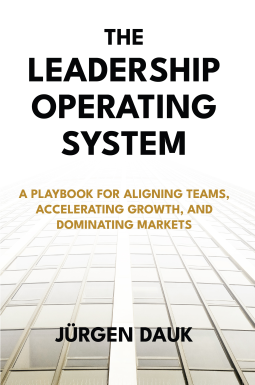
The Leadership Operating System
A Playbook for Aligning Teams, Accelerating Growth, and Dominating Markets
This title was previously available on NetGalley and is now archived.
Send NetGalley books directly to your Kindle or Kindle app
1
To read on a Kindle or Kindle app, please add kindle@netgalley.com as an approved email address to receive files in your Amazon account. Click here for step-by-step instructions.
2
Also find your Kindle email address within your Amazon account, and enter it here.
Pub Date Apr 15 2026 | Archive Date May 8 2026
My Word Publishing | Independent Book Publishers Association (IBPA), Members' Titles
Talking about this book? Use #TheLeadershipOperatingSystem #NetGalley. More hashtag tips!
Description
77% of strategic initiatives fail due to execution gaps. Here's how to join the 23% who dominate their markets.
THE LEADERSHIP OPERATING SYSTEM will solve this You'll discover the exact frameworks that have helped tech founders and enterprise executives:
- Build high-performing, aligned teams that execute strategy flawlessly
- Accelerate growth while maintaining quality and innovation
- Eliminate silos using collaboration systems
- Bridge strategic vision with flawless operational execution
This isn't another business theory book written from an ivory tower. It's a field-tested operating system developed by Jürgen Dauk over 25 years by learning from brilliant leaders, working for big tech companies such as Oracle, OpenText, and Avaya and helping start-ups and scale-ups to transform their organization.
A Note From the Publisher
ISBN: 978-3-9828102-1-8 (hardcover)
ISBN: 978-3-9828102-0-1 (paperback)
ISBN: 978-3-9828102-1-8 (hardcover)
Advance Praise
"What you'll find in these pages isn't just another business framework. It's a field guide for the messy, complex, infuriatingly human reality of actually getting things done in a world that changes faster than most companies can adapt.
The harsh realities Jurgen describes in Chapter 1? I've lived them. The execution gaps he identifies in Chapter 10? I've fallen into those chasms myself. The technology decisions that either amplify your competitive advantages or constrain them? I've made both kinds, sometimes in the same quarter.
But here's what makes this book different from the stack of business books collecting dust on your shelf: Jurgen has actually done this stuff. Not once, not in perfect conditions, but repeatedly, in the trenches, with real companies facing real constraints and real market pressures.
He's made the mistakes so you don't have to. He's tested the frameworks so you know they work. He's distilled the lessons so you can skip the expensive learning curve." —Karim Ben-Jafaar, Serial Entrepreneur, Consultant and Industry Leade
Available Editions
| EDITION | Ebook |
| ISBN | 9783982810225 |
| PRICE | $21.95 (USD) |
| PAGES | 326 |
Links
Available on NetGalley
Average rating from 1 member
Featured Reviews
 Reviewer 1964003
The Company That Could Not Hear Its Own Machinery
In “The Leadership Operating System,” Jürgen Dauk turns vision, customers, talent, technology, and execution into a practical study of how organizations lose the path between intention and action.
By Demetris Papadimitropoulos | April 19th, 2026
A company can lie without anyone in it meaning to. It can call itself customer-centric while arranging the work around internal queues, permission gates, approvals, and handoffs no customer requested. It can call people its greatest asset while giving them blurry roles, tools that dull the work, and managers who turn talent into compliance paperwork. It can say it is data-driven while measuring activity with the devotion of a monk and value with the curiosity of a houseplant. It can announce a strategy, bless the slide deck, and then watch the whole thing sink into the carpeted marsh between budget, ownership, meetings, incentives, and Monday morning.
Jürgen Dauk’s “The Leadership Operating System” is most interesting when it notices those polite institutional falsehoods. The subtitle promises alignment, growth, and market conquest. The better book underneath that voltage is quieter and more useful. Its real task is to make the company described in executive vocabulary resemble the one actually running through calendars, dashboards, job descriptions, customer calls, tools, and handoffs. That is less glamorous than conquest, but more durable. Domination ages badly. A system that tells the truth about itself can at least be repaired.
Dauk writes for organizations that have outgrown improvisation but not yet earned discipline. These are the technology founders, scale-up executives, product leaders, senior operators, and executive teams living through the peculiar humiliation of having smart people, plausible strategy, decent products, and still too much activity with too little arrival. The claim is simple, and bracing because it is simple: companies do not usually fail because they lack ambition or intelligence. They fail because their internal machinery works at cross-purposes. Vision does not guide decisions. Customer understanding stops at segmentation. Capable people sit in badly fitted roles. Matrix structures produce meetings instead of value. Dashboards count motion but miss proof. Technology is chosen for procurement hygiene rather than human capability. Strategy is approved, admired, and starved after applause.
Across twelve chapters, Dauk follows symptoms back to the arrangements that keep producing them. The opening chapters identify the “harsh realities” of contemporary technology businesses: unhappy customers, disengaged employees, missed growth, and the profit paradox that tempts leaders to improve the next quarter by weakening the next decade. From there, he moves through root-cause analysis, North Star vision, ideal customer profiles, role fit, agile organization design, product operating models, evidence-based management, strategy execution, and technology-stack decisions. The final chapter snaps the parts into relation and makes the useful point that none of these admired initiatives works alone. Vision guides customer selection; customer understanding shapes the operating model; people systems determine follow-through; evidence keeps the machinery honest; technology either amplifies the whole arrangement or jams the works.
The map is wider than it is novel, and Dauk knows the territory better than he redraws it. Readers of Richard P. Rumelt’s “Good Strategy/Bad Strategy,” John Doerr’s “Measure What Matters,” Marty Cagan’s “Inspired,” Gino Wickman’s “Traction,” and Matthew Skelton and Manuel Pais’s “Team Topologies” will recognize many of the tools already on the bench. North Star vision, OKRs, agile teams, customer personas, product operating models, servant leadership, and outcome-based measurement are not new inventions. Dauk’s contribution is the wiring. He is less a theorist unveiling a hidden law than an operator walking through the plant and asking why the expensive machines are not plugged into one another.
Business books often court one sacred lever. Here is the metric. Here is the structure. Here is the customer method. Here is the leadership habit. Pull hard enough and the company will change. Dauk distrusts that fantasy. A North Star is useless if employees cannot connect it to the work in front of them. Customer insight dies if feedback stops three handoffs away from the team that can act. Agile teams become theater if permission still lives at the top. Product thinking withers if budgets still fund projects. Evidence-based management collapses if metrics reward visible busyness over proof that a customer is better off. Technology can make capable people faster, clearer, and more valuable; it can also turn them into clerks with better login credentials.
In the chapter on technology, an acquisition goes wrong in a way that gives the book its cleanest cautionary tale. An acquired company’s finely tuned marketing engine is dismantled in the name of efficiency. The acquired team had built a sophisticated arrangement of tools, integrations, attribution, workflows, and hard-won judgment. Corporate standardization replaces it. Lead generation drops, conversion rates fall, and the people who understood the system leave. It miniaturizes the argument. The problem is not software. The problem is failing to see that tools remember how work learned to work. A stack is not just what appears on the invoice; it is experiment, habit, memory, and advantage embedded in use. Strip it away and you may not get efficiency. You may get a centralized method for forgetting what made the team worth buying.
Customers, in Dauk’s best pages, stop being market segments and become rooms full of people with different risks. He separates champions, decision-makers, influencers, and blockers; distinguishes corporate pain from personal pain; and expands cost beyond price into time, risk, reputation, opportunity cost, and political capital. Here the book stops speaking about markets and starts noticing rooms. A prospect is not simply a budget with a problem attached. It is a committee of ambitions, fears, incentives, private embarrassments, departmental grudges, career hopes, and one CFO somewhere quietly preparing to say no unless the “why” is plain. Dauk’s insistence that companies validate assumptions through actual conversations is not glamorous, but it is sturdy. A CRM record is not a relationship. A persona is not a person. A dashboard is not a customer interview, no matter how handsomely it glows.
The people chapter is best when it treats miscasting as a design failure rather than a character flaw. Dauk is right that generic job descriptions produce generic hiring, and that leaders often confuse talent with fit. His sports-team analogies are familiar, but familiarity is not always failure; sometimes the striker really does need to be kept out of goal. The chapter is especially good on the cost of promoting people whose individual competence conceals managerial harm. Toxic leaders do not merely damage their direct reports. They reorganize the emotional weather around them. Teams become cautious. Information stops flowing. Collaboration turns into self-protection with a calendar invite.
The chapter wobbles slightly when its confidence in personality assessment outruns its support. The broad point is sound: organizations should define roles more precisely, assess candidates more rigorously, and stop pretending that a charming interview and a shiny résumé reveal how someone will behave under pressure. But the best version of this section is a plea for humane precision: know the work, know the person, know the team, and stop calling mismatch a performance problem. The thinner version risks making personality tools look more settled than they are.
The prose moves like a manager late to the next decision: brisk, declarative, allergic to mist. Dauk likes crisp oppositions – outputs versus outcomes, projects versus products, data versus evidence, perks versus purpose, talent versus fit. These pairings give the book much of its force. They are simple, but not necessarily simplistic. They let a reader look at a messy organization and ask better questions. What are we rewarding? What are we measuring? What does this structure make easy? What does it make almost impossible?
The style occasionally sprays on the consultant cologne. Words like transformation, domination, journey, and game-changing appear with more enthusiasm than precision. The book is most convincing when it resists its own promotional reflexes and simply shows where the machinery is jamming. It does not need a trumpet. A torque wrench suits it better.
As architecture, “The Leadership Operating System” behaves less like an essay than a workshop tool. Most chapters follow a recognizable pattern: a business problem, a diagnosis, a framework, an example, a set of questions, and an action list. Read straight through, that rhythm can become predictable. The weary executive appears; the hidden misalignment is revealed; the framework arrives with a clipboard. Yet the repetition is not merely padding. Dauk is building a workbook, and workbooks repeat because implementation repeats. There are, regrettably, many nails. There are also several executives holding screwdrivers upside down.
The structure matters because it makes the book’s main claim visible: no single fix survives inside a misaligned system. The chapters do not simply stack topics. They show dependency. A company with a weak North Star will misread its customers. A company with shallow customer intelligence will fund the wrong products. A company with project thinking will mistake completion for learning. A company with the wrong metrics will mistake its own busyness for proof of life.
What makes the book matter is its unromantic view of execution. Dauk understands that strategy rarely fails in one cinematic moment. It does not usually happen when the market cackles and pulls a lever. It happens in handoffs, unclear ownership, incompatible metrics, overcentralized decisions, under-specified roles, bad tooling, polite evasions, and teams rewarded for optimizing their corner of the maze. The book’s most useful repeated question is not “What do we want?” but “What does our system make likely?”
The same tidying impulse, though, can make the book too clean by half. The case examples often resolve with the satisfying click of an immaculate consulting slide: company struggles, root cause appears, framework is applied, metrics improve. That makes the lessons easy to grasp, but it can sand down the more stubborn grain of organizational life. Silos are not only design flaws. They are territories. Metrics are not only measurement choices. They are political settlements. Bad structures persist not merely because leaders lack frameworks, but because someone’s authority, budget, identity, or insulation depends on them. Dauk knows enough to mention blockers, incentives, and politics, but the book remains more comfortable with architecture than with power.
That matters because the book is, at its deepest, about organizational self-deception, and self-deception is rarely cured by a template alone. A leader can audit the org chart and still avoid naming the executive who benefits from confusion. A company can adopt OKRs and still set goals nobody dares challenge. A team can call itself agile while preserving the old permission structure in nicer shoes. The book gives leaders many useful instruments, but it sometimes underestimates how easily good instruments can be used to play the old tune in a cleaner key.
Its usefulness now lies in its distrust of fashionable fixes that arrive before the problem has been properly named. The book speaks naturally to the rush to adopt AI and other technologies without first clarifying value, workflow, data quality, ownership, or evidence. It speaks to employee disengagement disguised by culture theater. It speaks to companies announcing product models while still funding projects, or promising agility while preserving approval chains. But it does not need to dress itself as a book about the latest managerial weather. Its deeper concern is older: organizations have always had a gift for saying one thing, measuring another, rewarding a third, and then being wounded when reality proves literate.
“The Leadership Operating System” lands for me at 76/100, or 3/5 stars: sturdy, workshop-ready, and plainly limited, held back by familiar frameworks, repetitive mechanics, uneven prose, and a thinner account of the power dynamics that make execution failure so durable.
The book is too familiar to be called fresh and too useful to be waved away. For a founder whose company has outgrown improvisation, a product leader weary of feature factories, a COO trying to separate activity from progress, or an executive team confusing agreement with alignment, it could provide real help. It is not a major new theory of leadership. It is not especially elegant. It will not surprise readers already steeped in modern product, agile, and execution literature. But it does something practical and worthwhile: it gathers the scattered vocabulary of competent modern management and asks whether any of it is actually true inside the company.
That question is harder than it looks. A company can hang a North Star in the lobby and still wander. It can buy tools and remain dull. It can hire stars and miscast them. It can measure everything except what matters. Dauk’s book earns its keep whenever it forces leaders to stop admiring the language of alignment and begin the less photogenic labor of making alignment real – not as a slide, slogan, or system diagram, but as the daily route by which work finds the customer without getting lost inside the building.
Views expressed in promotions/advertisements do not necessarily reflect those of NetGalley or its affiliates.
© 2026 NetGalley LLC
• All Rights Reserved


Views expressed in promotions/advertisements do not necessarily reflect those of NetGalley or its affiliates.