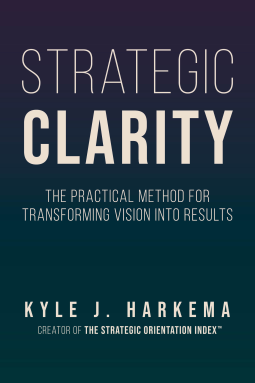
Strategic Clarity
The Practical Method for Transforming Vision into Results
This title was previously available on NetGalley and is now archived.
Send NetGalley books directly to your Kindle or Kindle app
1
To read on a Kindle or Kindle app, please add kindle@netgalley.com as an approved email address to receive files in your Amazon account. Click here for step-by-step instructions.
2
Also find your Kindle email address within your Amazon account, and enter it here.
Pub Date Jun 16 2026 | Archive Date Jul 20 2026
Talking about this book? Use #StrategicClarity #NetGalley. More hashtag tips!
Description
What if your strategy isn’t broken—your execution is just misaligned?
That’s a big problem, and you need to act fast. But how? After two decades as an executive, professor, and consultant, Kyle J. Harkema delivers your best next moves.
In Strategic Clarity, Harkema shares a new research-backed diagnostic mirror that decodes how your company truly thinks, listens, and acts. Then he gives you the road map you need to get back on track to grow.
As Harkema well knows, strategy lives or dies in an organization’s behaviors. Once you see the patterns of your company with clarity, you can stop talking strategy—and start living it. You’ll find:
• How companies behave under pressure: the five personas
• The fast diagnostic assessment to show where you really stand
• Strategic playbooks that shift orientation so you can grow
• Real case studies that tie alignment to measurable outcomes
Harkema doesn’t bring you theory dressed up as insight. He delivers the right diagnostic tool for these times—so ambitious executives, teams, and organizations can pivot, grow, and win.
Whether you’re leading an enterprise, scaling a start-up, or teaching students about strategy, Harkema’s book will forever change how you look at any organization—and how you can make the smart moves to transform it.
Because in the end, strategy isn’t what gets written down. It’s what gets repeated.
Advance Praise
“Strategic Clarity offers executives a clear, research-grounded way to diagnose why strategy breaks down in behavior and how to fix it. A rare fusion of academic rigor and managerial clarity.”
—Vijay Govindarajan, Thinkers 50 Hall of Fame, Coxe Distinguished Professor of Management, Tuck School of Business, Dartmouth College
“Strategic Clarity is one of those rare strategy books that actually makes complex ideas feel usable. Kyle Harkema takes big academic concepts—entrepreneurial mindset, market orientation, opportunity spotting—and breaks them down into clear, practical guidance leaders can apply right away. If you want a smarter, more grounded way to make strategic decisions without the usual buzzwords this book is the one you’ll keep coming back to.”
—Dr. Marshall Goldsmith, Thinkers50 #1 Executive Coach and New York Times bestselling author of The Earned Life, Triggers, and What Got You Here Won’t Get You There
“Great companies are simultaneously more market-driven and more entrepreneurial than competitors. Strategic Clarity brings new insights into how these two orientations can coexist and reinforce one another, and the ways in which they produce transformative approaches to creating, reaching, and serving markets.”
—Michael H. Morris, PhD, professor, entrepreneurship and social Innovation, Keough School of Global Affairs, University of Notre Dame
“I’ve watched countless executives freeze, panic, or double down at exactly the wrong moment. Kyle’s four-quadrant framework finally explains why—and more importantly, shows how to break these patterns. If you’ve ever wondered why your team’s best thinking disperses during a crisis, read this book.”
—Charlene Li, New York Times bestselling author and coauthor of Winning with AI: The 90-Day Blueprint for Success
“World-class performance in entrepreneurial environments derives from adaptable models that harmonize with how firms think and act. Because successful firms must think and act in increasingly unique ways, the field of strategy needs new and dynamic firm-level approaches, like the one in this book, for use in both scholarly contexts and practical settings.”
—Patrick J. Murphy, Goodrich Endowed Chair for Innovation and Entrepreneurship, University of Alabama at Birmingham
“As both an academic and a practitioner in Marketing, I have come to believe that the philosophy of Marketing held individually and collectively in the organization directly guides the practice of Marketing. The material provided by Dr. Harkema is very valuable because it helps the person and the organizational leader diagnose the orientation that is shaping the practice of Marketing. Strategic Clarity provides significant insights for business results. This is a resource that I want to use with my students and one that informs me as I work with organizations.”
—Michael Wiese, marketing professor, Point Loma Nazarene University
“The Strategic Orientation Index™ gave our executive team something we’ve been missing for years—a shared language for what we were feeling but couldn’t measure. We’ve done strategic plans before, but SOI was the first tool that actually revealed how differently our teams were interpreting and enacting strategy.
“The results were eye-opening. Nine out of ten departments saw themselves in the Hybrid Zone, not because people were misaligned in intent, but because we were behaving out of sync. The SOI session didn’t just diagnose the issue—it created clarity, energy, and momentum in the room. My team immediately recognized themselves in the findings, and more importantly, saw a path forward. What stood out to me personally was how practical the framework felt. It wasn’t academic theory—it explained what we were experiencing every day.
“The conversation it sparked across sales, product, operations, marketing, and engineering was one of the most productive strategic dialogues we’ve had as a leadership team.
“SOI helped us choose Insightful Optimizer™ as our strategic aspiration—a posture that fits our culture, our market, and the disciplined, relationship-driven way we want to grow. Dr. Harkema’s work has already influenced our priorities, especially around Voice of Customer and cross-functional coordination.
“For any mid-market firm looking to grow with strategic discipline, SOI is one of the clearest and most actionable tools I’ve seen. It helped us see ourselves honestly and move forward with intention.”
—Mitch Kehler, CEO, KMC Controls
“Harkema’s Strategic Clarity extends the work of gurus at the intersection of strategy content and process, combining theory with operational precision. He provides an elegant system for turning strategic intent into ubiquitous organizational behavior in a focused manner. A must-read for founders and executives pursuing disciplined growth, especially in times of significant market and economic uncertainty and upheavals.”
—Joe LiPuma, consultant and clinical associate professor, Questrom School of Business, Boston University
Available Editions
| EDITION | Paperback |
| ISBN | 9798891389045 |
| PRICE | $30.00 (USD) |
| PAGES | 464 |
Available on NetGalley
Available to Buy
Buy on BN.com Buy on Bookshop.orgAverage rating from 5 members
Featured Reviews
 Marta E, Reviewer
Strategic Clarity by Kyle J. Harkema is one of those business books that cuts straight through the noise.
At its core, it argues something brutally simple: most companies do not fail because they lack strategy, they fail because their behaviour completely drifts away from it. And that gap between intent and execution is where everything breaks.
What I liked most is how practical it is. This is not theory for theory’s sake. It feels like a toolkit built for real leadership problems, especially in fast-moving or scaling environments where alignment slips without anyone noticing.
It is sharp, structured, and very execution-focused. The kind of book that makes you look at organisations differently once you start applying it.
 Mike M, Media/Journalist
Many executives believe their strategy is clear, but once you read this book you will get another idea. This book clarifies everything. A great read.
 Reviewer 294918
Kyle’s Strategic Clarity: The Practical Method for Transforming Vision into Results introduces the Strategic Orientation Index™ (SOI™), a groundbreaking framework that helps organizations align their Entrepreneurial Orientation (EO), Market Orientation (MO), and Entrepreneurial Marketing (EM). The book’s core argument is that strategy is behavior—not just planning—and that misalignments in how firms think, listen, and act often lead to stalled growth.
The SOI™ simplifies these orientations into a Think-Listen-Act model:
- Think (EO) – Bold, innovative, and proactive.
- Listen (MO) – Customer-focused, competitor-aware, and responsive.
- Act (EM) – Behavioral execution through agility, alliances, and market immersion.
Firms are mapped into five strategic personas (e.g., Visionary Vanguard, Fearless Inventor) based on their SOI™ scores, each with tailored recommendations. The book is practical, offering diagnostic tools, radar charts, and action checklists for executives, consultants, and educators.
Kyle bridges academic rigor (drawing from Covin & Slevin, Narver & Slater, Morris et al.) with real-world applicability, making the book valuable for SMEs, startups, and large organizations alike. While the SOI™ is not yet empirically validated at scale, it serves as a powerful hypothesis-generating tool for strategic alignment.
Strategic Clarity is a must-read for leaders who want to diagnose misalignments, foster a shared strategic language, and turn vision into results. It’s a working manual—not just a theoretical exploration—making it an essential addition to any strategist’s library.
George N, Reviewer
Kyle J. Harkema has gifted those who lead with a roadmap to clarity. Too many times great ideas die as they travel from thought to action. Harkema expands on his Doctoral Thesis to share the knowledge he gained from not just the study, but the implementation of a workable solution. Rather than focusing on just one part of the process, he paints the complete picture and then tells us how to duplicate the picture, using his Strategic Orientation Index. The book contains infographics to help the reader see and retain the thoughts needed to make the changes necessary for strategic clarity. He addresses the roadblocks and gives you reasons to build cooperation between the vision and implementation. This is a book to keep on your shelf to use as a textbook to find strategic clarity. @aplifypubgroup
 Demetris P, Reviewer
The Company in the Mirror
Kyle J. Harkema’s “Strategic Clarity” turns business strategy into a test of organizational self-knowledge, asking what firms do when their best stories meet their actual habits.
By Demetris Papadimitropoulos | May 22nd, 2026
Companies are often gifted autobiographers. They know how to narrate themselves in the language of the managerial season: innovative, customer-obsessed, agile, values-led, data-driven, bold. They can recite the deck-polished version of their character with impressive composure.
What they cannot always do is give sworn testimony against their own habits.
That is the quietly accusing premise beneath Kyle J. Harkema’s “Strategic Clarity: The Practical Method for Transforming Vision Into Results.” Strategy, in Harkema’s account, is not what a firm says it believes. It is what the firm funds, repeats, rewards, delays, and excuses when the customer becomes inconvenient, the market turns noisy, the founder’s intuition collides with evidence, and sales, product, marketing, and operations begin running different races under the same company banner.
Strategy is what survives pressure. The plan is not the strategy. The reflex is.
Harkema’s central instrument, the Strategic Orientation Index, or SOI™, braids three ideas with long academic paper trails into one scoreable mirror: Entrepreneurial Orientation, Market Orientation, and Entrepreneurial Marketing. EO describes how a firm thinks – whether it is innovative, proactive, and willing to take risks. MO describes how it listens – whether it gathers market intelligence, watches competitors, attends to customers, and coordinates across functions. EM describes how it acts – whether all that intention and insight becomes visible in opportunity pursuit, customer contact, alliances, informal research, market immersion, and growth behavior.
Reduced to the whiteboard, it is almost suspiciously simple: Think. Listen. Act.
Courage without listening becomes vanity. Listening without courage becomes timidity. Action without either becomes theater with a budget.
From this triad, Harkema builds a set of strategic personas: Visionary Vanguard, Fearless Inventor, Insightful Optimizer, Reluctant Responder, and Hybrid Zone. The labels sound ready for laminated workshop cards, and a little pleased with their own capitalization, but they do the one thing labels must do: they travel. A Visionary Vanguard combines boldness with market attentiveness. A Fearless Inventor charges ahead on conviction and risks mistaking motion for fit. An Insightful Optimizer listens closely and executes carefully but may hesitate before reinvention. A Reluctant Responder survives by habit, protection, or inertia. The Hybrid Zone is the most humanly revealing category: the firm with pockets of energy, fragments of insight, clashing departmental logics, and no shared behavioral grammar. Everyone is rowing, as the book suggests, but not always toward the same shore. Some are rowing toward the shore. Some toward the founder. Some toward the quarterly number. Some, quietly, toward a different company altogether.
The book comes alive when it stops explaining the grid and begins watching firms betray themselves. Harkema is strongest when he turns abstract strategy into corporate reflex: what a company does under pressure, what it rewards, what it ignores, what it postpones until certainty arrives wearing a name badge. Some of his cases breathe; others pose obediently for the quadrant. The best ones give the instrument pulse.
Bright Harvest, the values-driven organic-produce distributor, has the romance of founder conviction and the familiar ache of organizational adolescence. Taylor Ramos builds the company on instinct, mission, and identity. Those qualities make the firm distinctive. They also begin to block customer learning, retention discipline, and scalable systems. Customers complain about late boxes and unclear communication. A grocery buyer wants sell-through data and co-marketing planning. A growth director proposes CRM systems, NPS tracking, segmentation, and structured feedback loops. Taylor hears not discipline but dilution. “If we wait for the data, we’re already behind” is a revealing line because, depending on the quarter’s churn rate, it can sound visionary, defensive, or faintly catastrophic.
NimbleTech is sharper still. A once-disruptive IoT firm now suffers not from stupidity, laziness, or lack of talent, but from incompatible habits. Sales behaves like a Fearless Inventor, promising custom features in pursuit of growth. Engineering behaves like a guardian of stability, resisting technical shortcuts. Marketing collects customer insight but lacks the authority to make it matter. The CEO sounds visionary in all-hands meetings and cautious in decision forums. Sales promises. Engineering resists. Marketing hears. Product hesitates. Soon the dysfunction becomes measurable: custom deals collapse after the sale, product launches slip, churn rises, and customer-success managers leave. This is not a strategy problem in the abstract. It is a room full of people using the same nouns and different verbs.
The book’s cleanest gift is diplomatic grammar for rooms already beginning to curdle. A firm can be “high EO, low MO” rather than arrogant. It can be an “Insightful Optimizer” rather than cowardly. It can be trapped in the Hybrid Zone rather than doomed by incompetence. This matters. Corporate life is full of soft evasions and hard accusations; Harkema offers a middle register, one that permits diagnosis before combat. “We are behaving like a Hybrid Zone” is less inflammatory than “no one here knows what we are doing,” and generally better for the snacks at the offsite.
Harkema’s prose is whiteboard-clean and workshop-shaped. It defines, explains, lists, classifies, recommends, and restates. Sentence by sentence, the book does not seduce; it orients. The rhythm is classroom-to-consulting-room, not essay-to-revelation. No one will underline “Strategic Clarity” for the shimmer of its sentences. They will underline it because a meeting they dread suddenly has a name.
The diction comes from the executive-education classroom: levers, quadrants, capabilities, metrics, action plans, growth orientation, market intelligence. Much of it is familiar, but Harkema gives the vocabulary a useful test: does anything actually change after feedback arrives? “Alignment,” in this book, is not agreement at the top or a smiling slide at the retreat. It means whether customer calls, churn data, buyer interviews, support tickets, product roadmaps, and executive incentives point toward the same choices. It means whether feedback changes the product. It means whether the buyer’s complaint survives the meeting instead of being thanked, summarized, and buried alive.
Formally, the book suffers from the ailment it diagnoses: strong intent, crowded execution, too many initiatives competing for the same room. At its best, “Strategic Clarity” moves from scholarly foundation to integrated diagnostic to persona map to casebook to implementation guide. Harkema’s scholar-practitioner identity is not decorative. The author bio presents him as a DBA/MBA, educator, marketer, consultant, and bridge-builder between theory and practice; the book’s form confirms the self-description. It wants to be rigorous enough for a classroom, usable enough for a client engagement, and plain enough for an executive team already tired before lunch.
The bibliography, like a conference tote bag after a long week, tells on the book. It ranges widely across strategy, entrepreneurship, innovation, marketing, customer experience, agile work, alliances, finance, analytics, organizational culture, and classic management theory: Porter, Narver and Slater, Lumpkin and Dess, Teece, Ries, Hsieh, Kotler, Drucker, Christensen, Kaplan and Norton, and many others. There are real beams here. There are also loose boards: repeated entries, mixed citation styles, peer-reviewed anchors sitting beside business books and web articles, and the occasional sense of a reference apparatus that wants to prove seriousness by accumulation. The book wants to move research from the footnote to the offsite. Sometimes it builds the bridge; sometimes it keeps delivering lumber.
The tax on that ambition is bulk. Too many chapters keep proving what the best chapters have already made clear. The book circles, with variations, the same counsel: listen better, innovate with discipline, align teams, build feedback loops, measure outcomes, use customer insight, stay agile, act intentionally. None of this is wrong. Much of it is sound. But sound advice can become wallpaper when it returns in a new blazer. Sections on profitability ratios, SMART goals, common marketing challenges, large-company applicability, future trends, personalization, AI, ecosystems, and implementation tactics are relevant, yet they sometimes feel less like necessary architecture than the standard contents of the management pantry. There are good tools on nearly every shelf. The shop is still crowded.
This is especially apparent in the later chapters, where the SOI™ model competes with the book’s urge to become the whole seminar. Harkema can move from a genuinely useful diagnosis of strategic posture to familiar summaries of gross profit margin, return on assets, EBITDA, SWOT analysis, segmentation, A/B testing, loyalty programs, social media marketing, scenario planning, and digital transformation. These are not irrelevant. But the more comprehensive the book becomes, the less distinctive it feels. Its originality lies in the SOI™ lens; whenever that lens is set down, the prose begins to sound like a very competent syllabus looking for a binder.
The company examples reveal the same tension. Bright Harvest and NimbleTech work because they are designed to expose action: the founder whose instinct stops scaling, the sales team that outruns engineering, the customer data that gets collected and then ignored. The famous-company examples are less casework than silhouettes: recognizable, useful, and a little too smooth around the edges. Zappos as an Insightful Optimizer is persuasive: its advantage comes less from radical product invention than from service culture, customer intimacy, and disciplined experience design. Dollar Shave Club, as Fearless Inventor, also fits: a company that entered a saturated market with a disruptive model, a comic voice, and a willingness to punch upward.
Tesla and Airbnb are trickier. Tesla can be read as Visionary Vanguard if one emphasizes bold innovation, market-shaping ambition, vertical integration, and customer feedback loops. Yet the quadrant smooths complications many readers will feel pressing at the edges: brand volatility, executive spectacle, labor criticism, regulatory scrutiny, and the unstable line between customer intimacy and social-media theater. Airbnb, too, fits the model’s account of bold innovation plus market sensing, but its civic and regulatory consequences remain more background than reckoning. The teaching cases breathe because they exist to reveal the model. The public-company silhouettes sometimes look cleaner in the grid than they do in the world.
The book’s most significant intellectual risk is its claim that SOI™ can become more than a mnemonic. Harkema wants it to be a scoring instrument: a model that classifies strategic posture, reveals blind spots, guides transitions, supports workshops, serves classrooms, and helps consultants move leaders from vague discomfort to shared language. That ambition gives the book its energy. It also exposes the boundary of its proof. Harkema acknowledges the limitation: self-reported data can distort scoring, firm-level personas can hide business-unit variation, and the system has not yet been validated through large-scale longitudinal studies. That candor helps. It also clarifies the real verdict. SOI™ is strongest as a shared sentence for a tense room, not yet as a machine that can certify its own accuracy.
As language, though, SOI™ works. It encourages leaders to ask questions that many organizations avoid because the answers would disturb the mythology. Are we bold but deaf? Attentive but timid? Stable or merely stalled? Energetic or incoherent? Do customer insights change product decisions, or do they merely decorate reports? Does our founder story still describe us, or has it become a ceremonial costume? Would frontline employees, customers, partners, and executives place us in the same quadrant? Executives may score the company they wish they ran. The best use of the tool is to make that wish visible.
The book also understands something more elegant strategy books sometimes miss: misalignment often appears first as mood. Meetings get heavier. Launches get messier. Teams become less certain which choices are actually rewarded. Sales hears urgency, engineering hears danger, marketing hears the customer, finance hears cost, leadership hears all of them and calls it complexity. Later, the mood becomes measurable. Missed growth. Eroded margins. Churn. Product delays. Exhausted employees. By then, the quadrant has been speaking for a while. No one wanted to read it.
The ending explains the book backward. After the future-facing material on digital transformation, personalization, alliances, informal research, market immersion, and customer-centric innovation, Harkema turns directly toward action: guided SOI™ workshops, university licensing, consulting-firm applications, corporate-team training, facilitator kits, persona grids, client-ready templates, partner portals. Tool-seekers may admire the candor; stylists may hear the register change as the book opens a side door into a licensing portal. Both responses are earned.
Yet that final turn also makes earlier choices more legible. The repetitions, matrices, scorecards, case prompts, strategic implications, and persona summaries begin to look less like mere editorial excess and more like product architecture. Harkema is not simply making an argument; he is packaging an intake system, a teaching platform, a consulting instrument. “Strategic Clarity” wants to be read, but it also wants to be used, licensed, facilitated, and brought to the next retreat. It becomes less graceful as prose and more coherent as product.
For all its overpacking, the thing still has a handle – and in a noisy room, handles matter. It does not replace SWOT, Porter’s Five Forces, Balanced Scorecard, Business Model Canvas, Blue Ocean Strategy, McKinsey 7S, or EOS, and Harkema is right not to claim that it does. Its contribution is narrower and more interesting: it asks whether a firm’s inner habits match its declared ambition. It shifts attention from what the plan says to how the organization behaves when the plan meets buyers, competitors, silos, committees, founders, and fear. In a dashboard age fluent in measurement and strangely inarticulate about habit, that shift matters.
The catch is that “Strategic Clarity” keeps escorting its best idea with more furniture than the room requires. The book does not need every familiar strategy and marketing concept to accompany SOI™ into the room. It does not need to prove, repeatedly, that customer focus, innovation, agility, measurement, and partnerships are valuable. Its best pages already show the harder thing: why firms that know all those words still fail to enact them. The gap between knowing and doing is where this book belongs. When it stays there, it has bite.
As prose, then, the book will most satisfy readers who want structure, classification, and usable vocabulary: consultants, executive educators, founders in transition, functional leaders stuck in cross-departmental fog, and students learning to connect strategy theory to organizational life. Consultants may dog-ear it before the coffee cools. Faculty may assign pieces of it. Founders may feel a small, useful sting. Stylists may sigh at the trademarks, matrices, repeated definitions, and cheerful imperatives of the workbook voice. Spare is not the ambition here. Deployable is.
My final rating is 76/100, which corresponds to a Goodreads-compatible 3/5 stars: a useful, overbuilt, notably uneven book whose central instrument is more memorable than its prose and more compelling than some of the material surrounding it. Harkema has not written the last word on strategic coherence, but he has built a mirror with labels sharp enough to make the room go quiet. The ordinary reader will ask whether the mirror is flattering. The braver one will notice that the reflection is holding a different strategy deck – and may have been making the decisions all along.
Readers who liked this book also liked:





Tim Leatherman; Chris Kornelis
Biographies & Memoirs, Business, Leadership, Finance