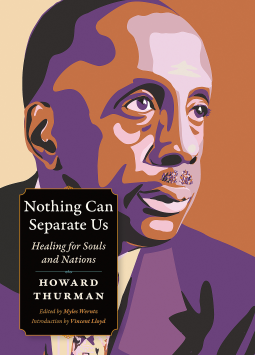
Nothing Can Separate Us
Healing for Souls and Nations
This title was previously available on NetGalley and is now archived.
Send NetGalley books directly to your Kindle or Kindle app
1
To read on a Kindle or Kindle app, please add kindle@netgalley.com as an approved email address to receive files in your Amazon account. Click here for step-by-step instructions.
2
Also find your Kindle email address within your Amazon account, and enter it here.
Pub Date Sep 22 2026 | Archive Date Sep 22 2026
Plough Publishing | Plough Publishing House
Talking about this book? Use #NothingCanSeparateUs #NetGalley. More hashtag tips!
Description
Profound division is the narrative of our current moment. But Howard Thurman says God can transcend every barrier and heal every wound. Family feuds, church fractures, racial tensions, political polarization, systemic injustice, and international conflicts can all be overcome by disciples who actually make room for the Living God in their interior lives.
Thurman’s message is persistent: true spirituality enables us to transcend individualism and alleviate actual injustice and suffering. As spiritual advisor to civil rights leaders such as Martin Luther King Jr. and James Farmer, Thurman made – and lived – the connection between faith and action.
In these selections from his many books, Thurman reflects on the power of silence, contemplative prayer, the importance of community, and the call to “live in the world as it is and still believe in the possibility of redemption.” Whether you are new to his writings or have long admired his work, this little book offers an overarching picture of Thurman’s spiritual vision of reconciliation, justice, and a hope grounded in the transformative work of love in the world.
A Note From the Publisher
- Book for the moment: Meets renewed interest in nonviolent resistance and in contemplative faith that transcends race and politics.
- Mentor to civil rights leaders: Thurman served as spiritual advisor to Martin Luther King Jr, James Farmer, and other civil rights leaders.
- Martin Luther King Jr is known to have carried a copy of Thurman’s Jesus and the Disinherited (1949) in his pocket for years.
- Thurman’s thought has been cited frequently by a wide variety of pastors and leaders including John Lewis, Jesse Jackson, Barbara Brown Taylor, Barack Obama, and Tim Keller.
- Hopeful message: Thurman believed that faith can reconcile former enemies.
Advance Praise
Howard Thurman’s writings have become, for me, sacred texts—ground I return to again and again for wisdom, clarity, and renewal. I am especially grateful to encounter his voice in this remarkable collection created with such care. Each reading deepens my understanding and reorients my spirit, challenging me to live more faithfully into the demands of love, compassion, honesty, and courage. Thurman's words never leave me unchanged; and I suspect you may find yourself transformed by these pages too. —Michelle Alexander, author, The New Jim Crow
Howard Thurman is one of the most important Christian contemplatives of the last century, and his writings have informed my life and work. I’m delighted about this new book, which will help preserve his legacy by introducing his message to new generations. —Richard Rohr, Order of Friars Minor
With both courage and wisdom, Howard Thurman tackles the underlying questions that have plagued humanity across the ages. Nothing Can Separate Us is both a personal roadmap for survival and a way forward for a civilization in crisis. —Martin Doblmeier, founder, Journey Films
In Nothing Can Separate Us, Thurman’s prophetic voice reminds us that the human condition requires us “to say yes to life and to our life,” that authentic living is not something to be postponed into an uncertain future, that we must eschew the temptation of contentment within solipsistic silos in order to fulfill our ultimate responsibility: to love God and our neighbors as we love ourselves. We are called to direct radical love, most of all to the oppressed, even when – especially when – it may cost us. —Matthew E. Henry, poet and author
Howard Thurman asks us to look inward – deeply and contemplatively inward – so that we can look outward towards human division and social injustice around us. This book provides nine examples of how Thurman addressed this fundamental message of his life. It is a most valuable contribution both to Thurman studies and to anyone wishing to access some of Thurman's most profound points about our spiritual journeys. —Paul Harvey, author, Howard Thurman and the Disinherited
In today’s fast-paced world of “new, now, and all about me” it can be tempting to make our walks with Jesus like that too, especially when it comes to justice and activism. Thurman reminds us that it’s just our turn to take up the mantle for our leg of the Christian story, and offers us wisdom from his faithful race. —Jonathan P. Walton, author and speaker
Rarely does one find so much wisdom packed into a book of 144 pages in length. This is one to read slowly and savor. —Friends Journal
Boy, could we use a Howard Thurman today, in a world in which our spiritual needs and political realities have rarely been more askew. But we can still learn from Thurman, and Nothing Can Separate Us is a lovely, succinct introduction to some of the major themes of his religious and social thought. —Peter Eisenstadt, author, Against the Hounds of Hell
In an era of hostilities, hatred, and violence, this book provides a bracing invitation to a different way of life. Thurman asks us to see that nonviolence is more than just a set of tactics; it is a recognition that ultimately there are no enemies because we are all neighbors and each of us is seen, known, and beloved by God. This love of the Father for us, his prodigal children, forms “the context, the climate, the atmosphere” in which each of us can truly love God, each other, and ourselves. —Anthony M. Barr
Appreciation for Howard Thurman:
I have read Howard Thurman and been informed, influenced, and girded by his courage, intelligence, and abiding love. —Maya Angelou
If you are a serious person about your own journey, especially if you are in the struggle for human rights, you've got to meet Howard Thurman. —Otis Moss Jr., in the documentary Backs Against the Wall
I carried [Thurman's] book with me, Jesus and the Disinherited, every day just as a reference. —Jesse Jackson, in the documentary Backs Against the Wall
In those long midnight hours when morning seems weeks away, the words of Howard Thurman have kept watch with me. —Alice Walker, in the audiobook The Living Wisdom of Howard Thurman
Nothing in Thurman’s large and magnificently varied body of work ever yielded itself to superficial readings. —Vincent Harding, in his forward to the 1996 edition of Jesus and the Disinherited
Marketing Plan
- Feature in Plough Quarterly, circulation 16,000
- Featured on Plough’s website, 500,000 monthly visitors
- National publicity campaign
- Feature in Plough Quarterly, circulation 16,000
- Featured on Plough’s website, 500,000 monthly visitors
- National publicity campaign
Available Editions
| EDITION | Other Format |
| ISBN | 9781636081731 |
| PRICE | $12.95 (USD) |
| PAGES | 144 |
Links
Available on NetGalley
Available to Buy
Buy on BN.com Buy on Bookshop.orgAverage rating from 13 members
Featured Reviews
 Eric G, Educator
I have long wanted to have an introduction to Dr Thurman’s life and teachings and this volume offers a great path into fulfilling that desire. His was an important voice in his lifetime and his messages are still relevant in our time.
 Bob T, Reviewer
Summary: The inner work of transformation through which God works to bring reconciliation, justice, and hope.
Plough Publishing is releasing its latest installment in the Plough Spiritual Guides series in September 2026. In this case, it is a collection of the writings of Howard Thurman. He was a pastor and theologian who mentored civil rights leaders, including Martin Luther King, Jr. This guide, like preceding ones in the series offers a brief biography of Thurman followed by a guide to reading him, and then readings from Thurman’s works. Vincent LW. Lloyd, in the latter, observes this distinction between King and Thurman:
“If Martin Luther King, Jr. invites collective struggle to transform the political world, to end racism, Howard Thurman invites interior struggle to transform the self. There is no need for a choice between the two….Thurman demonstrates how we participate in God through struggle, how we struggle against false gods, against those individuals and systems and habits of mind that take themselves to be absolute authorities, and how the struggle within and the struggle without are intimately linked” (p. xxviii).
Lloyd thus offers a précis of the theme connecting the nine selections from Thurman’s writings. These selections, titled in the form of imperatives, offer nine ways we engage with God as we “engage the struggle without.” In “Know Thyself” he invites us to live in the present and in the disarming presence of God that strips us of illusions. Then, in “Love Your Neighbor” he connects our love of God and neighbor. He concludes with the wonder of “being completely and totally understood in the presence of God.”
But what does love have to do with our enemies? In “Love Your Enemies” he identifies three types of enemies the poor and disinherited face. He observes that even enemies are of infinite worth to God. Thus, it is worthy to try to make contact with this imago dei in the person’s life. We do this through forgiveness, leaving vengeance to God. Then, in “Choose Nonviolence” he addresses the nonviolent ethic of Jesus in both personal and national life. He offers the simple axiom that “No one ever wins a fight.” He discusses the choice of violence as the decision to will the non-existence of another.
Instead, we “Learn to Pray.” It is the acknowledgement that we do not want to be left to our own meagre resources. The chapter concludes with a wonderful prayer that models our dependence on God. An example of utter dependence comes from the slave experience and the spirituals that emerged from it. “Wade in the Water” speaks of coming to God in our vulnerability, trusting that God will “trouble the water” in healing. Finally, the road to dependency leads us to “Surrender to God.” Thurman describes in first person terms all the areas involved in full surrender to God.
This inner transformation has outward effects. For example, his call to “Attend to Nature” challenges us to “reverence for all expressions of life.” Likewise it results in an “at-homeness in the world.” Lastly, he calls us to “Live in Community.” He warns us against isolation and of ever thinking of “people” in merely abstract terms.
To devote oneself to seek God’s kingdom and pursue his reconciliation and justice in the world is a lifetime journey. We look for final fulfillment in Christ’s return. The wisdom captured in these nine short chapters from Howard Thurman’s writings capture the inner journey that transforms and sustains us as we seek societal transformation. The danger in any form of struggle against evil is to become like that against which we struggle. Thurman writes of the inner spiritual transformation that guards our hearts and makes reconciliation and healing possible.
_____________
Disclosure of Material Connection: I received a complimentary copy of this book from the publisher for review.
 Ashley S, Reviewer
This collection of Thurman’s writings felt like a balm for the soul in a deeply polarized world. His powerful reflections on contemplative prayer, community, and the bridge between interior faith and social justice offered me a beautiful, timely vision of spiritual reconciliation.
 Pete F, Media/Journalist
This newest volume in Plough’s Spiritual Guides series played to the strengths of this format. It opens with a really great biography and introduction, followed by 100 pages of selections from Howard Thurman divided into nine helpful chapters. Each chapter includes a handful of excerpts from various writings by Thurman—sometimes a few from one book, sometimes from multiple different books.
I greatly appreciated that the introductory material did not try to put on an objective stance but felt very personal. In fact, the introduction opens: “There are three moments in my life when I wish I had known Howard Thurman.” (You can read the full essay on Plough’s website: https://www.plough.com/articles/i-wis....) Howard Thurman is well known for being an influence on Martin Luther King Jr. “If Martin Luther King Jr. invites collective struggle to transform the political world, to end racism, Howard Thurman invites interior struggle to transform the self. There is no need for a choice between the two.”
The biography points to how Thurman embodied an ethos of love. “As a minister in Ohio and as a professor and administrator in Georgia and Washington, DC, he sought to join the life of the mind and the life of the heart by means of hospitality.”
The chapter are organized in a logical order. The progression of the first three chapters is “Know Thyself,” “Love your Neighbor,” and “Love Your Enemies.” Thurman says, “Most often you are brought face-to-face with yourself only when such an encounter is forced upon you.” Once we see ourselves, we also see others more clearly as their own Subjects, not our pawns. “In love, we do not seek the balance, as normal as it is. Love goes beyond the balance.”
I took the most notes from the chapter titled “Choose Nonviolence.” He says that in contrast to love, “violence embodies a will to nonexistence.” Ironically, to seek violence is ultimately a danger to ourselves: “Men are made for each other, and any sustained denial of this elemental fact of life cannot stand.” Each chapter fits well with the title Nothing Can Separate Us.
We can see Thurman’s influence on Martin Luther King Jr., especially in how he shows that nonviolence is not a strategy but an ethic of neighbor love. He claims that to use nonviolence only as a technique until it proves less useful “has the same moral basis as violence.” Later in the book, he explains that we are responsible for extending forgiveness, but “it is not my responsibility if the individual whom it moves rejects it.”
Near the middle of the book, we have a chapter on prayer leading into a few chapters on surrendering to God. Prayer is an admission that we cannot pull ourselves up by our bootstraps. “Again and again, we discover that our resources are not equal to the demands of living.”
Of these chapters, “Wade in the Water” is the most opaque chapter title, trying to encompass a tricky topic. This requires an extended quote to show. Thurman draws on biblical language to explain, “God is troubling the waters when we are sick. Not in the sense that he causes the illness, not punishing us with sickness; but rather, God is troubling the waters in human illness because inherent in the illness something rational is active, and if it is understood, its secret can be revealed so that all the overtones and creative possibilities that result from the radical interruption of one’s normal processes can be turned into the glorious and redemptive account.” However, this is an experience we mist live through—we cannot just think our way around it. “There are no completely satisfying ways by which this conclusion may be arrived at by mere or sheer rational reflective processes.”
The book concludes with chapters on nature and community. We are only fully human when we are in right relationship with nature and others. Thus, he defines a sinner as “one who is out of community.”
The title Nothing Can Separate Us speaks to the quiet confidence Thurman has in our connection both with God and with other humans. Through the selections, Thurman’s calm tone reminds me of reading Henri Nouwen, especially how he reassures us that we can rest in God’s love.
Peter W, Media/Journalist
Few writers speak to the soul as profoundly as Howard Thurman, and Nothing Can Separate Us is a beautiful introduction to his enduring wisdom. Written with quiet grace and remarkable spiritual depth, these reflections invite readers beyond fear and division into a deeper awareness of God's abiding presence and unconditional love. Thurman never settles for easy answers or superficial optimism. Instead, he offers a faith that is honest about suffering while steadfastly rooted in hope.
What makes this collection so compelling is its timelessness. Although written decades ago, Thurman's insights speak powerfully to our own fractured and anxious age. His words encourage contemplation, courage, compassion, and a wider embrace of our common humanity.
This is not a book to race through but one to read slowly, returning often to underline passages and sit with them in silence. Plough has done a wonderful service by making Thurman's voice readily available to a new generation. Highly recommended for anyone seeking a deeper, richer, more transformative spiritual life.
Thanks to Netgalley and Plough for making this available.
 Mary A, Reviewer
Howard Thurman never gets old (apart from the language of his time.) His insights on the inner self, living with dignity, connections with different people, forming community, and working for peace feel timeless in this new book. The editors arrange his writing around nine themes, and I loved hearing Thurman's voice on these topics.
Michael C, Reviewer
Howard Thurman was a prophet, and this book gives a good insight into the main messages he conveyed. It starts with some appreciations of him by others, bringing out impacts he had on their lives, and giving helpful context. The bulk of the book is extracts from his writings. They are permeated by a sense of the critical importance of our respecting each other as equals, whatever our background, and of letting God's love flow through us. There is strong emphasis on nonviolence where there is injustice, and a recognition that those who belong to more privileged groups are themselves prisoners of the privileged environment in which they live. Interspersed is good advice on prayer.
A book to inspire and to return to.
With thanks to NetGalley and the publisher for letting me have a complimentary copy. The opinions in this review are entirely my own.
 Melvin H, Reviewer
I went into this book knowing Howard Thurman was an important influence on Martin Luther King Jr., but I came away understanding more about the depth of his own spiritual vision. What stood out to me most was that Thurman was not just concerned with changing society; he was concerned with changing the people who are fighting to change it.
One of the biggest ideas throughout this collection is that the struggle for justice has to happen both outwardly and inwardly. It is not enough to fight against hatred, oppression, or injustice if we allow those same things to transform our own hearts. Thurman shows that there is a danger in becoming consumed by the very things we are resisting. The fight for justice requires a foundation of love, humility, and connection with God.
I appreciated how the book organized Thurman’s writings into themes that build upon one another. Starting with “Know Thyself” and moving into “Love Your Neighbor” and “Love Your Enemies” creates a progression that makes sense. Thurman challenges us to honestly examine ourselves before we can truly see and love others. He reminds us that people are not simply categories, enemies, or problems to solve, but individuals who carry inherent worth.
The chapter on nonviolence was probably the one that impacted me the most. Thurman’s view of nonviolence goes much deeper than simply avoiding physical harm. For him, it is an ethic rooted in love. Nonviolence is not something we use because it is convenient or because it works better strategically. It is a way of seeing another person as human, even when that person has done harm. That is a difficult teaching because it requires discipline and a level of compassion that goes beyond our natural reactions.
Another part that stood out was Thurman’s understanding of prayer and surrender. He acknowledges something many people struggle to admit: there are moments when our own strength and understanding are not enough. Prayer is not about pretending we have everything figured out; it is recognizing our dependence on God. Surrender is not giving up—it is trusting that we are not carrying everything alone.
I also found his thoughts on suffering interesting, especially his use of “Wade in the Water” as a metaphor. Thurman does not suggest that suffering is something God causes, but that even painful experiences can contain opportunities for growth and transformation. Some lessons cannot simply be understood intellectually; sometimes they have to be lived.
What I found most powerful about Thurman’s writing is how calm and grounded it feels. There is a sense of peace throughout his words, even while addressing some of the deepest struggles humanity faces. His message is not one of ignoring injustice but of approaching the struggle from a place of spiritual strength.
Nothing Can Separate Us is a reminder that justice, reconciliation, and hope are not only about changing systems—they are also about transforming ourselves. Thurman’s wisdom feels just as relevant today because he asks a question that every person involved in any struggle should consider: How do we fight against what is wrong without allowing it to change who we are?_
Libby B, Librarian
A friend has been recommending I read Howard Thurman, and he's been on my TBR list for several years. I'm thankful for Plough's Spiritual Guide series which gives me the opportunity to dip into Thurman's thoughts with excerpts from his writings. The excerpts are long enough to capture the trajectory of Thurman's thoughts, not just short quotes pulled out of context. This guide let me know I definitely want to read more by Thurman, but even if I don't, there is so much here to think through and process. I now echo my friend's recommendation of Howard Thurman, and this book is a great place to start.
 Educator 820676
An excellent essay collection by Howard Thurman who influenced Martin Luther King, Jr. and the nonviolent Christian focus of the early Civil Rights Movement in the United States. These essays can be challenging-- not because the language is difficult, but because Thurman's unwavering commitment to Christ's teachings, particularly on love of enemy and what that entails, are bound to provoke self-examination and deep thought.
 Emily C, Reviewer
Thurman covers a variety of themes throughout this title, but perhaps the most pertinent and important is the simple need to come together to meet challenges head-on with the benefit of a support group.
While this was a bit of a slower read despite being a shorter book, the messages are sound and worth the read.
Thank you to NetGalley and Plough Publishing for this advanced reader copy.
 Mikala S, Reviewer
Nothing Can Separate Us is a small book that carries an enormous amount of weight. It's the newest entry in Plough's Spiritual Guides series, and it gathers selections from across Howard Thurman's many writings into nine short, thematic chapters: Know Thyself, Love Your Neighbor, Love Your Enemies, Choose Nonviolence, Learn to Pray, Wade in the Water, Surrender to God, Attend to Nature, and Live in Community. Thurman was the theologian and pastor who mentored civil rights leaders like Martin Luther King Jr. and James Farmer, and his gift was connecting the inner life of the spirit to the outer work of justice. As the introduction puts it, if King invites us into collective struggle to change the world, Thurman invites the interior struggle to change the self, and you don't have to choose between the two.
What makes this collection work so well is the editing. The excerpts are long enough to let you follow the actual trajectory of Thurman's thinking rather than reducing him to tidy quotes, and the biographical introductions by Myles Werntz and Vincent Lloyd are warm and personal instead of distant and academic. Thurman's voice is calm and quietly confident, reassuring in the way that reading Henri Nouwen can be. His chapter on nonviolence lands especially hard, framing it not as a strategy you pick up and drop but as an ethic of neighbor love, with the reminder that no one ever really wins a fight.
For a world that feels more divided than ever, this is a bracing and hopeful read. It works beautifully as an introduction if you've never read Thurman, and as a book to return to and sit with if you have. At around 144 pages there is far more here to think through and process than the page count suggests. I'd recommend it to anyone drawn to contemplative spirituality, faith rooted in action, and the belief that we can live in the world as it is and still hold onto the possibility of redemption.
Steven C, Reviewer
Over the years I have had the privilege of reading a number of Thurman's works. As a Christian Pastor, I found his understanding of the Christian life, not only challenging, but inspiring. While this is not necessarily a book for people who have read Thurman, it is a great introduction to the man and his gifts.
This is book 10 in the Plough Spiritual Guides, and continues in providing an introduction to the works of some of the great spiritual leaders of the 20th Century. "Nothing Can Separates Us" fits well into this series.
If you want to learn more about Thurman, and get a quick overview of his worldview; this is a great resource. Thurman is needed today, more than ever!
Thanks to NetGalley and Plough Publishing for an ARC. All opinions are my own.
Readers who liked this book also liked:
Brian G. Murphy; Shannon T.L. Kearns
Christian, LGBTQIAP+, Nonfiction (Adult)