Dreams in Which I'm Almost Human
A Memoir
This title was previously available on NetGalley and is now archived.
Send NetGalley books directly to your Kindle or Kindle app
1
To read on a Kindle or Kindle app, please add kindle@netgalley.com as an approved email address to receive files in your Amazon account. Click here for step-by-step instructions.
2
Also find your Kindle email address within your Amazon account, and enter it here.
Pub Date Jun 2 2026 | Archive Date Jul 2 2026
Talking about this book? Use #DreamsinWhichImAlmostHuman #NetGalley. More hashtag tips!
Description
“Soyer's beautiful debut is essential reading for anyone trying to understand how, why, and through what means we construct ourselves.”—Cyrus Dunham, author of A Year Without a Name
Dreams in Which I’m Almost Human is a genre-defying memoir of disability, identity, and desire that fuses lyricism, myth, and medical truth to explore what it means to live and love a body defined by others.
At eight years old, Hannah Soyer had no choice but to undergo an intensive spinal fusion surgery, in order to keep her lungs from eventually collapsing. Fourteen years later, she chose another treatment for her neuromuscular condition: regular drug injections into her spinal fluid. But what does “choice” really mean, and how much weight do our choices hold?
In taut, lyrical chapters, Dreams in Which I’m Almost Human confronts and communes with bodily autonomy, medical and sexual consent, traveling abroad in a wheelchair, caregiving and caretaking, appreciating the natural world, family history, bedtime stories, fantastical creatures, Irish poetry, and the limits and wonders of language and love. A bold collection of genre-bending essays, this memoir is an investigation into what we (and our words) are capable of, as we yearn to make sense of our relationships to ourselves, each other, and the worlds we inhabit.
Advance Praise
“Dreams in Which I’m Almost Human generously and whimsically offers a timely examination of life—rich, complicated life—in a vulnerable body. With lyrical finesse, Hannah Soyer weaves together the personal and the political, dreams and nightmares, flesh and machine, the mermaid tail and the surgical scalpel, to tell a story that wonders and wanders. Instead of offering cheap, tidy resolutions, she invites readers to sit boldly, audaciously in the ambiguity of life tethered to a body.”
— Rebekah Taussig, author of Sitting Pretty: The View from My Ordinary Resilient Disabled Body
“Hannah Soyer’s Dreams in Which I’m Almost Human asks readers to radically reconsider what constitutes a body. Exploring themes of ability, capacity, and dependency, Soyer pushes readers to question the boundary between self, other, and world. Soyer does this work lyrically, poetically, and mythically, merging coming-of-age, fairy tale, and quotidian daily life into an expansive, unique, and uncanny new world. Soyer’s beautiful debut is essential reading for anyone trying to understand how, why, and through what means we construct our selves.”
— Cyrus Dunham, author of A Year Without a Name
Available Editions
| EDITION | Other Format |
| ISBN | 9781636284743 |
| PRICE | $18.95 (USD) |
| PAGES | 232 |
Links
Available on NetGalley
Available to Buy
Buy on Amazon Buy on BN.com Buy on Bookshop.orgAverage rating from 55 members
Featured Reviews
 RG P, Reviewer
To start, I enjoyed the style of the prose in this book, it had a meandering structure and whimsicality to it that felt very well suited to the intimacy and melancholy of the memoir. Overall I thought it achieved what it set out to do, and the ruminations on "complicated, messy humanity" certainly struck an emotional chord. There were also some beautiful allegories and meta-commentaries on the nature of story telling that sometimes come off as over-indulgent, but in this case I felt that they really worked.
I feel somewhat ambivalent about the mermaid metaphor in the prologue. It's a charming and poignant idea but they way it was executed felt a little clumsy. The writing in the rest of the autobiography however was much more sophisticated, with evocative descriptions of emotion and anger that really hit home. And the mermaid allegory does make a satisfying bookend, as it reappears at the end as well.
The passages discussing the COVID pandemic and its effects on the disabled community, particularly in highlighting the disregard demonstrated by a general public refusing to take necessary precautions that could save lives, were especially impactful. The author offers many keen insights into this time and the trauma and dissonance that followed.
Definitely worth a read, this is an autobiography that opens a door to the authors experiences in a way that is frank and honest: it never shies away from hard truths and brutal realities.
 Reviewer 1990013
Dreams in Which I’m Almost Human is written in short, lyrical chapters that are easy to follow but carry a lot of depth. From a disability perspective—and especially for someone who works closely with disabled individuals—it really stands out in how it explores bodily autonomy, consent, caregiving, and what it means to move through the world in a wheelchair, including while traveling.
What I appreciated most is how it captures the balance between needing support and maintaining independence, and how thoughtfully it reflects the realities of care—both giving and receiving it. It also weaves in themes like family, nature, storytelling, and even bits of fantasy and poetry in a way that feels very human and grounded.
At its heart, this memoir is about understanding yourself and your place in the world, while also questioning how much language can truly express those experiences. It’s reflective, honest, and especially meaningful for anyone who works in or alongside the disability community.
 Jessica M, Reviewer
'Dreams in Which I'm Almost Human' shows the defying moments from Hannah's point of view. Hannah has conquered her disability. She goes through surgeries and treatments. This book is a collection of essays that cover many topics. It's about living with a disability, revealing your true identity, caring for others, fantasy through a mermaid, and other things. This book is a good read for anyone who is living with a disability or knows someone who is living with a disability.
 Literary R, Reviewer
A poignant collections of essays about what it means to live with a disability. Recommended for lovers of memoirs and beautiful, soulful writing.
 Sam E, Bookseller
I found myself highlighting so many quotes from this book to reflect on later, and I read many of the quotes out loud to my partner. This book is so creative and somewhat genre defying, so do not expect it to be a typical linear memoir. I loved that aspect, and it felt fresh to me, as someone who reads a lot of memoirs. Hannah talked about her experiences with such raw emotion and vulnerability that this book surfaced some big feelings in me by reading it. For people who feel frustrated by ableism, especially around the COVID-19 pandemic, reading this book pulls those deep, hurt feelings up from the depths of your heart and brings them into the light. I highly recommend this book.
 Vera Kelly A, Reviewer
If you'd like to read this review with the spoilers censored, make sure to view it on Goodreads (@The Reading Frog) or Storygraph (@the_reading_frog).
Thank you to Hannah Soyer, Red Hen Press & NetGalley for this free ARC in exchange for my honest review
⋆⁺₊⋆ ━━━━⊱༒︎ • ༒︎⊰━━━━ ⋆⁺₊⋆
Thank you to Hannah Soyer, Red Hen Press & NetGalley for this free ARC in exchange for my honest review
Rating: 4.5/5 ⭐
A list of uncensored CWs is included at the end of this review.
Representation
I can't list representation as I traditionally would for a fiction book. I will, however, provide a list of groups/themes highlighted in this memoir.
╰┈➤ Queer | Hannah Soyer self-describes as primarily into women and gay. She describes aspects of straight and queer (romantic) dynamics she has experienced.
╰┈➤ Disability | Though primarily focusing on Hannah's lived experience with SMA (Spinal Muscular Atrophy) as well as a spinal fusion in childhood, other disabilities, chronic/pain illnesses, conditions (even undiagnosed ones), dynamic disabilities, and immunocompromised individuals are mentioned/explored as well.
╰┈➤ Mental health | Anxiety, panic attacks, depression, PTSD.
╰┈➤ BIPOC | Intersectional in its approach, the book highlights indigenous and African-American voices, specifically queer, disabled, black artists/writers.
Themes
Disability, chronic illness, chronic pain, (bodily) autonomy/agency or the lack thereof, accessibility, politics in the context of disability, blame shifting/self-advocacy, activism, (toxic/abusive) caretaking, medical consent and why it is dubious, infantilization, intersectionality, (medical) care as a privilege, forced intimacy, COVID/pandemic, (medical) trauma, pain as something subjective/intangible, eugenics, generational trauma, breaking the cycle.
What I liked/loved
✧ This memoir isn't typical in its format. It's genre-bending and includes both recounting/reflection of lived experiences, highlighting of disability discourse/essays, as well as almost folkloric segments featuring mermaids.
I would almost call it a blend of fiction and non-fiction, but the mermaid segments could be read as a poetic/artistic embodiment of disabled experiences and thus lie somewhere between these two.
✧ Though I have delved into disability theory/discourse before (even writing my thesis on it years ago), this memoir opened my mind to aspects I hadn't yet fully understood the significance of.
This specific one I might have missed because I'm not a native English speaker. This memoir highlights more than the obvious aspects of ableism in language.
Language, specifically figurative speech, is based on able-bodied experiences. Hannah Soyer does a great job highlighting this aspect and questioning how disabled voices can express experiences if there is no language to do so with. Each time she uses a phrase that implies a type of movement not achievable as a wheelchair user, she reminds us of this fact. (Think of sentences like "stumblin' into a room")
✧ Discourse on blame shifting and being forced to learn the skill of self-advocacy. It highlights the intense labour, emotional/physical energy, and effort it takes to access the care one needs to live.
"Instead of changing a broken system, we have to pour time and energy into finding workarounds."
✧ Feminist themes, specifically in the context of care, and how the role of the caregiver has historically almost exclusively been enforced on women.
✧ Lots of exploration of death. Death as a mercy, death as a form of erasure, death as something one is constantly contemplating/confronted with when dealing with a progressive/chronic illness, and death in the context of eugenics.
"We try to make her death mean something. Her being plural, her being subjective, her being, of course, so many people. I’m fourteen years old and there is no pandemic yet, but illness still kills, especially if your life keeps slipping through the cracks of what society has deemed valuable."
✧ Highlights how disability affects mental health, quality of life, and will to live.
✧ Explores trauma as a result of medical procedures and forced intimacy. A concept which I'm glad to now have a term for, since it's something I, too, constantly deal with.
"Consent is a particularly loaded concept in the context of forced intimacy, when there are certain things that disabled people must consent to in order to stay alive."
✧ Discourse on sexuality, intimate/romantic dynamics, and the heartbreaks that come with them, specifically in the context of being disabled.
It also highlights desire/fear and how they can become intertwined and hard to identify.
"Fear and desire feel awfully similar, I realize, which is perhaps why it takes me such a long time to understand that my churning stomach and clammy skin before going on dates with men is a side effect of my anxiety around intimacy with men, not butterflies."
✧ Although not specifically stated in those words, there is an exploration of comphet and trying to cater to the male gaze as well as chasing the feeling of being wanted.
✧ The impact of COVID on people with disabilities and how it affects access to (medical) care.
✧ Discourse on choice. The lack of it. The questioning of the autonomy of a choice when there are limited or lose-lose type options. The creation of situations, even unsafe/negative/non-beneficial ones, that allow for the opportunity to choose.
Having no control over certain aspects of one's life tends to lead someone to try to find that control somewhere else.
"(...) my first year of grappling with the truth that I am drawn to situations in which I am forced to make difficult choices for the sole reason that in these moments, I actually have a say."
✧ Discourse on the problematic behaviour of non-black disabled people who equate every ableist thing/situation to racism, with which they erase the existence and experiences of black disabled people.
✧ (Chronic) pain, as something subjective and often dismissed, especially when it comes to marginalized bodies. Specifically, black women's pain is undertreated.
✧ As someone who has both been visibly and invisibly disabled, this quote really hit me:
"it never looked as terrible as it felt / for this i could never forgive my body"
✧ Highlights how disabled experiences tend to remind able-bodied people of their own mortality and how this is reflected in the treatment of disabled bodies/people.
✧ Discourse on the dehumanization of marginalized bodies.
✧ Sara Ahmed mentioned!!!!
✧ Discourse on childhood (medical)trauma and how it can, and most likely will, affect someone's life and mental health decades later
What I didn't like/felt lackluster about
✦ It was sometimes a bit challenging to read, which might be due to my own inexperience in reading books that combine fiction and non-fiction.
Either way, I didn't always fully understand what was going on in the mermaid chapters, but I did enjoy them and felt like I at least partially understood it towards the end.
✦ For me, this one really hit on an extremely personal level as a queer disabled lesbian. I can, however, imagine not everyone feeling as connected to it, since it's a very personal and particular read. I'm unsure of how easily this content is understood and consumed when a reader's own lived experience is far removed from the one portrayed in this memoir.
Conclusion/Notes
This was a hard one to read, probably because it hit a little too close to home.
But god, were the words on these pages demanding to be heard! Regardless of them leaving me with an aching heart, I received them loud and clear. I wouldn't have wanted to miss them.
Truly such an important, personal, and hard-hitting memoir.
A needed read for anyone wanting to learn more about or see themselves reflected on these pages when it comes to agency, (bodily) autonomy, (medical) consent, (medical) trauma, disability/chronic illness/chronic pain, caregivers/care receivers, queerness, and/or otherness.
I'll be thinking about this one for a long time to come.
⋆⁺₊⋆ ━━━━⊱༒︎ • ༒︎⊰━━━━ ⋆⁺₊⋆
Content Warnings
Explicit | Grief, loss of a loved one.
Moderate | Medical procedures, panic attacks, sexual harassment, (emotional) abuse, dissociation, vomit.
Mild | Mention of alcohol use/abuse, death, mention of sa, mention of trump(yes, he gets his own trigger warning), child death, mention of animal death, self-harm, co-dependency, depression, anxiety, mention of ethnic cleansing, suicide, suicidal ideation, softdrugs, racism, ableism, cancer, medical gaslighting.
 Jana A, Reviewer
Dreams in Which I’m Almost Human by Hannah Soyer is one of those books that settles into you slowly, quietly and then all at once. It is a memoir, but it also feels like a meditation. A collection of essays, but also a long conversation with language itself. A book about disability, yes, but also about desire, autonomy, grief, care, storytelling, bodies, feminism, queerness, memory, and the terrifying weight of trying to name what has happened to you.
Thank you so much to NetGalley for providing this ARC in exchange for an honest review.
What struck me almost immediately was the book’s fixation on words. Not just language in the broad sense but words specifically. Their meanings. Their limitations. The way a single term can crack open your understanding of yourself and your past. The memoir repeatedly circles around variations of not knowing the word for something at the time, only to later learn the language for it and I found that incredibly powerful. There is something almost haunting about realizing that some experiences only fully materialize once language catches up to them. Once you finally know the word for something, you cannot unknow it. Suddenly your memories rearrange themselves around it.
I think the memoir understands how language can heal, expose, wound, validate, liberate, and confine all at once. So much of the book feels like an act of retroactive understanding, of trying to name pain, desire, grief, autonomy, and selfhood after the fact. And honestly, I think that is one of the most honest things a memoir can do.
As someone with an invisible disability myself, and also as a queer woman, reading this memoir felt emotionally complicated in a way I still struggle to fully articulate. Our experiences are obviously vastly different but there were moments throughout this book that hit with an almost uncomfortable familiarity. Not necessarily in the specifics but in the emotional architecture of it all. The exhaustion of constantly needing to explain yourself to people who have already decided what your body means before you even speak. The strange loneliness of realizing your body moves through the world differently than other people’s, and that this difference is something others will continuously interpret, question, romanticize, pity, politicize, or misunderstand.
What I especially appreciated was that the memoir never tries to reduce disability into inspiration or tragedy alone. It resists easy narratives and neat resolutions. Instead, it lingers in ambiguity, in messy humanity, in exhaustion and joy existing simultaneously. There are moments of anger here that feel raw and justified, moments of tenderness that made my chest ache, moments that made me physically recoil in discomfort, and moments of humor that caught me completely off guard in the best way possible.
The writing style itself is very straightforward, which I actually think works strongly in the book’s favor. While there is lyricism woven throughout, especially in the imagery and recurring metaphors, the prose never feels inaccessible or overly ornate. It knows when to be poetic and when to simply tell the truth plainly. I appreciated that balance a lot. The memoir’s emotional power often comes not from exaggerated language but from the clarity with which Soyer articulates experiences many people either misunderstand or refuse to see altogether.
And then there are the mermaids.
Without question, my favorite parts of the memoir were the sections involving mermaids and the way the concept is used metaphorically throughout the book. I thought those sections were genuinely masterful. The mermaid becomes so many things at once: disability, queerness, alienation, longing, transformation, survival, spectacle, body horror, beauty, isolation, desire. Sometimes the metaphor feels soft and melancholic. Other times it feels sharp enough to wound.
There is also a deeply political undercurrent running through this memoir, particularly in the essays dealing with the pandemic and institutional failures surrounding disability care. Reading those sections in 2026 felt eerie at times. I am not American, and my knowledge of the intricacies of American politics is admittedly limited, but there was something almost surreal about reading these reflections with hindsight. It felt like reading from inside a moment that did not yet know how history would continue unfolding. There were multiple moments where I found myself internally thinking, oh, if you only knew what was still coming.
Those sections especially made me curious about how the author feels about the current state of the world now, particularly under the current Trump administration and the broader political climate. Reading this memoir made me want to hear even more of her thoughts about society at large.
The sections discussing the women in Soyer’s family were some of the richest emotionally for me. There is such a strong awareness of generational patterns throughout the memoir. Women taking care of others because they have been taught that care is synonymous with worth. Women sacrificing parts of themselves because survival demanded it. Women navigating constrained choices while still trying to carve out tenderness and dignity within those limitations.
I do think there were moments where some transitions (particularly regarding timelines) felt slightly loose or where I wanted clearer grounding temporally. However, it never became distracting enough to significantly lessen my enjoyment. If anything, the fragmented structure often mirrors the memoir’s thematic concerns about memory, embodiment, and identity. The book meanders, but intentionally so. It wanders through thought and association rather than moving in a rigidly linear way.
TL;DR (because I really need to stfu really)
Overall, Dreams in Which I’m Almost Human feels like a book deeply concerned with what it means to exist inside a body while the world continuously attempts to define that body for you. It asks difficult questions without pretending to have neat answers. It explores the unstable boundaries between self and story, flesh and language, survival and autonomy. And through all of that, it remains deeply human.
There is a line of thought that runs quietly underneath the entire memoir: that words are imperfect, but we reach for them anyway. We keep trying to name ourselves, our pain, our desires, our histories, because even imperfect language can still become a bridge toward understanding.
And maybe that is what stayed with me most after finishing this book. The image of someone standing at the edge of language itself, trying over and over again to make meaning from a body and a life the world keeps misunderstanding.
Educator 1830890
A lyrical collection of essays from author Hannah Soyer about her experiences navigating both childhood and adulthood with her disability, and reflecting on how society can make people feel like an "Other". An important, poignant book. Recommended!
Thank you to the author and publisher for this excellent ARC.
 Melissa B, Reviewer
Great emotional stories and a very good read to those who are interested in an awesome memoir.
Thank you to NetGalley for the ARC!!!
 Charlie J, Reviewer
If you pick up a disabled read this year, this will be a good pick!
Thank you to NetGalley and Red Hen press for providing me this advance reader copy in an epub format.
Disabled authors make me feel so seen and heard in my inner most deepest thoughts and this one was no exception.
This book doesn’t shy away from real feelings, pandemics and the disabled joys and hardships and I appreciated it so much in a hard spot.
Highly recommend! The voice is amazing and will be a fantastic comfort reread in the future.
 Mandy Q, Reviewer
4 Stars, thank you to the author, publisher, and Netgalley for this ARC.
This was part memoir, part essays, part reflection on the treatment of disabled people by those more able-bodied during the beginnings of COVID-19, and also part fiction in the mermaid interludes.
I greatly enjoyed the sections with the mermaids and about disability justice/fighting for accessibility. and proper care. Learning about SMA, Spinal-Muscular Atrophy, as well as when the author, Hannah, discovered this was the reason for her body being the way it was, is something I greatly related to with learning about my own chronic illness, hydrocephalus.
This was also a book about language, about desire, autonomy, grief, and being the "other" in so many different ways. I know what it is like to be othered in some ways the author describes, being a disabled queer person, but not in others, like needing people to care for you in several aspects of your life (which I have only experienced in a limited capacity). I greatly enjoyed the personal aspects of this novel, but admittedly, some of the COVID-19 sections were triggering for me as I spent time in the hospital alone having brain surgery during 2020.
Some of the theory portions were also hard to understand, but only because I don't know much, but I will definitely be reading more! I also liked the books and authors that Hannah Soyer mentioned and will be looking into them; I highlighted a lot of this book because it was so relatable.
 Hannah H, Reviewer
Soyer's writing is charming and this collection of short essays moves at a comfortable pace that never felt boring.
Something that stood out to me was how acutely a reality of "otherness" is experienced by people whose bodies exist at odds with not just the reigning infrastructure, but with language itself. Multiple times Soyer points out the disingenuousness, the fraud, of having to verbally step in another skin for the simple task of conveying basic emotions:
"I stumbled into the room"
"I fell to my knees"
Factoring in the inability to safely experience those same basic emotions; where a stress induced lack of appetite may very well lead her body to cannibalize her organs, it's easy to see how important it is to find, or at least witness, others with similar lived experiences.
We all want to be recognized and accepted by our own, not for the sake of setting ourselves apart, but for the chance to truly be seen.
Initially, I struggled with this book; memoirs aren't generally my cup of tea, but I found Soyer's prose very intimate and captivating. That being said, if you aren't prepared to question the distinction between "early intervention" and "eradication," hit up your closest friend with a disability so you two can parse out your feelings a bit before you accidentally argue yourself into a eugenics-coded corner.
Annette J, Reviewer
Dreams in Which I'm Almost Human is a powerful memoir from Hannah Soyer, with a beautifully lyrical writing style and a raw honesty that makes for uncomfortable reading at times. Don't let the idea of that discomfort put you off picking up this book however, this is an important account of the day to day realities of life in a body that does not conform to "normal" standards. Themes of vulnerability, empowerment and consent run throughout the book as the author discusses both the medical decisions and procedures that she has faced, and the obstacles she felt when it came to love and intimacy. A significant proportion of the book highlights the extreme dangers and challenges she faced during the Covid 19 pandemic but other areas explored include the difficulties of travelling while in a wheelchair, the vulnerability of needed round the clock care and the challenges of finding and paying for that care. Throughout the book the author used an allegorical tale involving mermaids, inspired at least in part by the work of Irish Poet Nuala Ni Dhomhnaill, The Fifty Minute Mermaid, and while I found the premise interesting, I felt like it disrupted the flow of the book at times.
This is a book that will resonate with many people living with disabilities, and one that I hope reaches a wider audience as I think it does an excellent job of illustrating the challenges and triumphs that so many able bodied people live their lives in complete ignorance of.
I read an ARC courtesy of NetGalley and the publisher ,all opinions are my own .
 Lauren K, Reviewer
Out today - 6/2/2026. Thank you to NetGalley and Red Hen Press for a digital ARC in exchange for an honest review!
I really enjoyed the essays about the impact of the COVID-19 pandemic, bodily autonomy, choice, forced intimacy and caregiving and queer identity woven throughout. I get the connection with the mermaid metaphor, but those chapters and the dreams didn't fully land for me. I definitely recommend this memoir/essay collection.
 Abigail H, Reviewer
This book is essential reading whether you're able bodied and never spoke to a disabled person before or if you've been disabled your whole life. I found myself relating so hard, learning and laughing along with the author. The quotes were perfect and the author really touched on some hard hitting points. I'd love a physical copy to reread and annotate. Definitely a 10/10 read!
Reviewer 1385957
Dreams in Which I’m Almost Human is Hannah Soyer’s memoir, where she talks about her life with SMA. From friendship to career, and medical procedures, she shares several aspects of her life in this memoir.
Hannah Soyer’s writing style is frank, honest and poetic. The use of the mermaids as a metaphore was really interesting. And as someone that don’t read a lot of non fiction, her writing style is really compelling.
Some passages were hard to read but this was such an important read. Hannah Soyer touches on her friendships, relationships, traumas, medical experiences, consent in all its forms, arts and writing, and so much more.
 Mary A, Reviewer
Hannah Soyer makes poetry and narrative out of the joys, revelations and frustrations of her life. Her memoir takes us into the world of disability justice and queer life, and her writing peels back layers and adds mystery. This book adds twists, images and metaphors to the story of her life, and there's a kind of smoke machine quality to reading it. Always a twist, always a treasure, always another question to ponder.
madds l, Bookseller
An incredibly thoughtful and beautifully written memoir that had me hooked from start to finish. Soyer has managed to create the perfect blend between real life and fairytale throughout this book, using mermaids as a recurring metaphor for disabled bodies. This was incredibly effective and transformed this book from a standard memoir into a truly unique and memorable novel. It made me laugh and it made me cry and it was unflinchingly honest and personal. The prose was so beautifully written and made the book felt like a deeply personal insight into Soyer's life.
Loved every minute of this read and will be recommending to everyone!
Reviewer 2094248
Thank you Red Hen Press for providing this book for review consideration via NetGalley. All opinions are my own.
4.5 stars. A beautiful Pride month read, "Dreams in Which I'm Almost Human" highlights the joy and magic of queerness and disability, without shying away from the pain.
The memoir centers around the author's experiences with Spinal Muscular Atrophy (SMA), with "mermaid interludes" interspersed between Soyer's personal essays. While the book touches on memories from throughout her life, the essays primarily provide insight into her challenges during Covid - both logistical, in finding carers who would be conscientious enough to keep her safe, and emotional, in questioning long-standing relationships as a result of the decision-making of loved ones.
The book is a wonderful example of specificity lending itself to universality. While I could easily relate to many of Soyer's experiences as a queer woman, her experiences with SMA were unfamiliar to me, offering a helpful and important glimpse into daily life with a disability. Still, I found myself remembering my own angst and frustration during Covid, when I often felt I was living in a different world from those around me.
I am grateful for Soyer's advocacy, both on the page and off. "Dreams in Which I'm Almost Human" is beautifully written and thought-provoking, a book that leaves glimmers in its wake.
Reviewer 726337
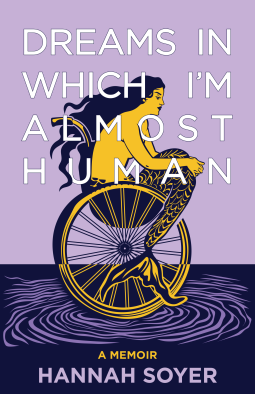
I absolutely loved reading this memoir. I had immediately been drawn to it by the gorgeous cover of the mermaid in a wheelchair, a symbol I hadn't seen before but which is carried throughout Hannah's experiences. Hannah writes with a raw honesty about her experiences as a queer, disabled, woman, and as a disabled woman navigating many of the same transition points in my life that she details,
I found every word resonating deeply. This memoir is an ode to disabled wisdom and joy, while not shying away from the painful realities of navigating a world not made for us, much like the mermaid who is carried through as a metaphor for disabled bodies and the way our society others us and tries to remove us from participating fully.
This is an energizing read for any disabled person navigating transitionary points in their life, but also a memoir that I think is deeply important for non-disabled individuals to read.
 Georgia T, Reviewer
A beautiful, important, compelling memoir/collection of essays/a little fiction. I learnt a lot reading this and also enjoyed it a lot. Hannah Soyer writes beautifully and shares so much of herself alongside informative and accessible information about disability history, activism and the failings of government and individuals surrounding it all.
This is a piece of work I can feel I will come back to again and delve deeper into everything she references.
Really impactful.
 Renée G, Reviewer
Actual Rating: 4.5/5 stars
"I’m not sure which inheritance has shaped me more— that of the women in my family who came before me, or that of my non-blood community, my Crip siblings and ancestors. I am someone with stories written on my body because of how my body is made, how it looks , how it inhabits the world— I need people to help me in order to live, a need that is painted as beautiful by some and horrible by others. I need care, and I have been raised by women who take care of others."
Disability, queer identity, intersectionality, fairytale motifs, language, and the every-day magic that can be within nature and daily life, all coalesce within this collection essays by Hannah Soyer. With Dreams in Which I’m Almost Human, she creates a powerful memoir that can be classified as “disability memoir”, but also transcends the bounds of the genre in its scope.
What I loved:
If I had to sum up this book in 3 words, they would be “insightful, intersectional and magical".
Insightful, for the way that Soyer manages to give words to her own experiences as a disabled, queer person, fueled and shaped by the stories she grew up around. Her observations were relatable to me in the best way; reflecting feelings and thoughts that I’ve had myself, but didn’t know how to articulate.
Intersectional, for the way it integrates different identities, topics and styles. Every one of the many themes mentioned in the synopsis is covered, and interwoven in some way or other. Soyer is also clearly very aware of her place in the landscape of disability writing, as she links and references many other works by fellow authors and scholars alike. Plenty of my personal favourites (Rebekah Taussig, Leah Lakshmi Piepzna-Samarasinha, Harriet McBryde Johnson and more) are referenced and credited here. These references make this book a powerful compendium and starting-place for readers just starting out in their discovery of these topics.
Finally, beautiful, for its fantastic prose, images and the metaphors of magic and fairytales used to explore its themes. The mermaid as a metaphor for disabled bodies is an old, tried-and-true one, and Soyer employs and cross-references it a lot in this collection. Since this happens to be one of my own personal metaphors, its integration here spoke to me a lot.
What I didn’t love:
There are two points of criticism that took off half a star from my final rating. First is the double-edged sword of the plentiful references to other works published within the disability-space. Although this makes it a good starting-point, it also takes away page time from the author to explore her unique thoughts and experiences. To me, as someone who’s read a lot op this subject, many of the quotes and references were already familiar; a repetition of someone else’s thought, instead of a unique insight of the author themselves. Although that doesn’t make the statements any less powerful, it does reduce the credits I can give to Soyer for formulating them.
Second, at times the structure – a series of collected essays that could be read as individual pieces as well – felt a little disjointed to me. Although the essays are linked by a series of shared themes, they didn’t always flow naturally from one into another, which took me out of the book at times.
Overall, I’m a huge advocate for disability fiction and own-voice memoirs on disability (justice), and am always happy to find a new quality work to add to my list of recommendations. Dreams in Which I’m Almost Human, is a welcome addition to this list. Valuable insights, beautifully described, and a great starting-place for anyone new to the genre, thanks to its many links to other published works.
Many thanks to Red Hen Press for providing me with an ARC in exchange for an honest review. All opinions are my own.
Silvia L, Reviewer
Reading this book on Netgalley was an incredible opportunity to continue reading about my fauvorite topic – disability; I think it’s clear that the author had wanted to write a book on this subject for a long time, drawing on her own experience. I really identified with the way she talked about having stories written on her body; I think the way one perceives the world when one has a disability is very deep, and she captures that very well.
As regards the narrative, the way it’s written is very direct and down-to-earth and I appreciated the honesty she showed through letters.
I have thought about the role of disability in imagined futures because this aspect is mentioned in one of their chapters. We don’t stay out of time, we revolution the concept of time.
I enjoyed it especially when she talks about what she does more slowly than people because her muscles slower and the manner that she accepts is a process which I went through as well.
Finally, I adored the chapter in what she explains about the special link she has with her art professor and how this figure inspires her to create so much.
Ray K, Reviewer
This book was a poetic and moving memoir that created space for the reader to dwell in deeply personal reflective moments, and to be encouraged along to further educate themselves through numerous references to additional literature. The prose of this book is moving, engaging and captures one's imagination. I found myself taking over a month to read this book, as it felt like I needed to read each part in short chunks to truly get the most out of its pages. Soyer's honesty surrounding her, and her community's, experiences before/during/after the pandemic was raw and honest. Soyer puts into words a plethora of emotions experienced throughout her lifetime, and also emphasises how these experiences, perceptions and beliefs change over time. Although there is a huge level of discrimination being discussed, Soyer does a fantastic job of infusing her writing with hope in a way that doesn't fall into inspiration porn but rather emphasises the complexity of humanity as a whole. For people who enjoy memoirs this is a must read.
Thank you to Net Galley and publisher Red Hen Press for the advanced readers copy in exchange for an honest review. 4.75 stars (rounded to 5 stars for NetGalley)
Readers who liked this book also liked:
Marshall J. Moore
General Fiction (Adult), Horror, Sci Fi & Fantasy
Publishers Lunch
General Fiction (Adult), Nonfiction (Adult), Teens & YA