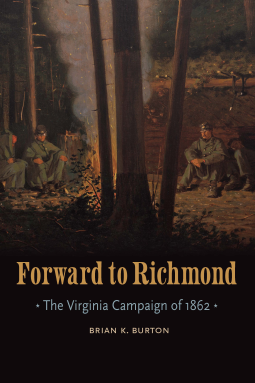
Forward to Richmond
The Virginia Campaign of 1862
This title was previously available on NetGalley and is now archived.
Send NetGalley books directly to your Kindle or Kindle app
1
To read on a Kindle or Kindle app, please add kindle@netgalley.com as an approved email address to receive files in your Amazon account. Click here for step-by-step instructions.
2
Also find your Kindle email address within your Amazon account, and enter it here.
Pub Date Jul 1 2026 | Archive Date Jun 30 2026
Talking about this book? Use #ForwardtoRichmond #NetGalley. More hashtag tips!
Description
In the early eastern theater of the American Civil War, the Northern and Southern armies saw little of combat and little of each other, with most of their military intelligence more akin to propaganda than objective fact. However, by 1862 both sides knew through bloody experience how the other could fight, though gaps in knowledge of the other’s tactics and political strategies remained. Perhaps most important, Northern soldiers had by then spent significant time in the South, and as they witnessed firsthand the effects of slavery, their attitudes hardened toward the South.
Covering all aspects of the war in Virginia in the first six months of 1862, Forward to Richmond treats the military actions in the Shenandoah Valley, the Piedmont, and the Peninsula as part of a theatre-wide campaign. Brian K. Burton goes beyond military events to also examine the political, social, and diplomatic interactions with military events, including the meetings of Union soldiers with Southern civilians and African Americans, ultimately leading to a turn away from conciliation and a beginning of a move toward support of emancipation.
Advance Praise
“Brian Burton has given us a fascinating account of the contest in Virginia—chiefly between Lee and McClellan—during the one-year period when it seemed as if that most celebrated theater of conflict might decide the war’s outcome. Thoughtful and rich in fascinating insights, Burton’s book brings into sharp focus the things that period of fighting changed, the things it did not change, and the reasons why.”—Steven E. Woodworth, author of Six Armies in Tennessee: The Chickamauga and Chattanooga Campaigns
“An outstanding example of military history synthesis, incorporating modern Civil War scholarship in its military, social, and political aspects. It is an introductory volume whose intended audience includes both the well-informed enthusiast and the serious student.”—Christopher S. Stowe, professor of military history, Command and Staff College, Marine Corps University
“Brian Burton offers a straightforward analysis of the Civil War in Virginia during the first six months of 1862. Most unique to his work is the consideration of the theaters of the war (the Valley, the Piedmont, and the Peninsula) in one volume, demonstrating to readers how these campaigns were not independent and exclusive from one another. Burton’s treatment of the Piedmont as less of a tertiary theater of war is an innovative and welcomed approach to a more nuanced understanding of the war in Virginia in 1862.”—Jennifer M. Murray, author of On a Great Battlefield: The Making, Management, and Memory of Gettysburg National Military Park, 1933–2013
Available Editions
| EDITION | Other Format |
| ISBN | 9781496229717 |
| PRICE | $39.95 (USD) |
| PAGES | 352 |
Available on NetGalley
Available to Buy
Buy on Amazon Buy on BN.com Buy on Bookshop.orgAverage rating from 2 members
Featured Reviews
 Bob C, Reviewer
An 1862 Civil War editorial cartoon, “Masterly Inactivity,” shows two giant generals relaxing in rocking chairs, eyeing each other with telescopes across the Potomac River, while tiny soldiers on the banks have a snowball fight with cannonballs. In Virginia, it’s the first six months of the war in a nutshell.
With Forward to Richmond, author Brian K. Burton examines the minds and actions of Union Gen. George McClellan and Confederate Gen. Joe Johnston and their wariness during the first half of 1862. Both leaders, focused on protecting Washington and Richmond, respectively, spent much of their time keeping the status quo. Add in egos and politics, and the inaction of the first months of 1862 comes into focus. That’s not to say there weren’t battles—Gaines’s Mill and Malvern Hill were big and bloody—but without the results that gave one side an advantage.
One of the book’s strengths is that it takes us beyond troop movements and strategies to show that burned bridges, floods, miscommunication, hunger, and fatigue were just as likely to influence outcomes as fighting—things that West Point textbooks probably never considered. This shines a light on the chaos of war and helps explain why early 1862 was such a careful dance. And maps throughout the book provide much‑needed visual aids for understanding how battles unfolded and who was involved.
Readers may find the sheer number of actors, movements, and locations overwhelming, especially with no clear results to clarify things. Burton’s writing is generally straightforward, but he sometimes reaches too far with his vocabulary. Words like celerity and manumission creep in.
One can think of Forward to Richmond as a school‑of‑hard‑knocks lesson. Rocking‑chair commanders were finished. Victory would require no mercy.
I received an advance reading copy from NetGalley.
William H, Reviewer
"Forward to Richmond: The Virginia Campaign of 1862," by Brian K. Burton, has been forwarded to me for review in the form of an ARC by the publisher, the University of Nebraska Press. I have just completed my read of the text and while I find that much of the material presented here will be very familiar to anyone who has immersed themselves in an examination of the early years of the War Between the States, it is a well written work which cogently summarizes the state of current scholarship in this area. Burton explicitly takes his purpose as extending scholarship too often centered in a sort of decontextualized vacuum that only peripherally touches on social, political and diplomatic matters. This is, of course, the path of much modern scholarship on the conflict. The period and geographical limits on the study in question, focusing on the first half of 1862 and the war of maneuver in the area of the Shenandoah Valley, the Piedmont and the Peninsula in Northern Virginia, serves as a useful limitation on Burton's work. The kind of issues connected grow organically out of the clash of arms in these regions and include things like changing attitudes amongst the troops involved on both sides as well as the organization and leadership of those troops, particularly as that leadership evolves and a dynamic develops between policy makers and political leaders on both sides. That may be one of the most fascinating aspects of the book. The scholarship appears current and on point and will prove useful as an intro. to some of these topics for those just approaching the subject matter. Recommended for all collegiate libraries and suitable for many secondary students as well.