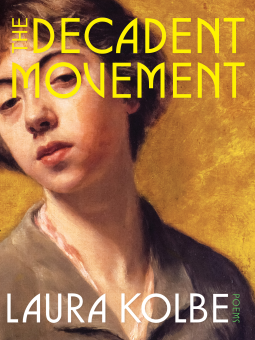
The Decadent Movement
This title was previously available on NetGalley and is now archived.
Send NetGalley books directly to your Kindle or Kindle app
1
To read on a Kindle or Kindle app, please add kindle@netgalley.com as an approved email address to receive files in your Amazon account. Click here for step-by-step instructions.
2
Also find your Kindle email address within your Amazon account, and enter it here.
Pub Date Sep 22 2026 | Archive Date Jul 31 2026
Talking about this book? Use #TheDecadentMovement #NetGalley. More hashtag tips!
Description
A Reverse-Diary in Poems that Chronicles the First Year of Motherhood and Nine Months of Pregnancy, from End to Beginning
The Decadent Movement is a book-length suite of poems that spins backward in time through the early days of parenthood and the preceding nine months of pregnancy. Beginning a year after childbirth in the harried throes of marriage and parenting, the collection proceeds toward its finale “Minus Time,” which marvels at death’s near-identical twin – that infinite period of nonexistence that precedes each new life. From the opening poem “Afterword,” each dated poem slides backward in time, with the poem “Hinge” at the manuscript’s midpoint spoken from the moment of childbirth.
This unraveling of a predicament by playing it in reverse – “Muybridged / out so anyone could see, framed, a woman / running for her life” – allows for rigorously honest accounting of mixed feelings about motherhood and its accompanying physical and psychic changes, detached from the readymade tropes of the “pregnancy plot.”
The Decadent Movement is a book about the fear of loss (of sexual personhood, bodily self-determination, the ability to write, and the license to be headlong and volatile). Yet it is also about the need to insist on new terms of engagement with those we love, new languages of willfulness and desire.
A Note From the Publisher
Advance Praise
"The intricate, barreling, and multifarious poems in The Decadent Movement explore the fraught situation of motherhood with tremendous excitement and frankness. Here is maternity as dilemma and possibility, a cluster of grand yearnings and workaday hazards. The desire to maintain a distinct, inner world comes up against separation as cosmic lostness; and yet, merger is engulfment as well as paradise. All the way through, Laura Kolbe’s self-consciousness about transformation keeps things bracingly restless, playful even, full of pleasure-pain."
-Sandra Lim, author of The Curious Thing
"It is a rare privilege to be inside the mind of this poet as she unspools the chronicle, told in reverse, of the arduous, hallucinatory, and utterly mortal time of pregnancy and early parenthood. With her, we experience the shock of what happens to a body, a marriage, an artist’s mind, as she becomes a mother. These poems are beautiful, intelligent, honest, funny, conflicted, hopeful, and real, and tell us the oldest story in a new and necessary way."
-Matthew Zapruder, author of I Love Hearing Your Dreams and Story of a Poem
"The poems of Laura Kolbe do more than just continue the noble tradition of physician-poets; in The Decadent Moment they redefine the relations between body and body, mind and mind, mother and child. The book’s astonishing final poem is an apostrophe to the not-yet-existent that ‘cannot be studied or moved’ but can be talked to. What bodies can do, and must do, is anticipate lovingly."
-Bin Ramke, author of Earth on Earth
Marketing Plan
Marketing Plans
- Galley mailing
- National print and online reviews
- Regional print and online reviews
- Select author appearances
- Online and social media promotion
- Feature at AWP 2027
Marketing Plans
- Galley mailing
- National print and online reviews
- Regional print and online reviews
- Select author appearances
- Online and social media promotion
- Feature at AWP 2027
Available Editions
| EDITION | Paperback |
| ISBN | 9780822968368 |
| PRICE | $20.00 (USD) |
| PAGES | 128 |
Available on NetGalley
Available to Buy
Buy on BN.com Buy on Bookshop.orgAverage rating from 3 members
Featured Reviews
 Lorena Maria L, Reviewer
The intimate privilege to be allowed inside the poet's mind is a startling experience that goes line by line. It almost feels like I am overstepping my bounds, that is how palpable each poem is in this book that goes beyond what I envisioned pregnancy and birth to be like. I also fine myself pulled to each poem; not a line is wasted and each thrums with intention.
Thank you to NetGalley & the University of Pittsburgh Press for granting me access to this ARC.
 TheNovel N, Reviewer
Most narratives of pregnancy and motherhood move toward birth as their inevitable destination. The Decadent Movement does the opposite, retracing its steps from the chaos of early parenthood back through pregnancy and toward the profound mystery of existence itself. The result is a collection that feels less like a memoir than an excavation.
The reverse structure is more than a formal experiment; it becomes a way of interrogating memory, identity, and transformation. By moving backward through time, Laura Kolbe strips away the familiar expectations attached to motherhood and asks readers to reconsider what is gained, lost, surrendered, and remade in the process of creating a life. The poems refuse sentimentality without sacrificing tenderness, making space for ambivalence alongside devotion.
What impressed me most was the collection’s intellectual and emotional precision. These poems are deeply concerned with embodiment — the ways a body changes, becomes vulnerable, becomes shared, and yet struggles to remain its own. Questions of autonomy, desire, creativity, marriage, and selfhood surface repeatedly, creating a portrait of motherhood that feels startlingly honest in its complexity.
Kolbe’s language is exacting and richly layered. Images arrive with the clarity of remembered dreams, while individual lines often carry emotional weight far beyond their brevity. There is an attentiveness to both physical experience and philosophical inquiry that gives the collection remarkable depth. Even its most intimate moments gesture toward larger questions about mortality, time, and the fragile conditions of being alive.
I was particularly moved by the way the collection frames birth not simply as a beginning but as a hinge between forms of existence. Throughout the poems runs a persistent awareness that every arrival contains traces of absence, and every transformation requires a relinquishment of what came before. “The fear of loss” may animate the collection, but so too does the possibility of discovering new ways of inhabiting oneself.
Readers who appreciate contemporary poetry that is formally inventive, intellectually rigorous, and emotionally unsparing will find much to admire here. This collection will likely resonate especially with those interested in motherhood, bodily autonomy, memory, and the intersections between personal experience and philosophical reflection.
The Decadent Movement understands that becoming is never a single event. It is a continual unraveling and remaking, and these poems capture that process with remarkable grace and clarity.