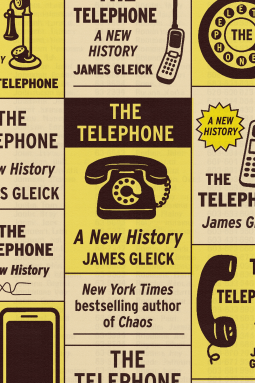
The Telephone
A New History
Sign In or Register Now to see if this title is available for request.
Buy on BN.com Buy on Bookshop.orgSend NetGalley books directly to your Kindle or Kindle app
1
To read on a Kindle or Kindle app, please add kindle@netgalley.com as an approved email address to receive files in your Amazon account. Click here for step-by-step instructions.
2
Also find your Kindle email address within your Amazon account, and enter it here.
Pub Date Nov 10 2026 | Archive Date Nov 11 2026
Talking about this book? Use #TheTelephone #NetGalley. More hashtag tips!
Description
From the bestselling author of Chaos and The Information, a sweeping history of the instrument that created modern life.
In 1876, Alexander Graham Bell spoke the words “Mr. Watson—come here—I want to see you” into a contraption he called the telephone, and for the first time a voice was carried along a wire. This feat has long been celebrated as a triumph of individual ingenuity and vision. In fact, the invention was a contest replete with bribery, fraud, and speculation, and no one, not even its inventors, realized what it was good for or how ubiquitous it would become.
Over the next century, the phone would prove less an invention than a continuous revolution. It would teach us new words (starting with the once-unfamiliar “hello” and “goodbye”) and a new way to speak, with instant reaction, instant feeling, instant possibilities. It would create an all-female profession—the operator—that by 1920 outnumbered nurses and waitresses put together. It would enable the skyscraper, the world war, the assembly line, and the multinational corporation. And the Bell System would become the largest monopoly in history: the sole owner of every phone in America. The science that Bell Labs created around the telephone, from pulsing wires to glowing vacuum tubes to the electronic transistor, would usher in the Information Age.
Along the way, the telephone changed human nature. It augmented our bodies, a prosthetic extension of mouth and ear. It gave us the party line, the busy signal, dial tones, wiretapping, the late-night D.J., and the booty call. It magnified the possibilities of government, of business, of friendship, of love.
For a while, the revolution was so successful that it made telephones themselves seem natural, eternal. They settled into the background, on bedside tables, desks, and kitchen walls; in subways and on corners; in novels, movies, songs, and on TV. No one could remember life without them.
Today we are more dependent than ever on little objects called phones, although their ability to make “telephone calls” is incidental. The phone book and the phone booth may be vanishing from memory, but as James Gleick shows, the telephone’s legacy is deeply ingrained—in our networks and our sophistication about networks, in the primacy of information, in the need for connection. Gleick is celebrated for his uncanny ability to make complex ideas vivid, understandable, and concrete. In The Telephone: A New History, he gives us a revelation: a story of technological breakthroughs that is also a universal history of intimate life.
A Note From the Publisher
Advance Praise
“That little device in your pocket has transformed so much—Long-distance! Operators! The yellow pages!—into history. Who better to chronicle it all than the masterful James Gleick? From Bell and Watson to Steve Jobs, from patent wars to the evolving nature of conversation, Gleick charts our distance-compressing, time-shifting telephonic adventure with exceptional brio and subtlety.” —Stacy Schiff, author of The Revolutionary: Samuel Adams
“The Telephone is at once a history of an invention and much more than that. It's a book about innovators and monopolists, tinkerers and geniuses, and, ultimately, the remaking—and re-remaking—of America. Science and technology never seem more exciting than when James Gleick is writing about them.” —Elizabeth Kolbert, author of The Sixth Extinction
Available Editions
| EDITION | Other Format |
| ISBN | 9780374618940 |
| PRICE | $35.00 (USD) |
| PAGES | 544 |
Available on NetGalley
Available to Buy
Buy on BN.com Buy on Bookshop.orgAverage rating from 4 members
Featured Reviews
 Librarian 1439640
This is a deep dive of interesting facts, a collection of stories that goes far beyond the invention of the telephone itself. James Gleick weaves together technological innovation, cultural shifts, and lesser-known moments in history to show how one invention transformed everyday life. An enthralling read for anyone who enjoys history, science, or the stories behind the technology we use daily.
Readers who liked this book also liked:

Marie Bostwick
Historical Fiction, Literary Fiction, Women's Fiction





Andy Richter; Aaron Karo
Biographies & Memoirs, Entertainment & Pop Culture, Nonfiction (Adult)









Paige Gordon
Biographies & Memoirs, Parenting, Families, Relationships, Self-Help