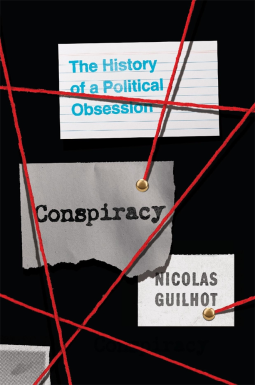
Conspiracy
The History of a Political Obsession
This title was previously available on NetGalley and is now archived.
Send NetGalley books directly to your Kindle or Kindle app
1
To read on a Kindle or Kindle app, please add kindle@netgalley.com as an approved email address to receive files in your Amazon account. Click here for step-by-step instructions.
2
Also find your Kindle email address within your Amazon account, and enter it here.
Pub Date Oct 6 2026 | Archive Date Oct 6 2026
Harvard University Press | Belknap Press
Talking about this book? Use #Conspiracy #NetGalley. More hashtag tips!
Description
A bracing intellectual history that illustrates how the modern and contemporary obsession with conspiracy theories stems not from the slipperiness of truth but from the inability to imagine a positive future.
Pundits, scholars, and the general public alike have argued that conspiratorial thinking is the greatest threat to liberal democracy. Nicolas Guilhot, however, challenges us to see conspiracy theories as a sign of the public’s desperation in light of liberal democracy’s failures. Conspiracism is widespread across the political spectrum, as citizens struggle with their disenfranchisement. How are we to imagine the future at the purported “end of history”? And how might this impasse make us susceptible to hallucinations and paranoia?
Conspiracy shows that narratives of conspiracy historically gain popularity when politics ceases to offer hope and apocalyptic thinking becomes a last refuge. Taking the reader from Karl Popper’s coining of the term “conspiracy theory” in 1948 through the essential commentary of Hannah Arendt, Alexandre Koyré, Richard Hofstadter, and others, Guilhot reveals how the fear of conspiracies has always operated against a backdrop of antagonism between the powerful and the many, the rich and the poor, the oligarchy and the masses. Today’s fear of a grand plot is no exception.
Turning conventional wisdom on its head, Guilhot shows that society’s focus on truth and falsehood masks how conspiracy theories feed on the dysfunctions of liberal democracies that no longer offer credible pathways toward a better future. Conspiracy theories offer a ready-made explanation for the feeling that one lacks agency and freedom. Rather than the cause of the current crisis, they are one of its consequences.
Nicolas Guilhot is Professor of Intellectual History at the European University Institute, Florence, and Research Professor at the Centre National de la Recherche Scientifique, Paris. His books include The Democracy Makers: Human Rights and the Politics of Global Order and After the Enlightenment: Political Realism and International Relations in the Mid-Twentieth Century.
Advance Praise
"Learned, astute, and constantly provocative, this dazzling intervention provides more than a novel genealogy of conspiracism. Ranging across literature, philosophy, and political theory, it makes a compelling plea for the urgent restoration of hope, history, and politics." - Paul Gilroy, author of The Black Atlantic
Available Editions
| EDITION | Hardcover |
| ISBN | 9780674297661 |
| PRICE | $32.95 (USD) |
| PAGES | 256 |