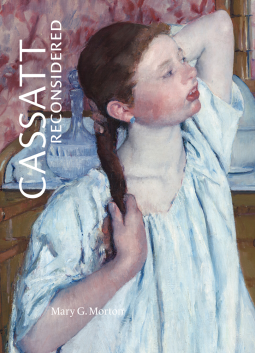
Cassatt Reconsidered
Sign In or Register Now to see if this title is available for request.
Buy on BN.com Buy on Bookshop.orgSend NetGalley books directly to your Kindle or Kindle app
1
To read on a Kindle or Kindle app, please add kindle@netgalley.com as an approved email address to receive files in your Amazon account. Click here for step-by-step instructions.
2
Also find your Kindle email address within your Amazon account, and enter it here.
Pub Date Nov 24 2026 | Archive Date Oct 4 2026
Talking about this book? Use #CassattReconsidered #NetGalley. More hashtag tips!
Description
A sweeping reconsideration of the artist we thought we knew—and the forces that obscured her legacy.
Fiercely ambitious and independent, Mary Cassatt defied expectations to become one of the most radical artists of the Impressionist movement, though she was—and remains—the least understood. Cassatt commanded and manipulated strains of old master and contemporary painting to express her female subjectivity through a brilliantly modern oeuvre on par with those of the most revered Impressionists. However, mishandled by the Parisian art establishment during her lifetime, and later by art historians and curators, she became known almost exclusively as a sentimentalizing painter of mothers and children.
How did this happen to the most aspiring, revolutionary female artist of the late nineteenth and early twentieth centuries? In Cassatt Reconsidered, author Mary G. Morton probes this central question and more, demonstrating how Cassatt disturbed conventional ideals of femininity, childhood, and maternity, an uncompromising feat for which she paid dearly during her lifetime and in the annals of art historiography.
Vibrantly illustrated with more than 100 images, Cassatt Reconsidered rewards readers with a fuller understanding of an artist who stands apart for daring to express, on her own terms, the unique, intimate experiences of modern women.
Available Editions
| EDITION | Other Format |
| ISBN | 9798887120508 |
| PRICE | $35.00 (USD) |
| PAGES | 208 |
Links
Available on NetGalley
Available to Buy
Buy on BN.com Buy on Bookshop.orgAverage rating from 7 members
Featured Reviews
 Nancy A. B, Reviewer
This year marks the 100th anniversary of the death of Mary Cassatt. Her legacy is presented in a new light in this book.
We learn how her conservative Catholic gallerist Paul Durant-Ruel controlled his artists’ subject matter based on marketability, pressuring Cassatt to paint domestic scenes with women and children. We learn of her place as a serious artist in the realist tradition, inspired by the Old Masters, and aligned with Edgar Degas and Gustave Courbet. Her feminist leaning are demonstrated with her work for the Woman’s Building at the World’s Columbian Exposition of 1893.
Cassatt as a woman artist faced prejudice during her life and her work stereotyped after her death.
100 illustrations accompany the text, allowing readers to study the art while reading about it.
I was enthralled by the book and my love for Cassatt reinforced.
Thanks to Getty Publications for a free book through NetGalley.
 Eileen K, Reviewer
Marie Cassatt, one of the few female artists of her period, relied on men to further her career. Recognized by male artists in her community, she was invited by Paul Durand Ruel, who coined the term “ Impressionism”, to exhibit in his shows. Unfortunately he was not consistent in his invitations. Venturing out she sold prints to Vollard; unhappy with his choices to exhibit, she returned to Durand Ruel. She interviewed with a biographer but was unhappy with the end result. She relied on her parents for financial support but had to provide for her materials, studio time and models. As a result, she often used family members for her portraits. When she exhibited in a suffrage movement fund raiser, some of them chose to boycott. In an attempt to break from her mother/child artist label, and not identifying with Impressionism, she traveled through Europe working on a Realist style. Her work at this point differs in subject and color. Cassatt seemed dissatisfied often, yet her works remain as proof to her talent. Aside from the maternal duties, she painted women as intelligent, reading and meditating. Louise Havemeyer described her as a true artist, staying true to her course. Mary G. Morton’s book is a treasury of her work, displaying various styles which deepens our appreciation of her talent.
 Anna F, Book Trade Professional
How an Agent Manipulated Impressionists and Its Rare Female Artist
****
Mary G. Morton, Cassatt Reconsidered (Los Angeles: Getty Publications, 2026). 200pp: color images. ISBN: 978-8-88712-050-8.
“Fiercely ambitious and independent, Mary Cassatt defied expectations to become one of the most radical artists of the Impressionist movement, though she was—and remains—the least understood. Cassatt commanded and manipulated strains of old master and contemporary painting to express her female subjectivity through a brilliantly modern oeuvre on par with those of the most revered Impressionists. However, mishandled by the Parisian art establishment during her lifetime, and later by art historians and curators, she became known almost exclusively as a sentimentalizing painter of mothers and children. How did this happen to the most aspiring, revolutionary female artist of the late nineteenth and early twentieth centuries? In Cassatt Reconsidered, author Mary G. Morton probes this central question and more, demonstrating how Cassatt disturbed conventional ideals of femininity, childhood, and maternity, an uncompromising feat for which she paid dearly during her lifetime and in the annals of art historiography.”
Any book with over 100 vivid color paintings attracts attention. The intro opens by describing a painting called Mother and Child, initially observing what everybody notices: it is a gentle scene of a mother grabbing onto her growing baby. But she then focuses on a less observed element: the “child’s feet… seem to be disintegrating, an almost bloody mess of peach and red… blending into the dark tones of his mother’s skirt” (vii). What this points to is that the artist stopped drawing the feet. The artist seems to have run out of time, or paint, and just left the feet with the under-color sketch, while finishing most of the rest of the composition. The author does not present this as an alternative but instead dramatizes this as an intentional bloody radical message. The intro further argues that “Cassett’s career, as well as her ongoing reception, was shaped by her primary gallerist, Paul Durand-Ruel.” He is credited with having “encouraged Courbet to make landscapes, Pissarro to make cityscapes, and Cassatt to paint children, eventually ensuring that maternity became her ‘brand’” (viii). My research into workshops hints that this was a collaborative artistic workshop with a dominant artist responsible for designing this Impressionist group’s directions, with them perhaps helping to color in outlines set by the master, or perhaps merely being the marketers who were selling individual pieces or brands to buyers or patrons. The Workshop could have been producing whatever they happened to have access to drawing and then individual pieces were distributed to bylines based on what each was “known” for. As Cassett’s biography begins, it is explained that Durand-Ruel had no formal contracts with artists, but merely “‘amicable’ agreements” that gave him exclusive control, with him keeping them loyal by paying “their expenses”. He apparently paid most to Monet, including a “down payment” on a house Mortgage” in 1890. There’s an explanation that Durand-Ruel monopolized the journalism about art by having “hired established critics to write prefaces for his catalogues” and thus obligating them to preferentially puff his artists. Durand-Ruel thus artificially created the Impressionism movement and steered its profits into his own pockets before handing out scraps to seem magnanimous. The section that begins explaining his relationship with Cassett skips over how or why he accepted this rare female artist, and instead focuses on how he contracted a puffer to “write the catalogue’s essay” that puffed Cassatt’s woman-and-child motif (21). It is also left vague how Cassatt trained in America to become a painter before successfully selling her “first Paris Salon submission” in 1868 (22). There is a clear explanation that she struggled to find funding to go to Paris to pursue this career, and had to apply for work as a copyist and the like, until she was oddly very successful for an unknown woman by winning a “commission… from the bishop of Pittsburgh” for two pieces (22). I think readers especially need to know what kind of letters she sent, or what references won this deal. Is there some trick an artist can use to stand out. But this is not what interests this author, it describes her somehow beginning this work and also securing on her own pufferies of her work-in-progress in newspapers.
This is a very well-written book, with fantastic illustrations and many insights. It is not delivering what I wish to know on this subject, but most readers will not be asking the types of questions that trouble me.
This is a great book for all types of libraries, as well as for artists’ or private collectors’ home libraries. Researchers of Cassett’s biography will certainly find much here that might not have appeared in past studies.
 Lydia W, Reviewer
Thanks to NetGalley and the publisher for providing an advanced reading copy in exchange for an honest review.
Cassatt Reconsidered is a dense, heavily academic retrospective. If you’re looking for a light, narrative-driven biography, this isn't it. It focuses far more on scholarly art history and historiography than a compelling human story, making the text feel dry at times.
The high point is undeniably the artwork. Growing up with prints of Cassatt's paintings in my bedroom, her work has always held a special place in my heart. Now as a mom, her tender, intimate capture of mothers with children hits even deeper, making me stop and treasure those everyday moments.
While the scholarly prose makes it a slower read, the gorgeous visual collection makes it worth picking up for dedicated art history fans or lifelong admirers of her work.
Miles L, Educator
Cassatt Reconsidered by Mary G Morton is a wonderful look at the whole of Cassatt's work with an eye toward what she wanted for her work and what many around her decided was the point of her work.
Like so many women artists, or any field really, Cassatt had her legacy and her marketability during her lifetime controlled and usually manipulated by men more concerned for their own advancement and beliefs than hers even when she was the one with the talent.
Though known mostly for her mother and child paintings she did so much more, and often with radical, for the time, meaning. Whether those meanings and intentions were missed or ignored, the work that became her legacy for many years were works that, while beautiful and still containing some elements of her beliefs and ideas, could be safely categorized as women's art. Mothers and children, domestic sphere, and so on.
Morton doesn't downplay the beauty of these works but highlights both her more powerful as well as her more personally meaningful works. Placing her in the impressionism world, albeit with caveats and not always a perfect fit for the male dominated style, helps us to reassess what she had intended her work to represent. Less the conservative world of her primary gallerist or her later memoir/biography co-writer/interviewer and more of what is now clearly a feminist perspective on the shackles on women that come with the conservative worldview.
This won't make you appreciate her better known works any less, but it will help you to place them in a better context within Cassatt's own world and worldview. The writing isn't really academic so much as it simply avoids the flourishes of a lot of popular writing, fewer "juicy" bits and more facts. But clear and organized so any reader with a real interest won't have any difficulty reading it. If you're less interested in the context and her life, the pictures make this a beautiful book to add to your art book collection.
Reviewed from a copy made available by the publisher via NetGalley.
 Ashley H, Reviewer
This book gathers together the scant details left of Mary Cassatt and paints quite the picture of this oft-pigeonholed artist. Cassatt was known and is still known as someone who only painted mothers and babies. However, Cassatt lived in a time where a female artist was still a novelty which both angered and threatened the male status quo. Cassatt painted women because she essentially could not paint men who were not her family. She could have painted landscapes or still life, but she (and many others) felt that portraiture/figure painting were the highest forms of painting, and she refused to be entirely shut out.
What's so interesting about Cassatt and her paintings is how comfortable these women are. They are not beings held onto by the male gaze or painted as decoration or titillation (like Manet's Le Déjeuner sur l'herbe or Courbet's L'Origine du mond), but rather they are shown as fully human and real. Cassatt began in a very realist style and moved into impressionism, but she always held that sturdy foundation of realism in everything that she did.
The book also shows how Cassatt was always of two worlds. She was a female painter amongst almost solely men, she was an American who lived the majority of her life in France, and she was unmarried and childless. She was only able to do these things due to her family's wealth and eventually her own absolutely relentless pursuit to make a living as an artist, as well as being a formidable art dealer in her own right.
Morton also gives a lot of details about Cassatt's sometimes bumpy relationships with individuals like art dealer Paul Durand-Ruel and Edgar Degas. Cassatt was unapologetically outspoken and supported the suffrage movement as well as women in the arts.
The only qualm I had with this book was that it could feel quite repetitive, but I believe it's due to the small amount that is known about Cassatt. The book was well-researched and gave me a new appreciation for Cassatt and there were several paintings of hers I had not seen.
Readers who liked this book also liked:

Kenneth Womack; Scott Freiman
Entertainment & Pop Culture, Nonfiction (Adult)

Will Kaufman
Entertainment & Pop Culture, Nonfiction (Adult), Politics & Current Affairs