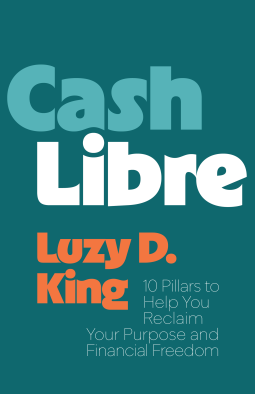
Cash Libre
10 Pillars to Help You Reclaim Your Purpose and Financial Freedom
This title was previously available on NetGalley and is now archived.
Send NetGalley books directly to your Kindle or Kindle app
1
To read on a Kindle or Kindle app, please add kindle@netgalley.com as an approved email address to receive files in your Amazon account. Click here for step-by-step instructions.
2
Also find your Kindle email address within your Amazon account, and enter it here.
Pub Date Oct 6 2026 | Archive Date Sep 26 2026
Talking about this book? Use #CashLibre #NetGalley. More hashtag tips!
Description
You were not born to hustle forever.
You deserve to stop worrying about wealth and start building it. Cash Libre is an unapologetic financial guide for first-generation Latina professionals ready to break free from generational money trauma, cultural guilt, and toxic money myths to redefine prosperity and build a life rooted in purpose and freedom.
Through deeply personal storytelling, cultural truths, and expert insights, award-winning financial educator and international speaker Luzy D. King explains how to unlearn the beliefs that keep you stuck in survival mode. Cash Libre offers clear guidance for simple mindset shifts and practical strategies that will help you tackle debt, invest with confidence, and start building lasting wealth.
Whether you’re navigating student loans, investing for the first time, or trying to feel safe with money, these pages will meet you with both strategy and soul. Cash Libre is a permission slip to heal and reclaim your time, power, and legacy.
Say adiós to shame. Say hola to wealth. Say sí to your liberation.
A Note From the Publisher
Luzy D. King, MBA, CPFI is a bilingual wealth educator, international speaker, and financial strategist and the founder of Say Hola Wealth, a platform and podcast that empowers first-generation Latinas to break free from survival mode and claim their financial power. Cash Libre is the book she wishes she had when she was navigating money, identity, and motherhood as a first-generation professional. She lives in the Pacific Northwest with her family.
Advance Praise
“Cash Libre is the book our tías, primas, and younger selves deserved.” —Lolita Taub, author of What Actually Matters: Startups, Capital, and the Rules Nobody Taught Us
“In Cash Libre, Luzy King gives Latinas permission to redefine success in their own terms. This book moves beyond hustle culture to true financial freedom, helping readers unpack inherited-money stories and build wealth with confidence and intention. A powerful and necessary guide for the next generation of Latina leaders.” —Ana Flores, author of Done with the Hustle
“I’m excited to see Cash Libre enter the wealth-building conversation! Luzy King’s lived experience translates into cultural relevance and practical lessons that I know will help more women see themselves as worthy of financial prosperity and ownership.” —Nathalie Molina Niño, author of Leapfrog: The New Revolution for Women Entrepreneurs
“Cash Libre is the next conversation every financially lit Latina needs to have. Luzy King expands the wealth-building conversation beyond budgets and bank accounts, diving into the cultural beliefs, family dynamics, and personal identity shifts that shape how we earn, invest, and create freedom. This is a beautiful and practical guide for any Latina who is ready to build wealth on her own terms without losing herself along the way.” —Jannese Torres, author of Financially Lit! and host of Yo Quiero Dinero
“Cash Libre is more than a book about money. It’s a guide for Latinas who are ready to step into their power, challenge limiting beliefs, and create a future rooted in purpose and ownership. Luzy King beautifully connects financial freedom to the leadership and confidence our communities need.” —Vicky Frausto, author of La Concejal and first Latina mayor of Sunnyside, Washington
“Growing up, I was taught that talking about money was taboo. We were not raised to have the language or the financial education that we needed to understand money or to even consider building wealth. Luzy’s book is an important read because it encourages readers to remap our relationship with money and the importance of reclaiming our power when it comes to achieving financial freedom. Cash Libre demonstrates that financial activism isn’t just about building wealth—it’s about creating opportunity, serving our community, and leaving a legacy for future generations that dismantles the taboos that exist about money.” —Mónica Ramírez, activist and founder of Justice for Migrant Women
“For too long, the conversation around Latina economic advancement has centered on earning more. Cash Libre challenges us to think bigger. Luzy King provides a compelling framework for building wealth, creating financial independence, and expanding opportunity beyond a paycheck. This is an important and timely resource for Latinas who aspire not only to succeed professionally but to create lasting financial security and generational impact.” —Yai Vargas, vice president at the Hispanic Association on Corporate Responsibility
“Warm, purposeful, and useful . . . a culturally grounded financial reset built on self-respect, boundaries, and long-term ownership. For readers who have felt alienated by generic money books, that is a meaningful contribution.” —Manhattan Book Review
“Cash Libre is a standout. . . . More than just another money guide, but an affirming, healing, acknowledging survey of the common obstacles to wealth that too rarely see the light of day.” —Midwest Book Review
Marketing Plan
- Confirmed and pending features in major outlets including Hispanic Executive, Business Insider, Forbes, Latina Media Co., Mujerista, Fierce by Mitu, and Poderistas.
- Postcast tour including Brown Way To Money, Yo Quiero Dinero, Show Up Real, Nourishing Creative, So Money Podcast, Beyond Private Practice, This Latina Travels, and many more.
- A multi-city community engagement campaign featuring book readings and signings, author Q&A sessions, community conversations on wealth-building.
- Virtual author conversations, book clubs, and community gatherings designed to continue the Cash Libre conversation with readers nationwide.
Available Editions
| EDITION | Hardcover |
| ISBN | 9781967510672 |
| PRICE | $28.95 (USD) |
| PAGES | 306 |
Links
Available on NetGalley
Available to Buy
Buy on BN.com Buy on Bookshop.orgAverage rating from 2 members
Featured Reviews
 Violeta G, Reviewer
This is a book I wish I had had while I was growing up. I felt like the words validated so many feelings that I couldn’t express and I connected to so many of the cultural references. This is a necessary book for all first-gen professionals and one that I will make sure to pass on to mi daughters.
 Demetris P, Reviewer
There Is Always Another Box to Check
Luzy D. King’s “Cash Libre” offers ten Pillars for building wealth, then arrives at the more mischievous question of whether a well-planned life can become another performance.
By Demetris Papadimitropoulos | September 22nd, 2026
Diligence is one of fear’s more convincing disguises. Luzy D. King begins “Cash Libre” as a woman who has done nearly everything she was told would make a life secure: studied, worked, advanced, became the first salaried employee in her family, learned how to look at home inside achievement. She has checked the boxes. The trouble is that the boxes keep multiplying. A steady job does not make instability unimaginable, and professional competence does not prevent humiliation. Earning, King discovers, is not the same thing as owning. Her book is therefore less interested in rescuing a reckless reader than in asking what happens when responsibility itself becomes a form of defense.
Early on, King gives that defensiveness four memorable costumes. The Super Saver turns accumulation into shelter and finds risk suspicious. The Chief Earner becomes everyone’s firewall, competent enough to carry the household and tired enough not to notice the carrying has become an identity. The Money Goer spends partly to make success visible. The Overgiver helps before anyone has to ask. King sees four strategies with one root: protection. Her fifth figure, the Cash Libre Mujer, is not free because she has stopped protecting herself. She is free because protection no longer gets to make every decision.
Money books love a system, and “Cash Libre” has one too: ten Pillars moving from mindset and emotional history through structural barriers, debt, credit, investing, life design, additional income, legal protection, and finally the allocation of capital. The order is the argument. King refuses to begin with the spreadsheet. Before the account, she wants the flinch; before the investment, the inherited story; before the budget, the question of whom that budget has quietly been built to protect. Correct information, she understands, does not automatically change a behavior that is still doing useful emotional work.
Even before the language turns therapeutic, the method is plain: get curious before getting ashamed. Avoiding a bank balance, hoarding cash, spending for visibility, undercharging, or overworking may all become expensive habits, but King does not mistake them for character flaws. For the women she writes toward, money can carry migration, sacrifice, motherhood, family rescue, professional self-editing, and memories of instability. She gives the behavior a history before she asks the reader to change it. That is a small editorial decision with a large ethical effect.
That refusal to shame supplies much of the book’s authority. King writes of leaving corporate work after a pregnancy-related encounter exposes how precarious her hard-won stability still feels; of becoming temporarily financially dependent on her husband and discovering fear in the body before reasoning catches up; of anger toward a father who left and a mother whose labor could register as both love and absence. Her older sister’s competence becomes another kind of family labor, the sort that starts looking virtuous long before anyone asks what it costs. Money is not a secret code underneath the family story. It is already inside it, deciding who gets to rest, who absorbs the emergency, who learns that gratitude means never asking for less to carry.
Rhythmically, King writes as though she expects to be heard. She likes short declarations, fragments, rhetorical questions, a repeated phrase followed by a quick joke before intimidation hardens into avoidance. Spanish and English mingle without apology or constant translation. Brokerage accounts, debt ratios, trusts, investment horizons, and equity sit beside family sayings, teasing, warnings, and tenderness. The result is not simply warmth. It is a refusal of the idea that financial fluency requires anyone to translate herself out of her own life.
Imagery is mostly pedagogical, and its best uses do real conceptual work. During a hike, the recurring money personalities begin discussing wage inequity. The trail grows steeper with the conversation; the Overgiver is literally carrying the heaviest backpack; what first looked like individual inadequacy starts to resemble people climbing the same mountain under different loads. Elsewhere, investing becomes la feria, with rides, lines, tickets, waiting, volatility, and a budget for admission. King’s metaphors are rarely ornaments. They turn institutions into places a nervous beginner can imagine entering.
Part of what “Cash Libre” resists is advice built around budgeting and optimization for a person imagined to be financially autonomous. King asks what “save more,” “negotiate,” “invest,” or “start a business” means when someone is underpaid, caregiving, supporting relatives, wary of institutions, or raised to believe humility is a form of safety. She does not turn those constraints into excuses for surrender. She simply refuses to pretend they vanish because a worksheet has clean columns. The spreadsheet may be neutral. The life entering numbers into it is not.
And betrayal, more than budgeting, may be the book’s submerged subject. How do you earn more than your parents without seeming to judge their sacrifices? Stop giving reflexively without becoming selfish? Charge fully without feeling grasping, invest without feeling reckless, rest without feeling lazy? King understands that prosperity can threaten belonging when a family’s moral vocabulary was forged under scarcity. Gratitude can quietly become obedience. Her harder question is not whether the reader understands compound growth. It is whether she can become financially different from the conditions that formed her without construing that difference as abandonment.
Perhaps King’s smartest move is refusing to make protection the villain. She asks the reader to change its form. Early protection means avoidance, control, cash hoarding, overwork, compulsive generosity. Later it means reserves, diversification, contracts, insurance, estate plans, boundaries, legal documents, assets. Safety changes from bunker to platform. What once kept risk out can eventually make chosen risk possible.
As the Pillars advance, the imagined reader’s role changes with them. She becomes not merely someone who manages money but someone who understands credit, participates in markets, designs a life around time rather than retirement alone, monetizes expertise, protects assets, and eventually considers herself capable of funding another person’s idea. King places angel investing after cash reserves, debt management, conventional investing, tax strategy, and other foundations. That sequence matters more than the glamour of the final step. The reader is being moved from consumer to owner to funder.
Debt receives one of the book’s cleaner demotions from morality to mechanics. King is not sentimental about balances or interest, but she objects to treating them as evidence of virtue or defect. Debt can be dangerous, expensive, or foolishly chosen without proving that its holder is foolish. She extends the same suspicion to credit scores, homeownership, and rigid retirement rules. The better questions are functional: What does this cost? What does it make possible? Whose future does it serve? At those moments, “Cash Libre” is refreshingly uninterested in financial sainthood.
If “Cash Libre” has literary neighbors, they live on different parts of the same block. Bari Tessler’s “The Art of Money” shares its attention to the emotional life of finance; Tiffany Aliche’s “Get Good with Money” offers a similarly programmatic route through financial competence; Giovanna González’s “Cultura and Cash” is its clearest first-generation Latina market cousin. Edgar Villanueva’s “Decolonizing Wealth” appears farther down the road when King begins asking who gets to direct money after earning it. King’s wager is to bring those conversations to one kitchen table.
More often than not, the wager works because she understands sequence. A reader frightened of checking an account does not need to be hectored about venture investing. Someone who has spent years as everybody else’s emergency fund may need a boundary before another optimization trick. Capacity comes before complexity, but King is best when she does not reduce that principle to a slogan. In practice it means self-trust before surplus risk, a working financial floor before an ambitious ceiling.
Its weakness is the same organizing intelligence overextended. Protection, survival, shame, cultural inheritance, inequality, and nervous-system responses explain a great deal in King’s account, and occasionally they begin to explain nearly everything. The Money Timeline is useful for mapping family history and changing financial circumstances, but King sometimes moves quickly from lived observation and coaching practice into prenatal stress, intergenerational transmission, and biology. The problem is not that emotion has no place in finance. It plainly does. The problem is that metaphor, therapeutic model, plausible interpretation, and causal evidence are different kinds of knowledge, and the prose does not always announce when it has crossed from one into another.
The book’s range eventually charges interest of its own. King takes on wage inequity, caregiving, credit, investing, taxes, entrepreneurship, insurance, estate planning, cross-border possibility, and startup capital in roughly three hundred pages. Some subjects therefore receive orientation rather than mastery. That would matter less if the coaching voice were less assured; instead its fluency can disguise how quickly the reader has been moved from one specialized field into the next. A guide can open many doors. It cannot furnish every room.
Repetition adds another expense. Survival, safety, shame, ownership, intention, liberation, inheritance: King has a compact vocabulary and is fiercely loyal to it. The same insight may arrive as memoir, explanation, archetype, exercise, and chapter-ending exhortation. The teaching logic is obvious, but there are moments when the reader has arrived and the book is still giving directions. A little more white space, metaphorically if not literally, would give the strongest sentences longer afterlives.
Once those repetitions are viewed across the whole book, though, they also reveal its design. Protection changes definition. Ownership changes scale. Inheritance moves from what the reader receives to what she can choose to transmit. Even the boxes of conventional achievement change function. What begins as a book about improving one’s relationship with money gradually becomes a book about authority: who decides what is enough, which risks are permissible, whom one is required to rescue, and when gratitude stops requiring obedience.
Persistent earnings and wealth gaps give King’s impatience with “budget harder” advice a material backdrop, while the mismatch between Latino entrepreneurship and access to investment capital helps explain why her final move from buyer to funder is more than motivational escalation. Yet the book’s truest scale remains domestic. A structural fact becomes a feeling at the kitchen table, then a habit, then a decision about whether to ask, keep, invest, leave, or build.
One of the pleasures of King’s voice is that seriousness rarely requires solemnity. A fairground can teach diversification; a cultural joke can sit beside a tax explanation; one of the money personalities can fuss over her blazer while the conversation turns to capital allocation. The humor lowers the threshold for subjects that have a bad habit of making beginners feel stupid. “Cash Libre” would rather wave the reader into the room than congratulate itself for knowing where the door is.
Ultimately, the Final Note reveals what all those accounts, exercises, and action steps have been trying to purchase. King returns to the boxes from the opening: degree, career, stability, credibility. There is no last one. Another certification can always be earned. Another title can always be chased. Eventually a person has to decide whether she is constructing a life or continuing to audition for approval. The irony is pleasing in a book crowded with plans: after teaching the reader how to make one, King warns her against becoming one.
Luzy D. King’s deeper argument is not that wealth resolves identity, family, or history. It is that money knowledge can give a person more room to negotiate with all three. The difficult threshold may come before the brokerage account or business plan, at the point where gratitude is separated from permanent self-limitation, loyalty from depletion, inheritance from command. That is also where the book returns, quietly, to King’s mother: sacrifice can be honored without being reenacted forever.
On a 100-point scale, I land at 84/100, corresponding to 4/5 stars. The book is perceptive about the feelings money acquires, thoughtful about the order in which readers may be able to change, and unusually good at making financial language feel inhabitable rather than exclusionary. The remaining sixteen points belong to its repetitions, its overcrowded remit, and the moments when an interpretation arrives dressed a little too confidently as proof.
Still, the image I carry from “Cash Libre” is not a balance sheet. It is a hand releasing a railing it once needed. The height remains. So does the possibility of falling. Freedom is discovering that safety never required standing there forever.