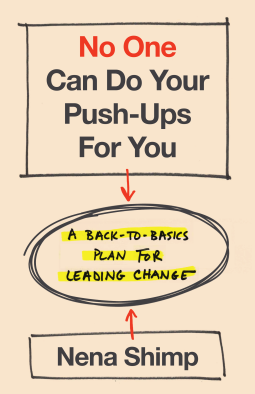
No One Can Do Your Push-Ups for You
A Back-to-Basics Plan for Leading Change
This title was previously available on NetGalley and is now archived.
Send NetGalley books directly to your Kindle or Kindle app
1
To read on a Kindle or Kindle app, please add kindle@netgalley.com as an approved email address to receive files in your Amazon account. Click here for step-by-step instructions.
2
Also find your Kindle email address within your Amazon account, and enter it here.
Pub Date Oct 6 2026 | Archive Date Oct 7 2026
Talking about this book? Use #NoOneCanDoYourPushupsforYou #NetGalley. More hashtag tips!
Description
Change doesn’t fail because strategies are flawed. It fails because leaders don’t show up in the ways that matter.
For over three decades, Nena Shimp has led transformation programs across industries—from manufacturing and technology to global supply chains. She’s seen every methodology, certification, and “new” type of leader, but the rate of failure remains the same. Change fails because executives delegate change instead of leading it. They sign the check, hire a program lead, and step aside—believing change management is a function, not a responsibility.
No One Can Do Your Push-Ups for You is a call to action for leaders who want to stop outsourcing ownership and start modeling the behaviors they expect from others. Stripping change leadership back to its fundamentals, Shimp combines corporate case studies, sharp insights, and simple daily push-up practices to teach leaders how to implement lasting change across industries.
Shimp’s unique voice—combining Navy-honed discipline, consulting pragmatism, and narrative flair—offers a grounded, no-nonsense road map for leading change effectively.
A Note From the Publisher
If you'd like to leave a review on Amazon, please use this link:https://a.co/d/0f5HQvQ1
ABOUT THE AUTHOR
Nena Shimp is a dynamic change professional known for driving real transformation results across various industries. With nearly thirty years of experience, she founded Change Accelerators and consults on how to implement change transformation. Outside of her work, she is a mother, grandmother, and, with her husband, a hobby farmer raising longhorn cattle, honeybees, chickens, and donkeys. No One Can Do Your Push-Ups for You is her first book.
Advance Praise
“This book should be considered an essential read for leaders responsible for driving change. Every chapter is full of wisdom, experience, and practical suggestions for leaders at every level. You’ll read it with a highlighter and come back to it again and again!” —Lori Reynolds, retired lieutenant general, United States Marine Corps
“This book is a great reminder that change is really not that complicated—but it takes effort, consistency, presence, and courage. The push-ups analogy is tangible and actionable. Everyone can do them, just like everyone can create change. Let Coach Nena show you how to do it right.” —Caroline Desjardins Smith, HR executive
“You can delegate the process. You can delegate the work. You can even delegate the blame. But you can’t delegate leadership. Most leaders disappear after launching a change initiative. That’s where the real work starts. Nena Shimp’s practical book reminds leaders that no one can do their push-ups for them and gives them actionable exercises to stay in shape.” —Gustavo Razzetti, bestselling author of Forward Talk and Remote Not Distant
“Don’t skip the basics. That’s the message—and Nena Shimp delivers it with enough evidence and honesty to make even experienced leaders reconsider how they’re showing up. A must read for anyone serious about developing the next generation of leadership.” —K. E. Mellits, VP, product engineering
“Nena Shimp hits the nail on the head with this unique and energetic book. I don’t love push-ups, but the alternative of failure feels more like never-ending burpees. Every chapter resonated, but as a thirty-plus-year leader of transformations, chapter 6 struck the most important chord for me, highlighting that completion is not the end of change—it is the proof of it! I strongly recommend this book for leaders or consultants driving transformations. Read this first and use the push-up plans—you will be better for it.” —James Schwalbe, VP, transformation leadership
“No One Can Do Your Push-Ups for You understands a truth most leadership books prefer to decorate rather than state plainly: Change efforts usually do not fail for lack of language. . . . [A] brisk, useful corrective to leadership books that mistake inspiration for discipline. It does not offer glamour. It offers responsibility, and in this genre that feels almost radical.” —Manhattan Book Review
“Unlike most books that address how to manage change, Nena Shimp focuses on how to be the catalyst for that change. . . . Chapters provide leaders with specific exercises, routines, guidance, and identifying factors to foster this change . . . the result is a study in paradoxes, reality, and applied mindful guidance that will intrigue an especially wide audience.” —Midwest Book Review
Marketing Plan
- Digital galley distribution on NetGalley
- Book review submissions
- Award submissions
- Post publication eBook discount campaign
- Digital galley distribution on NetGalley
- Book review submissions
- Award submissions
- Post publication eBook discount campaign
Available Editions
| EDITION | Paperback |
| ISBN | 9781967510863 |
| PRICE | $17.95 (USD) |
| PAGES | 140 |
Links
Available on NetGalley
Available to Buy
Buy on BN.com Buy on Bookshop.orgBISAC Codes
Average rating from 1 member
Featured Reviews
 Demetris P, Reviewer
A Dashboard, a Bonus Plan, and an Empty Chair Walk Into a Transformation
What Nena Shimp’s “No One Can Do Your Push-Ups for You” understands about the difference between what organizations say, what they reward, and what employees actually believe
By Demetris Papadimitropoulos | September 27th, 2026
Difficult truths in management books often arrive overdressed: proprietary frameworks, quadrant diagrams, a fresh acronym, perhaps a triangle for moral support. Nena Shimp’s “No One Can Do Your Push-Ups for You: A Back-to-Basics Plan for Leading Change” begins from the opposite suspicion. What if leaders do not chiefly lack methods? What if they have become remarkably good at using methods to avoid the behaviors they already know matter? One of Shimp’s best images is almost insultingly plain. A CEO has a chair reserved at monthly meetings for a global ERP rollout, and the chair stays empty nine months out of twelve. The organization has funding, governance, dashboards, and an official sponsor. The chair has better information.
Employees in Shimp’s world read leadership the way people read weather: through repeated signs rather than official assurances. They notice calendars, compensation plans, meeting attendance, the difficult subject postponed again, the promise repeated until the quarter turns bad. A transformation may have a sanctioned story, but workers assemble the one they believe from smaller evidence. Who remains after the launch? What gets rewarded when two stated values collide? Does the executive who invited candor still want it once candor becomes inconvenient? Credibility here is not charisma. It is what accumulates when those signals corroborate one another often enough to become predictive.
Management sophistication often enters these stories as camouflage. Project Atlas, a billion-dollar systems effort, fragments into incompatible pilots while dashboards stay reassuringly green. A chief executive delivers the kickoff speech, then quietly hands ownership down the chain. A company plasters customer-first language across its offices while paying people to maximize volume. A new platform reaches go-live before its users trust it. Shimp’s recurring pleasure – not always subtle, usually deserved – is in stripping the varnish from the official explanation until behavior is left standing underneath.
Each chapter repeats a compact mechanism: case, diagnosis, behavioral practice, questions. The questions matter because they revoke the reader’s temporary comfort as observer. What complexity are you protecting because it conceals fear? Where have you confused activity with achievement? What does your calendar say you believe? Shimp says early that she is not writing another framework-heavy change manual, and her preferred remedies are almost comically small beside the scale of the failures: attend a meeting, ask a question whose answer you do not control, name a trade-off, return after the launch, decide what “done” means before everyone starts congratulating themselves. The title earns its keep there. You may hire the trainer. You still have to lift your own weight.
The book knows these virtues are familiar. Transparency, curiosity, humility, consistency, follow-through – Shimp does not pretend to have excavated them from some undiscovered management tomb. Her argument is more annoying than novelty would be: you already know this, and you still may not be doing it. “Of course leaders should show up” sounds agreeable until the next question arrives. Did you? Did you still show up three months later, after the launch video was archived and the glitches were no longer photogenic? Familiar advice becomes interesting when agreement stops counting as evidence.
Repetition is therefore not an incidental defect, though at times it is certainly repetition. Shimp keeps returning to presence, questions, ownership, candor, finishing. The chapters themselves begin to feel like reps. That makes formal sense for a book claiming that practice matters more than comprehension, but metaphor does not grant blanket immunity from editing. The repeated “Push-Up Plans” and closing questions help because they alter the reader’s position: diagnosis must become a choice, however small. The best recurrences also change conditions around the same virtue. Curiosity under fear is not curiosity under fatigue; presence at launch is not presence six months later. Others arrive after the point has already acquired enough muscle. The book occasionally confuses another repetition with another layer.
In Chapter 6, that repeated attention to finishing suddenly becomes exact. A global platform linking operations, finance, and customer data is “92 percent complete.” The CFO exhales. A success announcement is being drafted. Shimp asks the program lead whether users are ready. Not really. Training has happened; belief has not. Then the prose stops short: “We weren’t there. We were almost there.” The repetition of “there” makes completion sound binary. “Almost,” the soothing word, turns hazardous. What follows spreads into a longer inventory – budgets closing, attention fading, resources moving, ownership dissolving. Two abrupt sentences refuse arrival; the longer syntax that follows lets organizational attention seep away clause by clause.
Post-launch, regions quietly reactivate old spreadsheets. Reports stop agreeing. A supposedly unified business finds itself carrying two versions of reality. Shimp calls the hidden cost of this premature celebration “momentum debt,” and the phrase earns its place because it names something the ordinary language of implementation tends to obscure: an organization can borrow the feeling of completion before it has built the capacity completion is supposed to describe. The bill comes later as rework, workarounds, disbelief, and less patience for the next transformation. A 2023 McKinsey survey does not prove Shimp’s explanation, but it gives the temporal problem scale: 56 percent of respondents said their organizations achieved most or all transformation goals, while only 12 percent said those gains lasted more than three years. Starting is spectacularly easier to record than staying changed.
A CIO supplies an even smaller version of the same argument. Minutes before a victory email goes out after an exhausting ERP implementation, he inserts a sentence acknowledging that adoption will determine impact and that the real work begins now. No code changes. No consultant is summoned back. He changes the sentence that tells the organization what has happened. That matters because Shimp has an unusually good ear for managerial language that closes reality prematurely. A launch becomes “success,” discomfort becomes “more data,” absence becomes “empowerment,” maintenance becomes “sustainment.” Her better interventions do not coin grander terms. They reopen nouns that have become too comfortable.
People follow the scoreboard, not the slide deck. Chapter 5 proves this with a company that declares customer centricity while tying bonuses, recognition, and advancement to production volume. Workers do exactly what a rational incentive system teaches them to do. Shimp pushes the thought one step further: “Culture isn’t what leaders intend. Culture is what employees infer from what leaders reward.” The sentence turns on its verbs. Leaders intend; employees infer; rewards settle the dispute. Culture is not handed down intact from the executive suite. It is reconstructed below from consequences. That makes hypocrisy almost beside the point. The executives need not be lying about customer care for the system to betray them; sincerity cannot neutralize a bonus formula. The old problem associated with Goodhart’s Law sits nearby: attach enough consequence to the proxy and people will optimize the proxy, sometimes at the expense of what it was meant to measure. Shimp gives that familiar problem an ethical sting. A bonus plan is also a statement about which disappointment the company can live with.
Authority, then, becomes believable through corroboration. A leader says the customer matters; the compensation system agrees. A leader says an initiative matters; the calendar agrees. A leader asks for honesty; the person who supplies it remains safe. Where the signals diverge, employees become amateur semioticians, usually with more data than the slide deck. This is what gives “No One Can Do Your Push-Ups for You” more depth than its cheerful exercise metaphor promises. It is a book about how people decide which version of authority to believe.
During Chapter 4, a division president demonstrates how quickly respectable language can conceal less respectable feelings. Two weeks before a major rollout decision, he says the team needs more data. Everyone can nod at that. More data is cautious, managerial, difficult to accuse. Later, in private: “I just don’t want to be wrong.” The distance between those sentences is the chapter. Shimp has a precise instinct for the moment when professionalism turns into self-protection, when delay gains a respectable vocabulary and therefore becomes harder to confront.
I trust the scene more than some of the circuitry Shimp builds around it. Her broader point – stress and threat can narrow judgment and worsen executive functioning – has solid support. But the chapter occasionally makes neuroscience behave with suspicious obedience, moving briskly through cortisol, amygdala response, dopamine, oxytocin, and psychological safety as though each management behavior had a tidy biological receipt attached. She also credits Amy Edmondson’s 1999 team study with a broader curiosity-to-safety-and-trust causal claim than the paper itself establishes. Edmondson found a relationship between psychological safety and learning behavior in teams; Shimp’s version extends further. Precision matters here because scientific vocabulary changes the rhetorical temperature: a coaching observation begins to sound less like experienced judgment and more like settled mechanism. The irony is that she does not need the extra certainty. “I just don’t want to be wrong” already tells us something more useful about the meeting than a hurried tour of the nervous system does.
More serious is what happens when Shimp’s behavioral clarity meets institutional causation. Project Atlas closely resembles the Navy ERP history listed among her primary case sources. A 2005 Government Accountability Office report documented four Navy ERP pilots, roughly a billion dollars invested, inconsistent designs, duplicated functions, deficient interoperability, and weak coordinated oversight. The resemblance vindicates the factual skeleton of Shimp’s opening story. The same report, however, is crowded with requirements problems, enterprise architecture, data conversion, interfaces, controls, testing, and other technical and institutional failures. Even the Defense Department disputed GAO’s simplest characterization of the pilots as wasted failures, arguing that they yielded usable capabilities and lessons. The documentary history does not undo Shimp’s reading. It refuses to fit inside it.
It is tempting to call that “oversimplification” and move along, but the problem is more specific. Shimp is often excellent at identifying a neglected intervention point inside a complex failure: a leader withdrew, an incentive lied, a question went unasked, a finish was declared too early. An intervention point is not a complete causal account. Technologies can be incompatible. Regulations can bind. Resources can be insufficient. Different divisions can possess genuinely different requirements rather than merely defending fiefdoms. This matters because the book’s moral pressure is strongest when a leader really can act differently. Where the constraint is structural, the same pressure can turn a diagnosis into blame. Shimp’s simplifications clear useful sightlines through such problems. Trouble begins when the sightline starts to resemble the whole terrain.
That objection cannot quite contain the book because Shimp repeatedly produces evidence against an overly individualist reading of her own thesis. The customer-first chapter shows a reward system overpowering sincere intention. Chapter 7 replaces some heroic executive presence with recurring rituals: leaders asking what was learned, what still blocks the work, what the organization refuses to acknowledge. Those routines matter precisely because they are designed to survive Tuesday morning, executive distraction, and eventually the executive. The book says nobody can do your push-ups for you, but its better organizational examples understand that leadership has to build conditions in which more people acquire muscle.
Read alongside L. David Marquet’s “Turn the Ship Around!,” the unresolved pressure becomes especially clear. Marquet worries about organizations that cannot act without the person at the top; Shimp has watched executives rename their disappearance “empowerment.” Neither problem cancels the other. When does delegation become abdication? When does presence create dependency? The distinction matters because a leader can fail by vanishing and also fail by making every meaningful decision require the leader’s presence. Shimp never fully draws the border. Garrett, the leader she saves for last, suggests the closest thing to an answer: attention should leave other people more capable than it found them.
Oppositions are Shimp’s favorite tool. Sponsor or leader. Motion or momentum. Installation or adoption. Slogan or scoreboard. Program or practice. They make an unruly subject carryable, which matters in a book written for people likely to remember a sentence from a meeting more readily than a page of qualifications. They can also tidy the room too quickly. Shimp is better when the opposition becomes a test than when it becomes a taxonomy. “What complexity am I protecting because it hides my own discomfort or fear?” works because it implicates the reader without declaring every complexity fraudulent. Her questions often contain more intellectual room than her maxims.
Progression across the ten chapters gradually changes the scale of the argument. The opening pages deal in vast systems, distributed accountability, money, pilots, governance. The middle turns toward fear, incentives, adoption, and the way attention thins after launch. Chapter 8 gathers the recurring failures into See-Move-Finish: failure to see answered by clarity and curiosity, failure to move by courage and commitment, failure to finish by consistency and continuity. The pairings are almost suspiciously well behaved. They are also memorable enough to be used. Here lies the book’s mild comic paradox: a work suspicious of managerial frameworks steadily manufactures them. But Shimp’s actual objection is not to structure. It is to structure that gives people the sensation of having acted. The framework is useful precisely when it remains provisional – a way to ask where the blockage is, not a claim that every blockage has only six possible levers. See-Move-Finish succeeds when it starts the argument in the room; it weakens when its symmetry begins to look like the room itself.
Objects keep rescuing the book from that symmetry. An empty chair. A bonus plan. A meeting deleted from the calendar. A green dashboard. A private spreadsheet. The spreadsheet is particularly revealing. A regional president sees healthy adoption metrics; a frontline manager down the hall keeps her own numbers because she trusts them more than the official system. Two documents coexist, one institutionally legible and one operationally useful. They do not merely disagree about performance; they belong to different economies of consequence. The dashboard reassures people far from the malfunction. The spreadsheet helps someone survive it. This is more than somebody failing to notice a problem. The organization has built a reporting mechanism capable of producing one reality for upward consumption while the work below requires another. Shimp calls the category “failure to see.” The scene is stranger, and better, than the label.
Until Garrett appears, people in the book often exist to reveal a management failure. Garrett gets to exist long enough to alter the emotional temperature. A vice president of sales and business development from early in Shimp’s career, he starts meetings with music, remembers what people told him last time, asks after families, stays close to customer-facing work, coaches telephone interactions, and waits while somebody thinks. When a person reaches an insight, his delight seems directed at the discovery rather than his own role in prompting it. Shimp says he is the only leader in three decades who seemed to embody every push-up in the book, not flawlessly, but consistently enough that people knew what to expect from him.
Late in the chapter comes the line that gathers the whole book more effectively than the Six Disciplines do: “We professionalized the role until we engineered the human out of it.” “Engineered” belongs to the vocabulary of systems, optimization, programs, and enterprise design; Shimp turns that vocabulary against itself. Professional management can become so elaborate that the person disappears inside the apparatus meant to organize people. That reversal also explains why Garrett is more persuasive than the diagrams preceding him: no label is asked to prove that he mattered. Then Shimp lets the sentence breathe by saying Garrett never got that memo. The joke is slight, almost tossed away. It works because Garrett has ceased to feel like a model. He feels like someone she misses.
Once Garrett occupies the final pages, the title changes its emphasis. At first, no one doing your push-ups for you sounds like stern individual responsibility. By the end, the exercise is still yours but its consequences are everybody else’s. Colleagues experience whether you practiced: the meeting you attended, the truth-teller you protected, the priority you repeated after the glamorous phase, the promise your incentive system did or did not betray. The push-up belongs to the leader; the evidence belongs to everyone around them.
Some images outlast the book’s named disciplines: the chair nobody occupied, the dashboard that remained green, the spreadsheet kept because the official system could not be trusted, the victory email interrupted before it could turn a launch into premature history. “No One Can Do Your Push-Ups for You” earns 82/100, or 4/5 Goodreads stars – strong, disciplined, practically intelligent, limited by recurrent compression and occasional scientific overconfidence, but considerably more thoughtful than its back-to-basics packaging might suggest. Its central difficulty remains productively unresolved. Institutions need systems sturdy enough to survive any one leader; systems are still interpreted through the people who inhabit them. Between the empty chair and Garrett’s attentive gaze, credibility becomes visible – not because somebody found the right framework, but because somebody kept coming back.