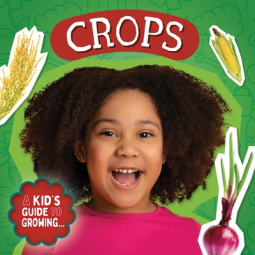
Crops
This title was previously available on NetGalley and is now archived.
Send NetGalley books directly to your Kindle or Kindle app
1
To read on a Kindle or Kindle app, please add kindle@netgalley.com as an approved email address to receive files in your Amazon account. Click here for step-by-step instructions.
2
Also find your Kindle email address within your Amazon account, and enter it here.
Pub Date Aug 1 2026 | Archive Date Oct 5 2026
Rosen Publishing Group | Kidhaven Publishing
Talking about this book? Use #Crops #NetGalley. More hashtag tips!
Description
Nonfiction for grades 1-3+, part of a 5-title series.
Growing crops is a way of life for people who live on farms. But how do farmers actually grow the fruits, vegetables, and other foods we eat? Readers find out in this helpful and fun guide to growing crops! As readers learn the basics of planting and harvesting, they also enhance their understanding of basic biology concepts. The clear and accessible text is paired with colorful photographs of kids helping out on the farm, inspiring young readers to develop a deeper appreciation of where our food comes from and the people who grow it.
Available Editions
| EDITION | Hardcover |
| ISBN | 9781534569874 |
| PRICE | $26.23 (USD) |
| PAGES | 24 |
Available on NetGalley
Available to Buy
Buy on BN.com Buy on Bookshop.orgAverage rating from 2 members
Featured Reviews
 Samantha S, Reviewer
Clear, Visual, and Genuinely Easy to Learn From
Thank you to NetGalley and KidHaven Publishing for providing an advance reading copy.
⭐ Overall: 4.5/5 — rounded to 5
📸 Photography / Visuals: 4.5/5
Crops does an excellent job of taking a potentially broad topic and turning it into an understandable process for young readers. Rather than presenting a collection of disconnected farming facts, the book walks children through how crops are grown—from preparing the land and planting through watering, protecting plants, harvesting, and crop rotation.
The photography is one of its greatest strengths because it frequently does real teaching work. Some of the strongest spreads pair simple explanations with photographs that make the concept immediately easier to understand. The bright colors and approachable layout also keep the book visually engaging without making the educational content feel overwhelming.
I particularly appreciated how thoughtfully new vocabulary is introduced. The book explains from the beginning how glossary words are identified and tells children where they can find their definitions, giving young readers a way to independently seek help when they encounter an unfamiliar term.
There are a few places where the visual hierarchy could guide the eye more clearly, but these were minor opportunities for refinement rather than problems with the overall experience. This is accessible, thoughtfully structured nonfiction that understands its audience and uses both words and photographs to help children build an actual understanding of how crops grow.
Who Should Read?
A strong choice for early-elementary readers interested in farms, plants, food, or how things grow, as well as parents, teachers, classrooms, and libraries looking for accessible introductory science and agriculture nonfiction.