*This page contains affiliate links, so we may earn a small commission when you make a purchase through links on our site at no additional cost to you.
Send NetGalley books directly to your Kindle or Kindle app
To read on a Kindle or Kindle app, please add kindle@netgalley.com as an approved email address to receive files in your Amazon account. Click here for step-by-step instructions.
2
Also find your Kindle email address within your Amazon account, and enter it here.
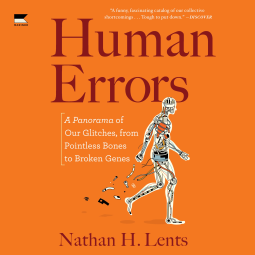
A biology professor’s illuminating tour of the physical imperfections—from faulty knees to junk DNA—that make us human. ¶“A funny, fascinating catalog of our collective shortcomings that’s tough to put down.”—Discover ¶ We humans like to think of ourselves as highly evolved creatures. But if we are supposedly evolution’s greatest creation, why do we have such bad knees? Why do we catch head colds so often—two hundred times more often than a dog does? How come our wrists have so many useless bones? Why is the vast majority of our genetic code pointless? And are we really supposed to swallow and breathe through the same narrow tube? Surely there’s been some kind of mistake? As professor of biology Nathan H. Lents explains in Human Errors, our evolutionary history is indeed nothing if not a litany of mistakes, each more entertaining and enlightening than the last. The human body is one big pile of compromises. But that is also a testament to our greatness: as Lents shows, humans have so many design flaws precisely because we are very, very good at getting around them. A rollicking, deeply informative tour of humans’ four-billion-year-and-counting evolutionary saga, Human Errors both celebrates our imperfections and offers an unconventional accounting of the cost of our success.
Supplemental enhancement PDF accompanies the audiobook.
A biology professor’s illuminating tour of the physical imperfections—from faulty knees to junk DNA—that make us human. ¶“A funny, fascinating catalog of our collective shortcomings that’s tough to...
A biology professor’s illuminating tour of the physical imperfections—from faulty knees to junk DNA—that make us human. ¶“A funny, fascinating catalog of our collective shortcomings that’s tough to put down.”—Discover ¶ We humans like to think of ourselves as highly evolved creatures. But if we are supposedly evolution’s greatest creation, why do we have such bad knees? Why do we catch head colds so often—two hundred times more often than a dog does? How come our wrists have so many useless bones? Why is the vast majority of our genetic code pointless? And are we really supposed to swallow and breathe through the same narrow tube? Surely there’s been some kind of mistake? As professor of biology Nathan H. Lents explains in Human Errors, our evolutionary history is indeed nothing if not a litany of mistakes, each more entertaining and enlightening than the last. The human body is one big pile of compromises. But that is also a testament to our greatness: as Lents shows, humans have so many design flaws precisely because we are very, very good at getting around them. A rollicking, deeply informative tour of humans’ four-billion-year-and-counting evolutionary saga, Human Errors both celebrates our imperfections and offers an unconventional accounting of the cost of our success.
Supplemental enhancement PDF accompanies the audiobook.
*This page contains affiliate links, so we may earn a small commission when you make a purchase through links on our site at no additional cost to you.
BISAC Codes
SCI036000 SCIENCE / Life Sciences / Human Anatomy & Physiology
*This page contains affiliate links, so we may earn a small commission when you make a purchase through links on our site at no additional cost to you.
BISAC Codes
SCI036000 SCIENCE / Life Sciences / Human Anatomy & Physiology
SCI027000 SCIENCE / Life Sciences / Evolution
SCI008000 SCIENCE / Life Sciences / Biology
Average rating from 1 member
This site uses cookies. By continuing to use the site, you are agreeing to our cookie policy. You'll also find information about how we protect your personal data in our privacy policy.