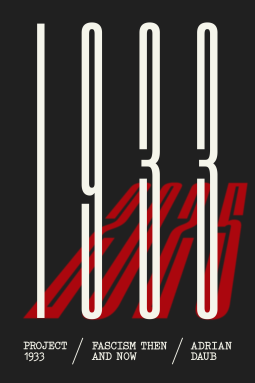
Project 1933
Fascism Then and Now
Sign In or Register Now to see if this title is available for request.
Buy on BN.com Buy on Bookshop.orgSend NetGalley books directly to your Kindle or Kindle app
1
To read on a Kindle or Kindle app, please add kindle@netgalley.com as an approved email address to receive files in your Amazon account. Click here for step-by-step instructions.
2
Also find your Kindle email address within your Amazon account, and enter it here.
Pub Date Apr 27 2027 | Archive Date Apr 20 2027
Astra Publishing House | Astra House
Talking about this book? Use #Project1933 #NetGalley. More hashtag tips!
Description
Since a new wave of far right-wing sentiment entered American political life a decade ago, political scientists and pundits have chided people for what they see as overly facile comparisons between today’s Republican leadership and Nazism. Are these comparisons just scare-mongering? Or could they tell us something useful about the state of American democracy?
Using the writings of German thinkers like Thomas Mann, Victor Klemperer, Hannah Arendt, and other meticulous diarists of the era, Project 1933 retells the story of the first year of the Third Reich month-by-month, pausing to draw connections between Germany’s past and America’s present. Adrian Daub deftly explores the truths of living under fascism—the grim uncertainty (and even grimmer certainty) of early days, the existential scramble to cleave to institutions that define us even as they are bent to the will of a despot, the creation of bystanders and collaborators, the shifting cultural conversations, and the day-to-day banalities.
While some parallels are downright terrifying, Project 1933 aims to remind readers of the choices that are available to us, and that fascism’s key magic trick is to convince us of its own inevitability. Project 1933 shows readers a path toward a more hopeful, moral imagination and the possibility of radical change.
Marketing Plan
• Pitch early excerpt • National media campaign including print, radio, and online coverage • Major podcast campaign • Pitch for feature stories and profile of the author/podcaster • Bookstore events and festivals • Target outreach to publications and reviewers focused on contemporary politics, fascism, political resistance, and political history • Pitch original essays and op-eds in advance of publication • Robust awards campaign • Bookseller and librarian outreach • Targeted academic campaign • Downloadable discussion guide for educators • Social media and email campaigns
Available Editions
| EDITION | Hardcover |
| ISBN | 9781662603686 |
| PRICE | $28.00 (USD) |
| PAGES | 336 |
Available on NetGalley
Available to Buy
Buy on BN.com Buy on Bookshop.orgBISAC Codes
Average rating from 2 members
Featured Reviews
 Cesar M, Reviewer
Project 1933 is a masterful historical comparison that feels urgent for today's political climate. I loved the focus on the actual diaries of thinkers like Hannah Arendt and Thomas Mann, it grounds the heavy theory in real human experience. It’s an eye-opening look at how easily societies slip into authoritarianism, but it ultimately offers a hopeful path forward.
 Reviewer 1870399
Thank you, Astra Publishing House, for providing this book for a voluntary review via NetGalley. All opinions are my own.
In Project 1933 Adrian Daub describes how the Nazis and Hitler consolidated power throughout the year 1933. As the book title suggests, Daub draws comparisons between the events of 1933 and the current Trump administration’s implementation of the policies outlined in the Project 2025 document.
Each chapter sequentially covers each month of the year and describes how Nazi policies gradually and step-by-step strengthened their grasp on the entire governmental structure while marginalizing certain groups within society, such as Jews, prostitutes, and transgenders. To illustrate the impact on Germans, Daub recounts the lives, activities, and perspectives of key personalities during the period, such as Thomas Mann, Victor Klemperer, Gabriele Tergit, Ernst Bloch, Luise Solmitz, and Carl Schmitt, through diaries, letters, articles, and pamphlets. To draw parallels, Daub compares the policies of the Nazis in 1933 with those of the Trump administration in 2025. Some examples:
• The introduction of concentration camps vs. for-profit internment camps;
• The de facto authorization of police forces to use deadly force against citizens ; i.e., the Gestapo in 1933, ICE in 2025;
• The marginalization of the powers of the German Parliament and the US Congress;
• The purging of government employees not loyal to those in power.
As I progressed through the book and read about the gradual dismantling of freedoms, rights, and laws, two visuals came to mind: (1) seeing a train wreck happening in slow motion; and (2) society being the proverbial frog in boiling water. I recommend all concerned citizens read Project 1933 as a warning of what is possible when authoritarianism overtakes democracy. Thank you, Adrian Daub, for the detailed research and the uncomfortable, yet necessary, read.