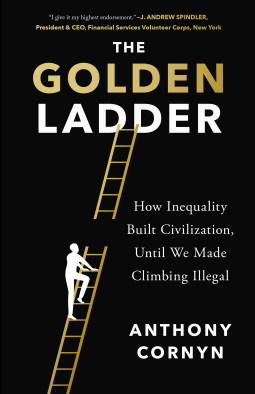
The Golden Ladder
How Inequality Built Civilization, Until We Made Climbing Illegal
Sign In or Register Now to see if this title is available for request.
Buy on Amazon Buy on BN.com Buy on Bookshop.orgSend NetGalley books directly to your Kindle or Kindle app
1
To read on a Kindle or Kindle app, please add kindle@netgalley.com as an approved email address to receive files in your Amazon account. Click here for step-by-step instructions.
2
Also find your Kindle email address within your Amazon account, and enter it here.
Pub Date Oct 6 2026 | Archive Date Mar 31 2027
Scribe Media | Houndstooth Press
Description
Inequality made civilization possible.
Modern debate treats the gap between rich and poor as a problem to eliminate. We assume that more equality means a better society. History suggests something more complex.
From the pyramids of ancient Egypt to the Renaissance to Silicon Valley, humanity's greatest advances required concentrated wealth—and the freedom to deploy it. Inequality didn't just accompany progress. It helped drive it.
But not all inequality works the same way. When the rungs hold, wealth builds—fueling innovation, opportunity, and rising living standards. When they break, the system shifts from building to collecting. Barriers rise. Access replaces merit. Climbing gets harder.
In The Golden Ladder, Anthony Cornyn flips the switch. The issue isn’t whether inequality is good or bad. It’s whether it’s still building—or whether lobbying, regulation, and gatekeeping have turned it into a system that protects those at the top.
Advance Praise
"My office at Cato looks out on K Street. If I chance to look in its direction—I try not to—I am reminded with pain of the ladder-pulling-up in which it specializes. Tony Cornyn has written the book that explains why."
—Deirdre N. McCloskey, Distinguished Professor Emerita of economics, history, English, and communication at University of Illinois at Chicago
"The Golden Ladder builds a case as vivid as it is provocative: inequality isn't one problem—it's two. Worse, we've been fighting the wrong version for sixty years. Sweeping through the Medici, the Dutch masters, Adam Smith, and Elon Musk with equal ease, Cornyn is a great storyteller channeling a serious thinker. The Golden Ladder doesn't just challenge how you think about wealth and opportunity—it hands you a sharper, more honest set of questions to ask. A genuinely fresh, fearless, and deeply readable book."
—Michael C. Munger, professor of political science and economics at Duke University
"The Golden Ladder makes a compelling case that the wealth that endures is the wealth invested in people. Cornyn's framework—rooted in history and economic research—resonates deeply with everything the human capital community has learned about what actually drives long-term prosperity."
—Rob Dugger, Co-founder of ReadyNation and co-director at Global Working Group on Human Capital and Economic Opportunity
"Anthony Cornyn's improbable defense of inequality couldn't be better timed."
—Marc Levinson, finance and economics editor of The Economist in London, journalist, economist, and author
“Extraordinary…At a time when progressive economic thinking decries growing wealth inequality, Tony Cornyn asserts that inequality is not the right problem to focus on. Rather, we should ensure that the bottom rungs of the ladder remain intact, offering opportunity to society's most disenfranchised. Lucid, engaging, packed with fascinating facts and illustrative examples—this is thinking outside the box at its best. A significant work for our times destined to find a vast following. I give it my highest endorsement.”
—J. Andrew Spindler, President & CEO, Financial Services Volunteer Corps, New York
“Wealth inequity is ubiquitous. It is the root cause of our social and economic dysfunction. Yet it goes on and on unaddressed. Wealth inequity is also why our politics is so tempest-tossed.
Along comes Anthony Cornyn to (paraphrasing Emma Lazarus) lift up his lamp beside The Golden Ladder. The book tackles the issue of wealth inequity from a cause-and-effect standpoint…not from the time-worn Blue vs. Red perspective.
In this season of politics and in political seasons to come, may Cornyn's sound recommendations form the basis for finally addressing this persistent issue."
—Cornelius Hurley, faculty member at Boston University School of Law, former official, and Federal Reserve Director
“Most economists approach inequality with either cheerleading or grievance. Anthony Cornyn brings a Federal Reserve officer's precision instead. The Golden Ladder is rigorous, readable, and long overdue.”
—Donald Billings, CFA, former Federal Reserve and RTC Officer, bank advisor, and board member
“The Golden Ladder is a challenging book that at every turn flips conventional wisdom on its head. What drives economic progress—inequality or equality? Concentrated ownership coupled with patient capital produces growth. But the concentrated capital that can be the engine of growth may also place people in positions of influence who will stop progress. Is inequality good? It depends on whether the inequality is productive or extractive. Does it build ladders or erect barriers? Does it create or protect?
Intentions are not results. That message is not an easy one to appreciate, but it resonates throughout The Golden Ladder. The book deserves a careful read as we grapple with questions about capitalism, economic growth, nationalism, regulation, fairness, and inequality."
—Stephen Cross, PhD, Senior Advisor at Alvarez & Marsal
“Anthony Cornyn in The Golden Ladder writes, 'The right questions aren't about reducing inequality. They're about which inequality.' By addressing inequality with this as a starting point, this book confronts an issue that politicians, policy analysts, and the general public have grappled with for centuries. Cornyn's approach is unique and deserves careful attention—and a permanent place on your bookshelf."
—Joseph A. Cernik, PhD, editor for The Missouri Policy Journal and essayist for The American Eclectic (Substack)
Available Editions
| ISBN | 9781544553214 |
| PRICE | |