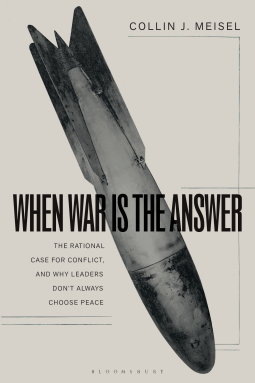
When War Is the Answer
The Rational Case for Conflict, and Why Leaders Don't Always Choose Peace
Sign In or Register Now to see if this title is available for request.
Buy on BN.com Buy on Bookshop.orgSend NetGalley books directly to your Kindle or Kindle app
1
To read on a Kindle or Kindle app, please add kindle@netgalley.com as an approved email address to receive files in your Amazon account. Click here for step-by-step instructions.
2
Also find your Kindle email address within your Amazon account, and enter it here.
Pub Date Jan 21 2027 | Archive Date Jan 21 2027
Talking about this book? Use #WhenWarIstheAnswer #NetGalley. More hashtag tips!
Description
Through an investigation of political leaders' decision-making on the path to war, this timely book addresses one of the most important and misunderstood issues of our time: the preference for war over peace.
“Suicide for fear of death” is how the first chancellor of the German empire Otto von Bismarck described a leader's choice to start a war. In the lead up to World War I, the phrase “'The Germans are dangerous, but they are not maniacs" is how people assured one another they were safe. Indeed, beyond immediate self-defense against an obviously imminent attack, the decision to start a war may seem to most of us to be utterly irrational given its exorbitant costs-human, financial, psychological, moral, and otherwise. Why, then, have many leaders decided that war is the answer to their questions of how best to achieve their personal and policy objectives? What drives leaders to choose war in the future? How can we deter them?
Security and military expert Collin Meisel addresses these perplexing questions, offering a theory of war and testing it across five cases studies. Rather than try to predict, this book seeks to explain and understand these rationales, guiding readers through leaders' decision-making on the path toward war and gleaning lessons for the future. When we better understand why leaders make such drastic choices against far less bloody alternatives, we may be able to better understand how to shape choices in the future, perhaps reducing the frequency (if not bringing about the long-desired end) of war.
Collin J. Meisel is the director of analysis at the University of Denver’s Pardee Institute for International Futures at the Josef Korbel School of International Studies. He is also a non-resident senior fellow at The Hague Centre for Strategic Studies, a non-resident fellow at The Henry L. Stimson Center, and a term member of the Council on Foreign Relations.
A Note From the Publisher
This is a set of uncorrected page proofs. It is not a finished book and is not expected to look like one. Errors in spelling, page length, format and so forth will all be corrected by the time the book is published several months from now. Photos and diagrams, which may be included in the finished book, may not be included in this format. Uncorrected proofs are primarily useful so that you, the reader, might know months before actual publication what the author and publisher are offering. If you plan to quote the text in your review, you must check it with the publicist or against the final version. Please contact USPR@bloomsbury.com with any questions. Thank you!
Available Editions
| EDITION | Hardcover |
| ISBN | 9798216451600 |
| PRICE | $30.00 (USD) |
| PAGES | 272 |