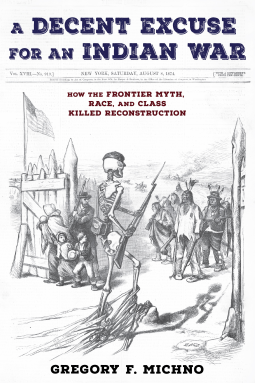
A Decent Excuse for an Indian War
How the Frontier Myth, Race, and Class Killed Reconstruction
Sign In or Register Now to see if this title is available for request.
Buy on BN.com Buy on Bookshop.orgSend NetGalley books directly to your Kindle or Kindle app
1
To read on a Kindle or Kindle app, please add kindle@netgalley.com as an approved email address to receive files in your Amazon account. Click here for step-by-step instructions.
2
Also find your Kindle email address within your Amazon account, and enter it here.
Pub Date Mar 1 2027 | Archive Date Feb 28 2027
University of Nebraska Press | Bison Books
Talking about this book? Use #ADecentExcuseforanIndianWar #NetGalley. More hashtag tips!
Description
A Decent Excuse for an Indian War details the post–Civil War conflicts over how to allocate scarce military resources in the context of three converging streams: Indian “war,” the exploding issue of race, and a developing industrialization leading to class conflict. Gregory F. Michno shows how Indian conflicts were manufactured in the West to justify troop removals from the South during Reconstruction. The army in the South helped Black people but hindered business exploitation; the army in the West helped white people and helped business exploitation. If the army simply remained in the South, fewer people would die, but business would make less profit. Capital, industry, and finance were in the saddle, and there was little doubt as to the final reckoning. In the meantime, Reconstruction generals often let bigoted attitudes drive their decisions to disregard legislative and executive direction, which played a large part in Reconstruction’s ultimate failure.
Though earlier books have addressed Reconstruction and the Indians wars, rarely have they examined the military, political, and social factors that connected them and led to the near destruction of both Indians and freedmen.
Advance Praise
“A two-fisted history that pulls no punches while exposing the tragedy of Reconstruction. Gregory Michno’s well-researched, vibrantly written, and cleverly argued book explores the tragedies that betrayed the lives sacrificed in the Civil War to give the United States a new birth of freedom. The frontiers Americans faced during this period were color lines where serried white interests exaggerated the threats posed by Indians, newly freed Black people, and militant labor to justify their violent suppression.”—Gregory J. W. Urwin, editor of Black Flag Over Dixie: Racial Atrocities and Reprisals in the Civil War
“A Decent Excuse for an Indian War probes deeply into the complex ties between America’s bloody Western Indian wars and the simultaneous cauldron of racial disparity plaguing Black America in an exploration of the ever-complex legacy of Manifest Destiny. Gregory Michno’s take is fresh if often grim and cannot be dismissed.”—Paul L. Hedren, author of Sitting Bull’s War: The Battle of the Little Big Horn and the Fight for Buffalo and Freedom on the Plains
Available Editions
| EDITION | Paperback |
| ISBN | 9781496249944 |
| PRICE | $29.95 (USD) |
| PAGES | 328 |