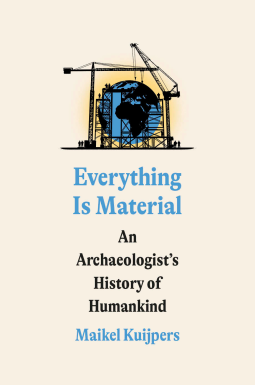
Everything is Material
How 500,000 Years of Materials Shaped Human History
Sign In or Register Now to see if this title is available for request.
Buy on BN.com Buy on Bookshop.orgSend NetGalley books directly to your Kindle or Kindle app
1
To read on a Kindle or Kindle app, please add kindle@netgalley.com as an approved email address to receive files in your Amazon account. Click here for step-by-step instructions.
2
Also find your Kindle email address within your Amazon account, and enter it here.
Pub Date Apr 29 2027 | Archive Date Apr 26 2027
Crown Publishing | Hutchinson Heinemann
Talking about this book? Use #EverythingisMaterial #NetGalley. More hashtag tips!
Description
'Fascinating, eye-opening and terrific fun' ELIZABETH KOLBERT
Since 2020, human-made materials have exceeded the weight of all living biomass on Earth. Nearly half of that mass is concrete, enough to cover the entire planet in a layer two millimetres thick.
We tend to think of all these materials – whether dug up or grown, forged or built – as completely inert, readily shaped to meet human need. But what if that relationship works both ways? What if, as we shaped the material world, it was also quietly shaping us?
In Everything is Material, archaeologist Maikel Kuijpers tells the story of humanity through nine materials that made our world: wood, soil, ceramics, brick, steel, glass, concrete, fertiliser and plastic. He explains what a 4,000-year-old plough tells us about how working the soil transformed our ideas of property and territory. He uncovers how ancient Mesopotamians used bricks not just to build their cities, but to measure, organise and govern them. He reveals how glass lenses allowed Galileo to reimagine humanity's understanding of its place in the universe. And he tells the extraordinary story of how we learned to turn air into fertiliser, allowing billions more humans to live than anyone thought possible.
Following these materials through time reveals a new history of our species. Our ideas and values, our language and cultures, even our understanding of ourselves have all emerged from our encounters with materials. Materials don't just determine what we do; they define how we think.
It is a history that builds to a simple, startling question. Is our entanglement with materials – the relationship that built human civilisation – now driving us to environmental ruin? And could better understanding it help us learn to live with the material world, rather than simply consume it?
Available Editions
| EDITION | Hardcover |
| ISBN | 9781529153446 |
| PRICE | £25.00 (GBP) |
| PAGES | 352 |