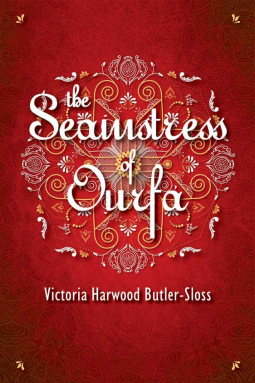
I fell in love with this story, and most of all with the characters that inhabit it. From an utterly enticing prologue (a child - Vicki - meeting her family members in Cyprus, in 1968), we are taken back to 1895, when Vicki's great grandmother (Khatoun) is little more than a child herself, and is soon to meet her future husband, Iskender. The setting is Ourfa in the Ottoman Empire.
And so the story moves forward, and we are introduced to a stunning array of characters, learning much about the traditions and family life of this time and culture. Khatoun becomes a seamstress, and it is she who stitches this unforgettable and beautiful story together. Beautiful, but not without sadness, loss, and in respect of the Armenian Genocide (which this novel depicts), terror. The beauty is in the characters' resilience to everything that is thrown at them, in their faithfulness to family and friends and long-held custom, in the courage to make a house a home and a haven, despite the growing threat from all around.
The scene where the beleaguered family climb to their roof and watch the many fires spreading across the town, as the violence and persecution intensifies, struck me as one of the most powerful in the novel.
There is great charm and humour in this story, which comes naturally from the absurdities, ironies, and joys of life among a vibrant and soulful community, and within a large family network.
Khatoun, Iskender, and his unlucky-in-love sister, Ferida, are the principal characters, and I loved them all and felt deeply drawn to them. For me, this novel is about family being the bedrock of a rich and civilised life - and how a strong family unit can then offer help to friends or strangers in times of need and trouble. Iskender is a curious and delightful character, a dreamer, and not at all suited to business. Khatoun and Ferida embody different aspects of feminine strength, wisdom and ingenuity - they are necessary to each other and to the balance of the novel as a whole.
Victoria Harwood Butler-Sloss writes beautifully, with elegance and a distinctly individual voice. The clarity and freshness of the descriptive passages is breath-taking, and the characterisation and dialogue is never less than compelling. In this novel, all the small and large eccentricities and foibles of a large extended family ring true: the jealousies, the feuds, and the making up, the falling in love, and out of love, all played out amid the growing horror that stalks beyond their doors and windows, and which threatens to engulf them all. You cannot help but fall under the spell this narrative weaves. You forget that it is writing - it is that good - you are simply transported, via all the senses, to the rooms and courtyards, the mountain roads and town streets, and from these into the hopes and fears, the complex nature and inner worlds of the characters depicted.
Food and drink play a large part in conveying the warp and weft of these lives, and through these, and the traditions of hospitality so minutely observed, you are enriched. You read the book as though you were dreaming it - it becomes something you half remember happening to yourself, or to those you may have known long ago. This demonstrates a wonderfully poetic sensibility in the author, as well as great narrative skill.
Victoria Harwood Butler-Sloss is a writer of outstanding talent; moreover, one of a rare kind of wisdom, laced with necessary humour, which conveys rich existence in strands of countless colours, thereby recreating the fabric of lives once lived, of love having been given and received.
One is left with a sense of wonder and admiration for the human will towards happiness, and of the transcendent nature of love, in all its forms. The idea that life is fundamentally wedded to change is a further theme in this novel, and one most powerfully realised. Yet despite the implacable changes that life brings with it, something of each human spirit survives and is passed on, faithfully, to later generations. Such familial essences may be communed with, if one, like Vicki in the prologue, follows her wise great-grandmother's injunction: "Open your eyes and you'll always be able to hear me."