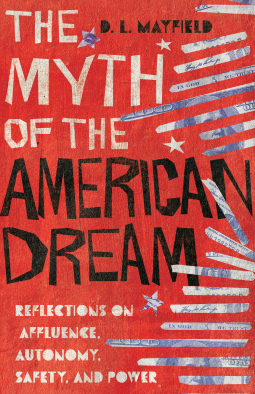
The Myth of the American Dream
Reflections on Affluence, Autonomy, Safety, and Power
This title was previously available on NetGalley and is now archived.
Send NetGalley books directly to your Kindle or Kindle app
1
To read on a Kindle or Kindle app, please add kindle@netgalley.com as an approved email address to receive files in your Amazon account. Click here for step-by-step instructions.
2
Also find your Kindle email address within your Amazon account, and enter it here.
Pub Date May 5 2020 | Archive Date Jul 15 2020
InterVarsity Press | IVP
Talking about this book? Use #TheMythoftheAmericanDream #NetGalley. More hashtag tips!
Description
>2020 ECPA Top Shelf Book Cover Award
Publishers Weekly starred review.
Affluence, autonomy, safety, and power. These are the central values of the American dream. But are they compatible with Jesus' command to love our neighbor as ourselves?
In essays grouped around these four values, D. L. Mayfield asks us to pay attention to the ways they shape our own choices, and the ways those choices affect our neighbors. Where did these values come from? How have they failed those on the edges of our society? And how can we disentangle ourselves from our culture's headlong pursuit of these values and live faithful lives of service to God and our neighbors?
Advance Praise
"Simply excellent! A wonderful mix of captivating personal experiences, biblical teaching, and probing structural analysis. Mayfield gently draws us in as she candidly shares her doubts and struggles, and she vigorously challenges us with her powerful summons to see and change systemic injustice. Unless the evangelical world begins to understand the fundamental critique of this book and truly repent and change, we do not deserve to continue to exist. A must read."
-Ron Sider, distinguished professor emeritus of theology, holistic ministry and public policy, Palmer Seminary at Eastern University, author of Rich Christians in an Age of Hunger
"In my work with immigrants to the US, I find most came in search of some combination of safety from persecution, opportunity to escape poverty, and freedom from oppression—all motivations consistent with the human flourishing that characterizes God's kingdom. In the US, however, these good desires that define many immigrants' 'American dream' have too often metastasized as we have turned safety, affluence, power, and autonomy into idols to be sought at all costs, even when—sometimes subconsciously—these pursuits have excluded others. D. L. Mayfield's beautifully written and provocative The Myth of the American Dream makes a compelling case that God's dream for the world is much grander than our culturally ingrained idols."
-Matthew Soerens, coauthor of Welcoming the Stranger, US director of church mobilization for World Relief
Available Editions
| EDITION | Other Format |
| ISBN | 9780830845989 |
| PRICE | $22.99 (USD) |
| PAGES | 192 |
Available to Buy
Buy on Amazon Buy on BN.com Buy on Bookshop.orgAverage rating from 22 members
Featured Reviews
 David S, Reviewer
Jesus "came to Nazareth, where He had been brought up; and as was His custom, He entered the synagogue on the Sabbath, and stood up to read. And the book of the prophet Isaiah was handed to Him. And He opened the book and found the place where it was written,
“The Spirit of the Lord is upon Me,
Because He anointed Me to preach the gospel to the poor.
He has sent Me to proclaim release to the captives,
And recovery of sight to the blind,
To set free those who are oppressed,
To proclaim the favorable year of the Lord.”
And He closed the book, gave it back to the attendant and sat down; and the eyes of all in the synagogue were fixed on Him. And He began to say to them, “Today this Scripture has been fulfilled in your hearing.”
Luke 4:16-21 [NASB]
This is the passage that D. L. Mayfield begins her book with. It speaks of flourishing for the poor, the captives, the blind, the oppressed, and the favorable year of the Lord (Jubilee). Throught out her book she weaves the fibers of the Biblical text and her experiences of trying to incarnate the texts in her daily life. She reflects on the difficulties stemming from being born of privilege, and the myths that come along with it. The end result is a beautifully woven narrative that reflects the Kingdom of God on Earth as it is in Heaven. The fabric though flawed in parts, due to our fallen state, still displays the beauty of human relationships in community and restorative justice as we pitch our tents in proximity, and action toward shalom with those many would refer to as "other".
She writes, "The only way to learn to both identify our longing for and live into shalom is by being in relationship to those who are the most affected by broken systems and broken relationships. Exiles, or the stranger or the foreigner, are a part of the triad of the vulnerable— including widows and orphans —that the Scriptures constantly tell the people of God to care for.
She asks two important questions to those who of us professing to be Christians. "Are we okay with the way our world works? Or do we long to see a different dream start to grow?"
Reading her book leaves you with the longing to "see a different dream" and "start to grow". To not be a part of constructing dividing walls, but tearing them down and be a part of reflecting the Kingdom of God on Earth as it is in Heaven.
Carl J, Reviewer
Hi, I'm Carl. I'm an American. I'm a Christian. I'm White. I'm male. Why is this important? Because it means that in "The Myth of the American Dream," by D.L. Mayfield steps on pretty much every toe I have and then manages to get a finger or two in there in the process. Mayfield's book is one that you'll likely either love or hate, but either way I would say it's one you need to read. Especially if you're someone a bit like me.
Mayfield tackles a number of of topics revolving around affluence, autonomy, safety, and power in the empire that is America which is never an easy topic. Thankfully, she does this with a both a needed bluntness and loving sense of grace through her own life and formation. Rather than pile on facts upon facts and bits of history on history (though that is all included as well), Mayfield takes you through bits of her own life and experiences that have helped up wake up to a few unfortunate truths that tend to come along with growing up as a White evangelical in America. At least for me, it seems a bit of a better approach for Mayfield to help guide you through some issues as more of a concerned friend who may only be slightly pushier about it than some of your high school friends who have suddenly contacted you about their newest MLM (that's meant in kindness and appreciation FYI), but it works better than perhaps a lofty and scholarly approach would.
Mayfield is a "boots on the ground" person as well which helps. Check out her first book as well and it doesn't take long to see that she's working to put her money where her mouth is, literally and figuratively. Again, the book has a lot added to it as you recognize that Mayfield is out there doing the work and that certainly adds to the credibility of the book.
I'd have to say *spoiler alert everyone* that my favorite part was the end, in which Mayfield mentions some of the work that others are doing that she knows. Yes, the fact that she talks about a tall man named Carl really caught my attention though it ended up not being about me, but she wraps up her Feeny-esque talks in a very Feeny way (yes, I'm writing this during the COVID-19 lockdown during which my wife has been watching a number of episodes of Boy Meets World while I type this) moving from a much stricter "talkin' to" to a much softer reminder of all the ways people really are making a difference in very normal ways we can all join into.
Without a doubt you will likely not see eye to eye with Mayfield on some topics. and you'll probably have some sore toes after reading it, but I would still say that just about any American at the least could greatly benefit from this book.
I received a copy of the book from Netgalley for free for an honest review.
 Faith H, Reviewer
D.L. Mayfield, author of the recent release The Myth of the American Dream, has a story that resonates with me and mirrors some of my own evolution in this area; to that end, I had some hesitance when I approached her book. Would I find it simply a rehashing of my own thoughts? That presumptuous attitude of mine was, thankfully, short-lived. I found this book a relevant, meaningful contribution to current dialogues.
Mayfield shows how our behaviors can evolve from being the generous benefactors to truly being in relationship with another. I recall how a church's vision for missions and outreach can often be in this uneven relationship, how the church is the one to give and the chosen countries/neighborhoods/schools are the ones to receive, an uneven balance that leaves most unchanged beyond the short term. I can feel self-aware as I reflect back on my own involvement in such ventures. How do we live out our faith in relevant ways, to admit areas we have come short, to push for improvement?
Mayfield has a friend who asks the question: "Who pays for our myths?" As she navigated what it means to acknowledge the privilege we have, as we reflect on what it would look like for justice to take place, for shalom to happen, we are changed. We may make sacrifices when we come alongside another, we may forego other's versions of safety or success, but we gain a truer understanding of what the world is, and what it could become.
The best compliment I can pay is that it felt like a conversation I have had with my friends, as we continue learning, continue being made aware of our assumptions and letting new information change us and urge us to act and to speak and to advocate for others so as to better live out our faith and our love for neighbor in the truest, most genuine sense.
(I received a digital ARC from InterVarsity Press via NetGalley in exchange for my honest review.)
 Brittany G, Reviewer
I was drawn to D.L. Mayfield’s writings because of her love of her neighbors, beautiful storytelling, and pursuit of truth. With that said, I loved the Myth of the American Dream. I feel like her writing and storytelling have really grown in this book and I was captivated by page one. She gently but truthfully pulls back the veil on what is the reality of the American Dream for so many. It’s an eye-opening, for the uninitiated, of systemic racism and classism that so many experience in the United States. It’s a timely message full of heart and the desire to shine the light on the lives of many in our midst. I didn’t agree with everything she said or even theologically land on the same page with her in some areas, but what’s the point of reading a book if you already agree with everything the author says? I loved the opportunity to be stretched in my worldview and examine my own heart for places I can let go of the “American Dream” so that my fellow immigrants, refugees, and other in generational poverty can rise up and experience the same “givens” I expect and want every day. I loved this quote about affluence from her book: “The antidote to affluence is not shame. It is, instead, thanksgiving. This is not a truth I learned on my own but one that has been revealed to me by my friends who excel in the duties of delight and gratitude and celebration, tempered by their very hard realities.”
Thank you for your perspective and voice, D.L.! It is much needed in a time like this. I would highly recommend this book to book clubs, men and women who want to expand their view of what IS the American Dream and what does Jesus have to say about it. Read it in a group, discuss it with your friends, your Bible study group. It’s well worth it!
Readers who liked this book also liked:








Andy Richter; Aaron Karo
Biographies & Memoirs, Entertainment & Pop Culture, Nonfiction (Adult)