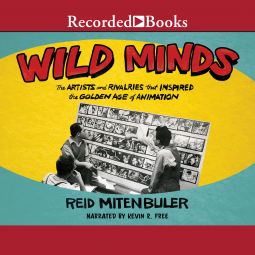
Wild Minds
The Artists and Rivalries That Inspired the Golden Age of Animation
with Kevin R. Free (Narrator)
This title was previously available on NetGalley and is now archived.
Send NetGalley books directly to your Kindle or Kindle app
1
To read on a Kindle or Kindle app, please add kindle@netgalley.com as an approved email address to receive files in your Amazon account. Click here for step-by-step instructions.
2
Also find your Kindle email address within your Amazon account, and enter it here.
Pub Date Dec 1 2020 | Archive Date Jan 22 2021
RB Media | Recorded Books

Talking about this book? Use #WildMinds #NetGalley. More hashtag tips!
Description
In 1911, the famed cartoonist Winsor McCay debuted an animated version of his popular newspaper strip, Little Nemo in Slumberland. Loosely inspired by Sigmund Freud’s research on
dreams, the film was one of the very first of its kind and astonishing for its time. McCay is largely forgotten today, but his work helped unleash the creative energy of animators like Otto Messmer, Max
Fleischer, Walt Disney, and Chuck Jones. Their origin stories, rivalries, and sheer genius, as Reid Mitenbuler skillfully relates, were as colorful and subversive as their creations—from Felix the Cat to
Bugs Bunny to feature films such as Fantasia—which became an integral part of American culture over the next five decades.
Before television, animated cartoons were often “little hand grenades of social and political satire” aimed squarely at adults as preludes to movies. Early Betty Boop cartoons included nudity.
Popeye stories slyly criticized the injustices of unchecked capitalism. Wile E. Coyote and the Road Runner were used to explore hidden depths of the American psyche. “During its first half-century,”
Mitenbuler writes, “animation was an important part of the culture wars about free speech, censorship, the appropriate boundaries of humor, and the influence of art and media on society.” During WWII
it also played a significant role in propaganda. The golden age of animation ended with the advent of television when cartoons were sanitized to appeal to a growing demographic of children and help advertisers sell sugary breakfast cereals.
Alongside these stories, Mitenbuler incorporates the surprising contributions of Theodor Geisel (Dr. Seuss), voice artist Mel Blanc, composer Leopold Stokowski, and many others whose talents
enriched the world of animation. Wild Minds is an ode to our lively past and to the creative energy that would inspire The Simpsons, South Park, and BoJack Horseman today.
Advance Praise
“Entertaining history of early cartoon animation. Demonstrating impassioned research and technical know-how, Mitenbuler presents a series of historical anecdotes that, sequenced together, bring to life one of the world’s most beloved art forms . . . The narrative crackles with captivating charm, adding color and nuance to a cast of familiar cartoon faces . . . Like a one-man animation department, [Mitenbuler] effortlessly renders both celluloid and background. A finely drawn history of a critical period in the history of animation.” —Kirkus Reviews (starred review)
“Journalist Mitenbuler casts the creators of animated cartoons as characters themselves in this rollicking history of the first 50 years of animation . . . In snappy prose, Mitenbuler writes a history rich with personalities. This Technicolor tour de force is impossible to put down.” —Publishers Weekly (starred review)
“While animation is often considered a children’s medium, its early days were filled with social commentary, sexuality, satire, and countless creative and financial battles . . . An entertaining and revealing look into the dawn of a revolutionary art form.” —Library Journal
Available Editions
| EDITION | Other Format, Unabridged |
| ISBN | 9781705008751 |
| PRICE | $34.99 (USD) |
| DURATION | 13 Hours, 43 Minutes |
Available to Buy
Buy on Audible Buy on Kobo Buy on Libro.fmAverage rating from 5 members
Readers who liked this book also liked:
Marie Bostwick
Historical Fiction, Literary Fiction, Women's Fiction


Sheila Roberts
General Fiction (Adult), Romance, Women's Fiction




Created by Hayao Miyazaki
Comics, Graphic Novels, Manga, Sci Fi & Fantasy