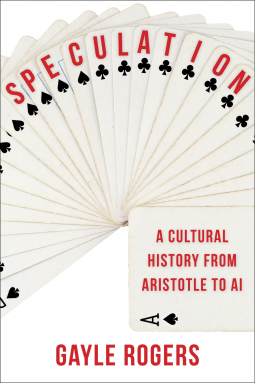
Speculation
A Cultural History from Aristotle to AI
This title was previously available on NetGalley and is now archived.
Send NetGalley books directly to your Kindle or Kindle app
1
To read on a Kindle or Kindle app, please add kindle@netgalley.com as an approved email address to receive files in your Amazon account. Click here for step-by-step instructions.
2
Also find your Kindle email address within your Amazon account, and enter it here.
Pub Date Jul 6 2021 | Archive Date Oct 13 2021
Talking about this book? Use #Speculation #NetGalley. More hashtag tips!
Description
In this cultural, literary, and intellectual history, Gayle Rogers traces debates over speculation from antiquity to the present. Celebrated by Boethius as the height of humanity’s mental powers but denigrated as sinful by John Calvin, speculation eventually became central to the scientific revolution’s new methods of seeing the natural world. In the nineteenth century, writers such as Jane Austen used the concept to diagnose the marriage market, redefining speculation for the purpose of social critique. Speculation fueled the development of modern capitalism, spurring booms, busts, and bubbles, and recently artificial intelligence has automated the speculation previously done by humans, with uncertain and troubling consequences. Unraveling these histories and many other disputes, Rogers argues that what has always been at stake in arguments over speculation, and why it so often appears so threatening, is the authority to produce and control knowledge about the future.
Recasting centuries of contests over the power to anticipate tomorrow, this book reveals the crucial role speculation has played in how we create—and potentially destroy—the future.
Advance Praise
"Speculation is at once an erudite study of the long history of a single term and a timely, entertaining read about the way words can reshape the relationship between ideas."
—Sophia Rosenfeld, author of Common Sense: A Political History
Available Editions
| EDITION | Other Format |
| ISBN | 9780231200219 |
| PRICE | $30.00 (USD) |
Available to Buy
Buy on Amazon Buy on BN.com Buy on Bookshop.orgAverage rating from 4 members
Featured Reviews
 Sayani S, Reviewer
Speculation
A Cultural History from Aristotle to AI
Gayle Rogers
Publisher: Columbia University Press
Pub Date: July 2021
ISBN: 9780231200219
288 pages
**This is an ARC provided by NetGalley for book reviews.**
Speculation is a natural history of intellectual, scientific, and financial speculation practices from ancient Greek thinking to modern-day AI. Professor Gayle Rogers combines an eclectic mix of literary, cultural, political, and intellectual history to capture the tumultuous rise of this hypothetical gamble on prospects and speculative ventures.
It begins with a careful distinction between the Latin words "speculum" (a mirror or a reflecting surface) and "specula" (watchtower) which Augustine brings about in his theological works. A mirror is a symbol of inward contemplation whereas, a watchtower is a symbol to look outward, into the unknown future from which speculation derived its current meaning in our modern world. This etymological distinction is carried forward by Boethius. He reconciled Aristotle's views about the superiority of a theoretical life over the practical one. Boethius's translations of Aristotle's works were transmitted throughout the Latin West till the 1500s. These translations contained the words "theoria" translated into "speculatio". Readers will enjoy this fascinating etymological whodunnit through the wonders of translations going back and forth between Latin and Greek. It shows how powerful language can be in shaping the course of any intellectual phenomenon. Perhaps the whole crux of this book lies in its first chapter.
From the medieval synthesis of philosophical and theological "speculatio" in Latin, the word "speculation" finally arrived in English through Chaucer's writings. But soon speculation turned into a negative form of idle, sinful, abstract thinking through the works of John Calvin in the 16th century and popularized by various Reformation movements across Europe. Only did it recover its reputation at the start of the scientific revolution, championed by Francis Bacon, who reclaimed the dignity of quiet contemplation in the formation of the scientific thought process. Here, once again, the discourse of language plays a significant role in spearheading the rise of modern science. Yes, Newton, Darwin, Boyle, Priestley, and many more experimental scientists and naturalists make their appearance. This particular text provides an insight into the formation of the scientific method in its earliest form.
The reader now ventures into the new world of financial speculation which rose side-by-side with the scientific revolution when "speculative" economic practices arrived in England via the lush and vibrant markets of Amsterdam. New modes of "imaginary" money in form of stocks, credits made people richer overnight without the accumulation of any material assets. This novel rise of bankers, stock investors, money speculators found their harshest critics in the likes of Daniel Defoe (to my surprise) and Jonathan Swift's Gulliver's Travels. By the year 1776, Adam Smith weaved "speculation" in The Wealth of Nations as a crucial point in the theory of capitalism. Smith formulates the importance of projections and speculation in any new practice of commerce. Accumulation of wealth through insurance and gambling practices were finally taking footholds in this new capitalism.
The most interesting and relatable chapter in the book is the speculation that brought the existence of America itself. By this point, we are presented with a well-known history of the early Puritan colonists, their penchant for land speculation, debt schemes, unstable credit schemes, which ultimately leads to the event of the Declaration of Independence. Christopher Columbus and George Washington put their hopes in a grand scheme of future speculation and gambled on the great project of new land and nation. A political emergence of the United States based on speculative practices is a fresh take on the nation's history. Follow the money as they say.
The book concludes with a touch-and-go account about machines and their ability to speculate. I expected a bit more on this subject but the book lacks an in-depth account barring the mention of Turing and Lovelace-Babbage. Modern financial markets are run on elaborate algorithms. Machines are already enmeshed to create future projections and execute trades and they learn better every day. Every simulation makes way for a better way to speculate. But whether can machines think rather than speculate is something yet to unfold in the future.
Any reader interested in a different conceptual introduction in the history of economics may take up this book. Equally enjoyable for language and philosophy enthusiasts.
 Louise W, Reviewer
“State your assumptions” is the advice my accountant husband gives me regularly “then you can’t be wrong”. In ‘Speculation: A Cultural History From Aristotle to AI’ by Gayle Rogers, English Prof. University of Pittsburgh, the author asks why, in the modern world, do we still resort to speculation?
Gayle uses cultural defences to show that we have never stopped speculating and we constantly project what tomorrow will be like - it’s human nature. What has always been at stake is the authority to produce and control knowledge about the future - which of course we can’t do.
The book is chock full of historical and cultural references to risk, prediction, gambling, chance - it’s a fascinating social history from early classical times to Shakespeare to Austen. It’s all in there and we can conclude no more than that speculation and the risks it involves is seduction and we are only human with all the weaknesses and failings this involves.