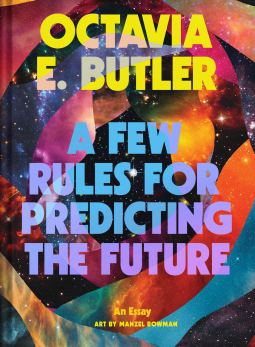
A Few Rules for Predicting the Future
An Essay
This title was previously available on NetGalley and is now archived.
Send NetGalley books directly to your Kindle or Kindle app
1
To read on a Kindle or Kindle app, please add kindle@netgalley.com as an approved email address to receive files in your Amazon account. Click here for step-by-step instructions.
2
Also find your Kindle email address within your Amazon account, and enter it here.
Pub Date Jun 18 2024 | Archive Date Jun 10 2024
Talking about this book? Use #AFewRulesforPredictingtheFuture #NetGalley. More hashtag tips!
Description
Originally published in Essence magazine in the year 2000, Octavia E. Butler’s essay “A Few Rules for Predicting the Future” offers an honest look into the inspiration behind her science fiction novels and the importance of studying history and taking responsibility for our actions if we are to move forward.
Organized into four main rules, this short essay reminds readers to learn from the past, respect the law of consequences, be aware of their perspectives, and count on the surprises. Citing the warning signs of fascism, the illusive effects of fear and wishful thinking, and the unpredictable nature of what is yet to come, Butler shares realistic but hopeful suggestions to shape our future into something good. An inspiring and motivational gift for students and recent graduates, fans of Butler's work, and anyone seeking a brighter day tomorrow, this exquisite gift book includes stunning Afrofuturist artwork by Manzel Bowman alongside the full text of the original essay.LITERARY ICON: Octavia E. Butler was a pioneering science fiction writer whose novels, written decades ago, remain eerily relevant, reflecting on themes of racial injustice, women’s rights, environmental collapse, and political corruption. In 1995, she became the first science fiction author to win a MacArthur Genius grant, and her books are taught in over 200 colleges and universities nationwide. This book shares Butler's timely but lesser-known essay and is a must-read for fans of her classic sci-fi works.
CELEBRATE BLACK CREATORS: This book spotlights one of the greatest authors of Afrofuturism, a genre and philosophy that explores and reimagines Black culture, creativity, and liberation through fiction, art, music, film, and other media. Octavia E. Butler’s forward-thinking essay is paired with contemporary illustrations by Manzel Bowman, whose evocative images are also inspired by Afrofuturist visions.
INSPIRING GIFT: A unique gift for students, recent graduates, and anyone celebrating life milestones or looking forward in life, this beautifully designed hardcover book is sure to inspire. Octavia E. Butler’s essay is also an important, evergreen reminder for writers, creatives, dreamers, and activists who want to envision and work toward a brighter future.Perfect for:
- Fans of Octavia Butler and her novels, including Kindred and Parable of the Sower
- People interested in nonfiction and essays by Black women writers
- Afrofuturism lovers and social justice-minded sci-fi readers
- Literary bibliophiles looking for a stunning new addition to their bookshelf
- Gift-giving to graduating high school and college students
- Activists and community leaders
- Inspirational essay readers
- Fans of Manzel Bowman and Afrofuturist art
Available Editions
| EDITION | Other Format |
| ISBN | 9781797229058 |
| PRICE | $14.95 (USD) |
Available on NetGalley
Available to Buy
Buy on Amazon Buy on BN.com Buy on Bookshop.orgAverage rating from 142 members
Featured Reviews
 Mara L, Reviewer
Such a gorgeous book for the Octavia Butler fan! The artwork is gorgeous and vibrant and I loved reading Butler's words. She was such a genius and icon. This would make a fantastic gift for the sci-fi enthusiast.
Thank you NetGalley and the publisher for providing this ARC. All thoughts are my own.
 Reviewer 1101542
This was a thought provoking essay that is a very fast read but with ideas best left to simmer.
The essay is broken into a few parts with 4 different messages all relating to “A Few Rules for Predicting the Future”, they are to: learn from the past, respect the law or consequences, be aware of your perspective, and count on the surprises. Octavia then goes on to elaborate more about each of these. The major takeaway from the essay is that predicting the future helps us best determine how to guide our future and that predicting the future, as Octavia did, is best done as an act of hope.
There are also a couple of pieces of beautiful artwork throughout the essay.
Thank you to Netgalley and the publishers for the arc that I read.
 Chloe F, Reviewer
This is a single essay, turned into a book with art.
I love the art in here, it's gorgeous and colorful. However, I'm slightly disappointed by the lack of content in this book. It's a essay that is pretty short, stretched into many pages through large font. It feels more pamphlet-size than book-size.
If you're buying this, you're buying it for the art. To have this beautiful volume in your hands. However, it's not an art book either. It's has a handful of beautiful spreads, but it isn't full of art.
The words are beautiful. The art is beautiful. I'm just not sure that it justifies its price tag.
 Peony P, Reviewer
It's a thoughtful essay by the inimitable Octavia Butler, and illustrations are beautiful, but I am not sure it needs to be a book on its own? I found the font really hard on the eyes, and the chosen format of framing a paragraph in the middle of the page a little too close to "live love laugh" kind of pamphlets... I would have dearly loved for this to be a collection of her essays instead.
Librarian 1195998
A beautiful edition of Butler’s 2000 essay, complete with vivid artwork and reflection by the author on her work and history throughout the years. A good reminder to reread Sower and Talents again.
 Lisa D, Reviewer
This is a tiny, beautiful book not just about how to predict the future but why. The ideas are succinct and inspiring. Maybe it's too late to save the world, but this is the kind of thinking that would help us make the changes we need. Thanks to NetGalley for letting me read this
Reviewer 1008516
A Few Rules for Predicting the Future is a very short collection of essays by the most amazing Octavia E. Butler. As I quickly read through each of the essays, they are not meant to tell a full blown lavish story, but a small, mind stimulating piece of information. In a time like this, it’s amazing this is going to be published. It discusses the manipulation of words, the forgetting of history, and the ignorance of people. I think all readers should read this or something similar. Thank you NetGalley and the publishers for providing me with an ARC!
 Plots a, Reviewer
All that you touch
You Change
All that you Change
Changes you
The only lasting truth
Is Change
God
Is Change
______________________________________________
As a former history major who would spend every waking minute reading if she could, I knew this essay was for me! I’m fascinated by the cross-section of history and story; how the two intersect, and how the truth of the past might infiltrate our fiction and remain truthful still.
I must admit that I haven’t read any Octavia Butler, though Kindred has been on my TBR for a while now. This tiny volume ensured that I will pick up more of her work sooner rather than later.
A Few Rules for Predicting the Future, a topical essay in 2000 and now, tackles the pervading sentiment of the times: why even try to predict (and shape) the future if, as Butler puts it: “... there are always surprises. The only safe prediction is that there always will be”? Butler says that there is no one answer to the problems that lie ahead. Instead “there are thousands of answers - at least. You can be one of them if you choose to be.”
Another of Butler’s insights comes when she offers us the double-edged sword that the way things are now are not what they always have been, and most certainly are not what they always will be. We cannot allow the mood of the times to impact our hope (or lack of) in the future.
I knocked off one star on this review because, though Butler’s words were soothing, I only appreciated the essay because I’d already come to all the same conclusions of my own accord some time ago. I’m not sure that this handful of pages has quite the power to persuade somebody of the importance of (history) education, or to motivate someone to keep the faith in the fight for humanity. Regardless, I appreciated the essay for the comfort it provided.
 Shannon O, Reviewer
One of my favorite things about Netgalley is that sometimes you unexpectedly stumble across gems by authors you admire. While scrolling through newly added books, I came across this essay from Ms. Butler being republished and accompanied by absolutely stunning artwork. If you are on Netgalley, it's so worth hitting the request button! If you aren't, that's okay, this little book of art and wisdom comes out this spring - April 16, 2024.
The essay itself is so on point for what our world faces today, despite being published over 20 years ago. Of course it is - we are talking about one of the most visionary writers in the modern era. It succinctly provides realistic advice for thinking about the future, demanding that we look to the past and reckon with the consequences of our society's decisions. There is hope too - the unpredictable forces colliding with our consequences. Maybe we, too, can become the change that's needed.
This is definitely meant to be experienced as a hardcopy. Reading the e-book was great, but I can't wait to see how the illustrations look on a page I can hold and touch.
Thank you, Chronicle Books and Netgalley, for the DRC in exchange for my honest review.
 Laurel S, Reviewer
Octavia Butler's nonfiction writing always stop and make me think as I read. She's known for her fiction, but the thought and meaning she intentionally weaves into all her reading is stunning. Her essay here remains timely as she lays out why we attempt to predict the future and reminds us of hope even when it is hard to do so.
This specific printing of the essay is accompanied by gorgeous artwork. This would make a beautiful gift to any Butler fan or a wonderful introduction to Butler's nonfiction writing for any reader. I highly recommend any science fiction fan diving more into Butler's words.
 Marion C, Reviewer
Really loved the design of the book and the images included in it. One thing on that aspect is that the font is quite hard to read especially on a screen. The font would be a deal breaker for me. Otherwise I really enjoyed the essay and the message of hope it gives on understanding our past and predicting our future. I really enjoy Octavia E. Butler’s writing. I will definitely read more of her work. This book will be a great gift to someone who loves speculative fiction and science fiction or just a fan of Octavia E. Butler.
 Maya J, Reviewer
A Few Rules for Predicting the Future: An Essay is a short essay and new book by Octavia E. Butler accompanied with beautiful artwork by Manzel Bowman. This is an older essay by Octavia Butler that was republished in this book and it's about how and why we as people predict the future. Butler uses references to her books "Parable of the Sower" and "Parable of the Talents" when discussing examples of how to predict the future. She also uses real world examples like The Space Race and The Cold War.
Overall this was a really pleasant reading experience and this essay seems very relevant when viewing today's world issues. I'm giving this 4 out of 5 stars.
⭐️⭐️⭐️⭐️ 4/5 Stars
Thank you to NetGalley and the publisher for the arc (advanced readers copy).
 Hannah B, Reviewer
Octavia E. Butler's "A Few Rules for Predicting the Future" is a powerful essay. It's a must-read for lovers of Butler's work, for readers of speculative fiction, and for those concerned with the future of our world. Butler's essay outlines several rules that individuals can follow if they want to predict what will likely happen in the future and what horrors we can expect in the future. Butler, an expert in speculative and science fiction, remains practical and optimistic when discussing the future. This hopeful attitude is so refreshing, especially from someone who had such a profound impact on the SFF community.
However, this edition of the essay from Chronicle Books is far more than just Butler's essay. The beautiful artwork in the book, the colorful pages blank pages, and the perfectly selected fonts used make this book a superb coffee table book or graduation gift. The cover is gorgeous, as are the absolutely breathtaking full-page Afrofuturist art prints by Manzel Bowman that fill this book. I highly recommend this book for the Octavia E. Butler lover in your life, especially if that's you.
Full blog review to come closer to the review date.
Sophia N, Reviewer
I love Octavia E. Butler, and her work is something I think we should all always return to. This essay is beautifully crafted, and the editions of artwork made it even more powerful. This essay is an important reminder that we can be part of new imaginations of the future, and that there can be joy and hope, but we also need to pay attention to history and to current horrors. Incredibly resonant not just in the context she wrote it, but especially today.
 Anne E, Reviewer
This beautifully illustrated book is so lovely for gifting. Octavia Butler, master of forward-reaching sci-fi gives four areas of hope for looking ahead, perfect for new grads, youth, and anyone who needs some inspiration.
I'm so thankful to have read this and will reach for it again when I'm feeling uncertain about the future.
Reviewer 1282384
This is a fantastic essay by Octavia Butler that like everything from her that I have read, has very relevant takeaways for our current time. In this she talks about the idea that predicting the future is a hopeful act, that she researches history and regimes of the past to see how the problems in present day could grow to become worse. This was a wonderful reminder to know and read history as a warning for the present and future.
Reviewer 531556
An intelligent and succinct essay that remains apt for the current times. Butler draws attention to the importance of studying the past while also cautioning against both optimism and pessimism for predicting the future. Overall, the essay retains a message of hope that I really appreciate. I enjoyed the one Octavia Butler novel I've read immensely and this essay made me want to pick up more of her works.
Reviewer 1177912
A very short book packed with wisdom in the form of an essay by the legendary sci-fi author Octavia E. Butler. There are beautiful colorful illustrations that I’m sure would look even more stunning in physical format.
 Justin E, Educator
A brilliant, pithy essay on the difficulties of predicting the future and why it matters. Buter writes with great clarity and hope using her experience as an author to navigate the perils of prediction. A great essay. Butler can say in a few paragraphs what it takes others to say in a book.
Edie C, Reviewer
Octavia E. Butler's words are accompanied by amazing artwork in this gift book - ready to inspire anyone stepping out into the future. The perfect graduation gift for the young person who understands how problematic the go-to from Dr. Seuss is. Present this to anyone about to embark on an adventure. Butler continues to prod us with insight which holds up decades later. The artwork enhances the words and feeds the imagination. Thank you to Chronicle Books and NetGalley for the chance to preview this eARC.
 Erin H, Reviewer
T
T
The wise words of science fiction icon Octavia E. Butler live on in this beautiful and giftable little volume.
“There’s no single answer that will solve all our future problems. There’s no magic bullet. Instead there are thousands of answers—at least. You can be one of them if you choose to be.”
Originally published in Essence magazine in the year 2000, Octavia E. Butler’s essay “A Few Rules for Predicting the Future” offers an honest look into the inspiration behind her science fiction novels and the importance of studying history and taking responsibility for our actions if we are to move forward.
Organized into four main rules, this short essay reminds readers to learn from the past, respect the law of consequences, be aware of their perspectives, and count on the surprises. Citing the warning signs of fascism, the illusive effects of fear and wishful thinking, and the unpredictable nature of what is yet to come, Butler shares realistic but hopeful suggestions to shape our future into something good. An inspiring and motivational gift for students and recent graduates, fans of Butler's work, and anyone seeking a brighter day tomorrow, this exquisite gift book includes stunning Afrofuturist artwork by Manzel Bowman alongside the full text of the original essay.
Review:
If you weren't able to collect this essay when it appeared in Essence, here is your opportunity to keep it to review-complete with beautiful artwork.
 Marissa C, Reviewer
I have yet to read Octavia Butler, but had a minute to read this essay. I love when she said that tomorrow is the child of today. I respect that she really seems to lay serious groundwork for her stories (though, she probably wouldn't be such a great author if it was otherwise).
This book would be a beautiful gift for the history, sci-fi, or Butler buff. Half of the book was artwork, making this a quick read that would look awesome displayed on any shelf. And, of course, Butler's words of wisdom will ring true at any stage of our human existence.
Abriyah W, Reviewer
Love everything that had to do with Mrs butler. She’s a visionary and should be remembered as such. This is another extension of her art. I loved it.
 Emma N, Reviewer
This is a beautiful and compact book that would make a great gift to children or teenagers. I want to buy a hard copy!
Katie S, Reviewer
Octavia Butler's "A Few Rules for Predicting the Future" is a wonderful, accessible volume of knowledge that beautifully expands of her groundbreaking work in "The Parable of the Sower" and "The Parable of the Talents." She describes three rules that helped guide her thinking in development of her work: Learn from the past; Respect the law of consequences; Be aware of your perspective; Count on the surprises. Each are followed by Butler's insight from her personal and political life, and ultimately reminds us of the responsibility we have to do our best to shape our futures into something good and worthy of our future children. The volume is also accompanied by beautiful artwork that flows seamlessly with the beauty of Butler's insights. A beautiful work I highly recommend.
Chad C, Librarian
I am huge Octavia Butler fan. The essay reprinted here is full of Octavia's insight and philosophy. It's a good essay and gives you a lot to think about.
The essay is interspersed with art pieces inspired by the text. The art is good, but I didn't feel it connected enough with the essay. I would have liked to see more interaction between the two.
 Megan C, Reviewer
I'm a big Octavia Butler fan, but I'd never heard of her essay. She elaborates on the idea that if we don't pay attention to history, we are doomed to repeat it, while also instilling a sense of hope and purpose into why writing speculative fiction grounded in past patterns matters. The essay is paired with vibrant collage art and makes for a very short but beautiful book for any Octavia Butler completionist.
Amanda W, Reviewer
Octavia Butler's essay is as observant and wise as I've come to expect of her.
The illustrations look like a beginner's attempt to use photoshop and detract from the essay. Manzel Bowman's collages do not suit this or really any of Butler's works.
Received via NetGalley.
 Caralee D, Reviewer
I stumbled upon this little gem of wisdom and art through sheer serendipity while scrolling through Netgalley. Visionary science fiction writer Octavia E. Butler is known for disquietingly realistic and plausible glimpses of dystopian near futures as trajectories of our current paths. In this short but eloquent and prescient essay, first published in 2000, the author discusses how the past and present sow the seeds of the future, the importance of looking forward to potential futures to chart a better course. Her observations are insightful and empowering, and timelessly relevant.
"There is no single answer that will solve all of our future problems. There's no magic bullet. Instead there are thousands of answers - at least. You can be one of them if you choose to be."
I'm a great admirer of Octavia E. Butler's work, and I loved this short but brilliant book. It's wise and hopeful, and beautifully illustrated by Manzel Bowman. This would make a perfect gift.
Many thanks to Chronicle Books and to Netgalley for providing me with a free advance reader copy of the book in exchange for my honest review. All opinions expressed are my own.
Reviewer 1084098
“There’s no single answer that will solve all our future problems. There’s no magic bullet. Instead, there are thousands of answers—at least. You can be one of them if you choose to be.”
Superb as always, Octavia Butler should be required reading in every high school in the country.
Marissa F, Reviewer
Short book with beautiful illustrations. Text is only on half the pages, and it's straightforward and conversational. A very quick read and although Butler references her previous books, you can appreciate this one without having read them.
I appreciate NetGalley and the publisher for providing a digital ARC. My honest review is my own opinion.
 Mysia P, Reviewer
Octavia Butler is one of the authors that brought me to love reading. Her writing style is so approachable, yet developed in a way that you know you will learn something. This reigns true even in this short essay. Butler drops many gems to educate the reader on the power of the thought, her writing and creative process, and the importance of predicting what it is to come, even when it is not as black and white as it seems. The art alongside this essay is stunning and I could easily see this being an amazing conversation starter or coffee table book in my home.
 Chantaal A, Reviewer
Octavia Butler's short essay is presented here in a book that's more akin to coffee table art, than a way to present her old words for a new generation.
When I first tried reading Parable of the Sower last year, I had to put it down and ultimately DNF it. The violence and apathy and overall world Butler imagined in that book felt much too close to reality and ultimately I couldn't handle it. After reading this short essay, it's easy to understand how she wrote such a creepily prescient work in the 90s - essentially, she studied history to be able to extrapolate where our future could go, and guess what? She wasn't too far off base. Scarily so.
The artwork in this short book is beautiful, but it feels like it dilutes the message of the essay. The way the paragraphs are broken up by pages of art feels like it takes away from the overall message because it keeps breaking it up and not in a way that feels organic.
Ultimately, this IS a good essay, and I'm glad that there will be a new volume like this to bring it back into light for new readers to discover. It'll certainly make for a beautiful display book for Butler fans.
Thanks to NetGalley and Chronicle Books for the opportunity to read and review this. The book will be available April 16, 2024.
 Cat D, Reviewer
Octavia E. Butler's essay is especially meaningful to me as it brings up memories of having read her novel Kindred in high school. In many ways, her essay reasserts many of the themes explored in Kindred. Butler intertwines elements of science fiction like time travel with an examination of history, human nature, and societal dynamics. Her emphasis on learning from the past for predictions of the future aligns with the exigence of Kindred.
What stuck out the most to me is the observation that predictions often arise from moments of sadness, worry, or fear, challenging the notion of purely analytical forecasting. In doing so, she encourages readers to view predictions as a means to step back and assess the world in a more compassionate manner.
Thank you NetGalley for providing me with a free advance reader copy of the book in exchange for my honest review.
 Yessa H, Book Trade Professional
Beautiful thought provoking essay accompanied with equally breathtaking illustrations. A wonderful little book to behold and to proudly display in one's bookshelf.
Bookseller 640192
So, I have never read the work of Octavia Butler & was interested in trying her stuff, but I wanted a gentle entry. This title, "A Few Rules for Predicting the Future" an essay & quick read, met that requirement. I enjoyed it & will now be looking into more of Ms. Butler's titles. My sincere thanks to NetGalley & the publisher for the "read now" complimentary DRC, my pleasure to review it.
 Kelly C, Reviewer
The illustrations in this copy are absolutely stunning. This is the kind of book you can use as a coffee table book and conversation starter.
How can one little essay have so many highlights? Octavia Butler somehow has a way of writing about massive topics in such a beautifully concise way. I had several highlighted sections throughout this essay but my favorite is:
“Moral: Wishful thinking is no more
help in predicting the future than fear,
superstition or depression.”
 Hannah F, Bookseller
Who am I to give feedback on the work of a literary giant like Octavia Butler? I was introduced to her work a few years ago and promptly read through the majority of her works. I think Octavia Butler is as wise as she is creative and I greatly admire her work.
A Few Rules for Predicting the Future is a five star read for me. It's brief, but thoughtful and insightful. I do think this will be even better in print when it becomes available. I am so grateful to NetGalley for granting me early access to this important essay.
 Maileen H, Reviewer
Octavia E. Butler is the seer of our generation, those born during the 1970s and 1980s. During this time, the United States was unraveling from the heavy weight of its global imperialist and nuclear ambitions, with Americans living in constant terror of others, both internal and external enemies. Through the dystopian novels "Parable of the Sower" (1993) and "Parable of the Talents" (1998), she brought to light the impending doom brought on by racism and classism.
The compact volume featuring Butler’s 2000 essay "A Few Rules for Predicting the Future" offers a peek into the seer’s process for imagining worlds that eerily mirror our present realities. In the essay, Butler discusses the importance of knowing history to understand present-day crises, such as the rise of fascism. In “Parable of the Talents,” Butler prophesied the election of a despot who gained popularity by declaring that he could “Make America Great Again.” Every action yields a consequence: What we do in the here and now produces what will come next.
“To study history is to study humanity.” Butler’s words are as poignant today as they were when they were first written. This book would make a great addition to any science fiction library. I reviewed the digital copy and was thoroughly impressed by Manzel Bowman’s art. Bowman interprets the aesthetics of the worlds that Butler has built, showcasing birth and decay, dissolution and emergence.
Reviewer 772461
This was a solid essay that posed interesting ideas about the future. I wouldn't say that this essay changed how I was thinking in some mind-blowing way, but it was thought-provoking which is what I was hoping for.
Reviewer 867835
Octavia Butler is the freaking GOAT and I'm so stoked to see this essay of hers treated with the RESPECT that it DESERVES. Okay, enough all-caps.
I may be biased, but this essay encapsulates how much Butler has done for the genre of sci-fi and illustrates how intimately our politics are reflected in what and how we read. On predicting the future, Butler writes: "[...] making predictions is one way to give warning when we see ourselves drifting in dangerous directions. Because prediction is a useful way of pointing out safer, wiser courses."
Reading has always been a way to expand my horizons and challenge what I know, and I'm not alone in this! I hope more folks pick up Butler's work because of this text.
Educator 549554
Gorgeous artwork accompanies a timely essay by the brilliant Octavia E Butler. Her words of wisdom ring true just as much today as when she wrote them. The artwork is incredible, I can't wait to purchase this as a hardcover because it's such a work of art accompanying profound words.
Reviewer 1021825
This is such a timely read. The illustrations are thought provoking. I feel that in the world's current state Butler's words speak to them in a prolific way even in a writing that was originally published over 20 years ago. I can only imagine what Butler would have to say about what is happening in our world today.
The passage about the child not knowing what Nazis were and the student who never feared nuclear war strike a chord over 70 days into an active genocide of the Palestinian people.
This is a great essay and I think everyone should take heed of Butler's words.
Emma G, Reviewer
Thank you to NetGalley for the free ARC.
This is a short essay by Butler. It is both advice for aspiring authors and a discussion on the hopeless of predicting the future, and yet striving to be hopeful and to keep working to improve any current or future situation.
The design is done well. The font is rather large. The artwork is done well and fits the mood of the piece,
Her writing on the misrepresentation of her thoughts on hope for the future was something that has stuck with me.
 Jamie H, Reviewer
Did this *need* to be a book? No. Is it good to have more of Octavia Butler’s words in the world? Yes, always. Beautiful art and powerful words in this (very short) essay, that’s good enough for me.
Librarian 1280192
Octavia Butler is a fantastic writer! I enjoyed this essay and I enjoyed the pictures that were mixed in with the writing.
Reviewer 1206814
I'm definitely a fan of Octavia Butler, and of course, the title drew me in. It was like hearing from Octavia from beyond the grave.
 Words, Images, Worlds (, Reviewer
Fascinating world building and reflection from a master of creative voice. This book could function as an introduction to this author or a reading companion.
 Malea J, Reviewer
Octavia E. Butler's work is, as always, grounded and accessible with the spark of inherent talent that makes a reader trust what she has to say. The imagery accompanying the writing was simply beautiful and connected with the energy often found in Butler's fiction writing.
The images, however, create a disjointed reading of the book in its electronic form. They add the necessary length to make this sellable as a book, and will undoubtedly be breathtaking in printed form, but are a bit irritating when reading. Now whether this is an inherent issue with the book or simply the consequences of reading a digitized copy remains to be seen, but arguably in this age of digital accessibility, a book should be designed or if necessary redesigned to offer an immersive experience on digital systems as well as in print.
Thank you to NetGalley and Chronicle Books for the ARC.
Readers who liked this book also liked:

CLAMP
Comics, Graphic Novels, Manga, Sci Fi & Fantasy, Teens & YA
Emily W. King, PhD
Nonfiction (Adult), Parenting, Families, Relationships, Reference
Veronica Agard
Multicultural Interest, Nonfiction (Adult), Religion & Spirituality
E. Sofia Mendoza; Lisa Bolden; Lizbeth Gaona
Nonfiction (Adult), Parenting, Families, Relationships, Self-Help