Please wait... This may take a moment.
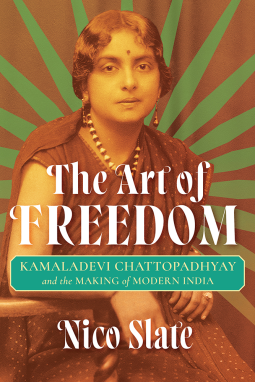
The Art of Freedom
Kamaladevi Chattopadhyay and the Making of Modern India
This title was previously available on NetGalley and is now archived.
Pub Date
Apr 30 2024
| Archive Date
Oct 31 2024
Description
Kamaladevi Chattopadhyay (1903–1988) was a prominent socialist, anticolonial and antiracist activist, champion of women’s rights, and advocate for the arts and crafts. Defying the borders of gender, nation, and race, her efforts spanned social movements and played a leading role in the creation of modern India and the development of the Global South. In The Art of Freedom, Nico Slate showcases new archival materials to document Kamaladevi’s campaign to become the first woman elected to provincial office; her confrontation with Gandhi that helped open the salt march of 1930 to women; her leadership of the All India Women’s Conference and the Congress Socialist Party; her pioneering work with refugees during the Partition of India in 1947; the major impact she had on the arts in postcolonial India; and her own career on the stage and screen. Slate also draws upon underexplored details from her personal life, providing new context for her experiences as a child widow, her remarriage to the mercurial actor/poet Harin Chattopadhyay, and her divorce (among the first civil divorces in modern India). Taken as a whole, Kamaladevi’s life offers a uniquely revealing vantage point on the making of modern India—a vantage point that centers the interconnections between struggles often seen as distinct, and that reminds us of the full promise of Indian democracy.
Kamaladevi Chattopadhyay (1903–1988) was a prominent socialist, anticolonial and antiracist activist, champion of women’s rights, and advocate for the arts and crafts. Defying the borders of gender...
Description
Kamaladevi Chattopadhyay (1903–1988) was a prominent socialist, anticolonial and antiracist activist, champion of women’s rights, and advocate for the arts and crafts. Defying the borders of gender, nation, and race, her efforts spanned social movements and played a leading role in the creation of modern India and the development of the Global South. In The Art of Freedom, Nico Slate showcases new archival materials to document Kamaladevi’s campaign to become the first woman elected to provincial office; her confrontation with Gandhi that helped open the salt march of 1930 to women; her leadership of the All India Women’s Conference and the Congress Socialist Party; her pioneering work with refugees during the Partition of India in 1947; the major impact she had on the arts in postcolonial India; and her own career on the stage and screen. Slate also draws upon underexplored details from her personal life, providing new context for her experiences as a child widow, her remarriage to the mercurial actor/poet Harin Chattopadhyay, and her divorce (among the first civil divorces in modern India). Taken as a whole, Kamaladevi’s life offers a uniquely revealing vantage point on the making of modern India—a vantage point that centers the interconnections between struggles often seen as distinct, and that reminds us of the full promise of Indian democracy.
A Note From the Publisher
Nico Slate is professor in the Department of History at Carnegie Mellon University. His research examines struggles against racism and imperialism in the United States and India. His most recent book is Brothers: A Memoir of Love, Loss, and Race.
Nico Slate is professor in the Department of History at Carnegie Mellon University. His research examines struggles against racism and imperialism in the United States and India. His most recent book...
A Note From the Publisher
Nico Slate is professor in the Department of History at Carnegie Mellon University. His research examines struggles against racism and imperialism in the United States and India. His most recent book is Brothers: A Memoir of Love, Loss, and Race.
Advance Praise
“A chiaroscuro of a life has been painted with stunning precision in Slate’s work. His scholarship and insight bring to vivid immediacy the light and shade of a gifted woman’s struggle for self-expression that coalesced with those of her country.” —Gopalkrishna Gandhi, Ashoka University
“In this magnificent biography, Nico Slate does full justice to the range and richness of Kamaladevi Chattopadhyay’s life and the depth and breadth of her legacy. His research is impressively thorough, his writing elegant and empathetic, his blending of biography and history seamless and deeply illuminating.” —Ramachandra Guha, author of Gandhi: The Years That Changed the World
“Nico Slate’s comprehensive and illuminating biography of the great Indian socialist and feminist Kamaladevi Chattopadhyay makes her life and achievements available to American audiences and as such is much appreciated.” —Ellen Carol DuBois, University of California, Los Angeles
“A chiaroscuro of a life has been painted with stunning precision in Slate’s work. His scholarship and insight bring to vivid immediacy the light and shade of a gifted woman’s struggle for...
Advance Praise
“A chiaroscuro of a life has been painted with stunning precision in Slate’s work. His scholarship and insight bring to vivid immediacy the light and shade of a gifted woman’s struggle for self-expression that coalesced with those of her country.” —Gopalkrishna Gandhi, Ashoka University
“In this magnificent biography, Nico Slate does full justice to the range and richness of Kamaladevi Chattopadhyay’s life and the depth and breadth of her legacy. His research is impressively thorough, his writing elegant and empathetic, his blending of biography and history seamless and deeply illuminating.” —Ramachandra Guha, author of Gandhi: The Years That Changed the World
“Nico Slate’s comprehensive and illuminating biography of the great Indian socialist and feminist Kamaladevi Chattopadhyay makes her life and achievements available to American audiences and as such is much appreciated.” —Ellen Carol DuBois, University of California, Los Angeles
Marketing Plan
- Galley mailing
- National print and online reviews and features
- Targeted South Asian and feminist media outreach
- Select author appearances and interviews
- Features for AAS 2024 and ASCA 2024
- Online promotion
- Social media outreach
- Galley mailing
- National print and online reviews and features
- Targeted South Asian and feminist media outreach
- Select author appearances and interviews
- Features for AAS 2024 and ASCA 2024
- Online...
Marketing Plan
- Galley mailing
- National print and online reviews and features
- Targeted South Asian and feminist media outreach
- Select author appearances and interviews
- Features for AAS 2024 and ASCA 2024
- Online promotion
- Social media outreach
Available Editions
| EDITION |
Hardcover |
| ISBN |
9780822948209 |
| PRICE |
$45.00 (USD)
|
| PAGES |
368
|
Available on NetGalley
NetGalley Shelf App
(PDF)
Send to Kindle (PDF)
Download (PDF)
Additional Information
Available Editions
| EDITION |
Hardcover |
| ISBN |
9780822948209 |
| PRICE |
$45.00 (USD)
|
| PAGES |
368
|
Available on NetGalley
NetGalley Shelf App
(PDF)
Send to Kindle (PDF)
Download (PDF)
Average rating from 2 members
Featured Reviews
 Anjana D, Reviewer
5 stars
5 stars
5 stars
5 stars
5 stars
The title is a hint of all the roles Kamaladevi played in the changing face of India pre and post partition. I have read another book with the history of several Indian female doctors but although this begins around the same time and has a few mentions of other in women in that book as well as another which focused on a different role, this was a textbook on a whole other part in history.
It is only when I read books like this I realise how lacking our education in India is with regards to the diverse roles played by so many people ( men and women, especially women). It took me a while to work my way through this book because at its heart ( although well presented with emotion) it is all about facts. It is the kind of accompanying book I would recommend if I ever had to teach Indian history in high school ( or more realistically know someone teaching history ). It opened my eyes to the kind of smaller but impactful roles that certain women played in the freedom struggle and more importantly, defining how they saw the country post independence.
I cannot appreciate the details enough. The author speculated on some emotions of his subject but he provides enough information to make it more of an educated guess than literal guessing. There is focus in the laying out of the details. There is limited back and forth in time, only when a detail required it and I was thankful for that.
There are so many letters and communications as well as newspaper articles about this person I had never heard of before ( I was always a very average student in history class anyway and might have missed a mention). I would definitely recommend this to any Indian ( or non-indian) who would like a bigger picture about the four to five decades around the Indian independence.
Regular readers of history books will probably be able to do more justice to the book but for me I am just glad I came across it and got a chance to read it.
I received an ARC thanks to Netgalley and the publishers but the review is entirely based on my own reading experience and slightly on my attachment to being Indian.
5 stars
5 stars
5 stars
5 stars
5 stars
Featured Reviews
Anjana D, Reviewer
5 stars
5 stars
5 stars
5 stars
5 stars
The title is a hint of all the roles Kamaladevi played in the changing face of India pre and post partition. I have read another book with the history of several Indian female doctors but although this begins around the same time and has a few mentions of other in women in that book as well as another which focused on a different role, this was a textbook on a whole other part in history.
It is only when I read books like this I realise how lacking our education in India is with regards to the diverse roles played by so many people ( men and women, especially women). It took me a while to work my way through this book because at its heart ( although well presented with emotion) it is all about facts. It is the kind of accompanying book I would recommend if I ever had to teach Indian history in high school ( or more realistically know someone teaching history ). It opened my eyes to the kind of smaller but impactful roles that certain women played in the freedom struggle and more importantly, defining how they saw the country post independence.
I cannot appreciate the details enough. The author speculated on some emotions of his subject but he provides enough information to make it more of an educated guess than literal guessing. There is focus in the laying out of the details. There is limited back and forth in time, only when a detail required it and I was thankful for that.
There are so many letters and communications as well as newspaper articles about this person I had never heard of before ( I was always a very average student in history class anyway and might have missed a mention). I would definitely recommend this to any Indian ( or non-indian) who would like a bigger picture about the four to five decades around the Indian independence.
Regular readers of history books will probably be able to do more justice to the book but for me I am just glad I came across it and got a chance to read it.
I received an ARC thanks to Netgalley and the publishers but the review is entirely based on my own reading experience and slightly on my attachment to being Indian.
5 stars
5 stars
5 stars
5 stars
5 stars