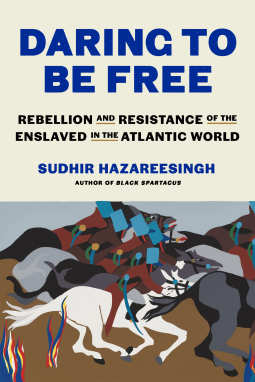
Daring to Be Free
Rebellion and Resistance of the Enslaved in the Atlantic World
This title was previously available on NetGalley and is now archived.
Send NetGalley books directly to your Kindle or Kindle app
1
To read on a Kindle or Kindle app, please add kindle@netgalley.com as an approved email address to receive files in your Amazon account. Click here for step-by-step instructions.
2
Also find your Kindle email address within your Amazon account, and enter it here.
Pub Date Dec 2 2025 | Archive Date Jan 2 2026
Description
An Amazon Best History Title of the Month
A revelatory history of enslaved people’s resistance and self-emancipation, across the Atlantic world and beyond.
In the 1720s, the West African chief Tomba was abducted for organizing the local resistance against slave raiders and imprisoned on a British ship, where he promptly led a revolt using a smuggled hammer. In the early nineteenth century, a pregnant woman named Solitude rallied laborers and soldiers to resist Napoleon’s efforts to reimpose slavery on Guadeloupe. A few decades later, Frederick Douglass fashioned his own template for self-emancipation. In Daring to Be Free, the acclaimed historian Sudhir Hazareesingh recasts the story of slavery’s end by showing that the enslaved themselves were at the center of the action—their voices, their resistance, and their extraordinary fight for freedom.
Throughout, Daring to Be Free portrays the struggle for liberation from the perspective of the enslaved and, wherever possible, in their own words. It highlights the power of collective action, stressing the role of maroon communities, conspiracies, insurrections, and spiritual movements, from Haiti and Brazil to Cuba, Mauritius, and the American South. These acts of resistance involved entire communities, with women often at the heart of the story as warriors, organizers, and agents of radical change.
Employing written archives and oral history, Daring to Be Free shows how the struggle for freedom was shaped less by Western Enlightenment or Christian ideals than by the enslaved’s own spiritual, martial, and cultural resources. Emancipation wasn’t handed down by benevolent reformers—it was seized, again and again, by those who demanded freedom. This vital, eye-opening history reclaims abolition for those who fought to liberate themselves.
A Note From the Publisher
Available Editions
| EDITION | Other Format |
| ISBN | 9780374611071 |
| PRICE | $33.00 (USD) |
| PAGES | 432 |
Available on NetGalley
Available to Buy
Buy on Amazon Buy on BN.com Buy on Bookshop.orgAverage rating from 3 members
Featured Reviews
 Bex C, Reviewer
Daring to be Free is essential reading for anyone who wants to understand how people resisted enslavement throughout the Atlantic. Every chapter is thoroughly researched and written to focus on historical evidence documenting inspiring individuals and communities that resisted the brutality and degradation of enslavement. Their knowledge of war, deep spirituality, and resourcefulness allowed enslaved people to resist in many ways: from acts of noncompliance, running away, forming secret communities, or rising up. As someone raised in the U.S., this book taught me more about the Atlantic slave trade than any history class. We are taught abolition in a way that centers prominent white people without focusing on how emancipation could not have happened without the ceaseless resistance of enslaved men and women. I honestly think that this should be required reading in schools. I will be picking up a physical copy when this book comes out!
Thank you Net Galley, Farrar Straus and Giroux (publisher), and Sudhir Hazareesingh (author) for the ARC!)
Readers who liked this book also liked:

Gerald J. Steinacher
History, Nonfiction (Adult), Religion & Spirituality