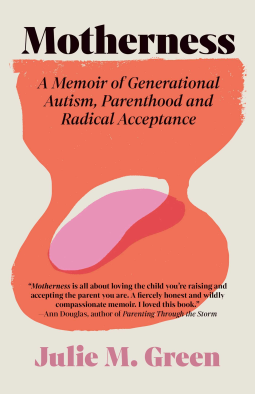
Motherness
A Memoir of Generational Autism, Parenthood, and Radical Acceptance
This title was previously available on NetGalley and is now archived.
Send NetGalley books directly to your Kindle or Kindle app
1
To read on a Kindle or Kindle app, please add kindle@netgalley.com as an approved email address to receive files in your Amazon account. Click here for step-by-step instructions.
2
Also find your Kindle email address within your Amazon account, and enter it here.
Pub Date Sep 23 2025 | Archive Date Aug 31 2025
Talking about this book? Use #Motherness #NetGalley. More hashtag tips!
Description
A funny, unflinchingly honest, and deeply compassionate memoir about one woman’s experience of raising an autistic child while discovering she is also “on the spectrum”
Almost 10 years after learning that her son is autistic, Julie Green was also diagnosed, shedding light on a lifetime of feeling othered and misunderstood. Motherness traces Julie’s journey from childhood to early motherhood, when she must advocate for her son while navigating her own struggles.
With more girls and women being diagnosed in the last decade — many of them later in life — the face of autism is changing. Motherness provides a rich, intensely personal account of what it is like to be autistic, through the lens of both a mother and child. Topics include sensory processing, meltdowns and shutdowns, masking, empathy, alexithymia, bullying, elopement, special interests, disordered eating, gender diversity, twice exceptionality, and more.
Motherness is a story about accepting your child while learning to accept yourself. This extraordinary, groundbreaking memoir speaks to the great challenges and great joys of autism, providing valuable insights to parents of autistic children, adults newly diagnosed or questioning their place on the spectrum, and anyone seeking a greater understanding of neurodiversity.
Available Editions
| EDITION | Other Format |
| ISBN | 9781770418028 |
| PRICE | $19.95 (USD) |
| PAGES | 288 |
Available on NetGalley
Available to Buy
Buy on Amazon Buy on BN.com Buy on Bookshop.orgAverage rating from 12 members

Featured Reviews
 Kaitlyn L, Reviewer
Reading Motherness felt like someone had reached inside my brain, grabbed a handful of thoughts I’ve never fully been able to articulate, and turned them into the most validating, funny, and moving memoir. I’m not a mom, but I am neurodivergent, and I grew up with a mother who, looking back now, was clearly neurodivergent too. We just didn’t have the words for it then.
That’s part of what made this book hit so hard for me. Julie’s journey isn’t just about parenting; it’s about identity. It’s about navigating the world with a brain that processes things differently, while trying to advocate for someone else doing the same. There’s this double layer of vulnerability in her story that I found so deeply moving: advocating for her son while quietly unraveling her own long unanswered questions.
It made me stop and reflect on my own mom. What she must’ve been going through. What it was like to raise a child (me!) while also struggling to make sense of a world that wasn’t built for her either. Motherness made me emotional in a way I didn’t expect and it gave me so much more compassion and understanding for her. Like, of course she didn’t always know how to help. She didn’t have the tools, the support, or even the vocabulary we have now. She was living in a world that lacked the resources we have now, and she was overstimulated and overwhelmed but could not get what we are afforded now. This really hit home for me!
Julie is so funny, by the way. Her writing is sharp and witty without ever being dismissive or flippant. She tackles some really heavy stuff, like meltdowns, masking, disordered eating, bullying, shutdowns, with a lot of warmth and relatability. I laughed out loud more than once, even while I was underlining passages that punched me right in the gut.
I especially loved the moments when Julie described recognizing traits in herself that mirrored her son’s. It reminded me of when I’d tell my mom something I learned about my ADHD or sensory issues and she’d pause and go, “...Wait, I do that too.” It’s funny how discovering things about ourselves can create a ripple effect that helps the people around us understand themselves too.
This book doesn’t have all the answers, and it doesn’t try to. What it does offer is honest storytelling, hope, and that warm feeling of being seen and letting you know you are not alone. It’s for the late diagnosed adults, the overwhelmed parents, the people navigating dual identities, and anyone who's ever felt a little too much or not enough.
💜 5/5 stars
📚 A must read for neurodivergent individuals and their families
😂 Funny, raw, real
🧠 Perfect for those who love memoirs that make you feel like you’ve found a long lost friend
Reading Motherness felt like coming home to a truth I didn’t know I needed. I will absolutely be recommending this one to everyone I know, especially my mom!
Thank you to NetGalley, Julie M. Green, and ECW Press for the eARC of this book.
 Reviewer 740146
Written from a place of motherly love, heartwrenching honesty and empowerment, "Motherness" is a book I am certainly going to be pestering every single fellow therapist I know for a very, very long time. Unique in its mix of self-discovery and parenting journeys, this book feels like biting into an ice-cream that's fresh out of the freezer: it sends a jolt through your whole body, and leaves you unable to think about anything else for a while.
As both the mother to an autistic child, and an autistic person herself, Julie M. Green hits the shelves with her family's story. Nobody prepared her or her husband for what raising an autistic child takes, but as one keps turning the pages and learning more about Mrs. Green's parenting journey, it's made abundantly clear that both her and her husband did their best and kept in mind their endgoal, which was their child's well-being. When Carson was diagnosed as autistic as a toddler, the Green family found themselves trying to navigate an allistic world that was neither ready, nor willing, to acommodate their child. Most people don't realise how hard it is to live with an invisible disability, or think that all autistic people are carbon copies of Sheldon Cooper whose autism is just a compilation of "quirks" and minor oddities. Consequently, autistic people and their families often face stigma and even discrimination as a result of autistic traits that are assumed as malicious or immature by others. When a child starts crying loudly at the supermarket, how many of us turn our heads to frown at the grown-up they are with for it? How often do we take offence when a pre-teen "talks back", and asks us for a reason why they should do things the way we tell them to? Aren't we, as a society, continuously singling out those who fail to "read the room" and end up saying or doing the wrong things? Don't we have a tendency to dislike anyone whose facial expressions are hard to read?
These are merely the tip of the iceberg when it comes to the myriad ways in which our society fails autistic people, and in this book Julie Green explores the many barriers that autistic people are faced with as a result. From non-verbal communication to unspoken social norms about touching, personal space, how much honesty is too much and whether eye contact is as big of a deal as allistic people make it out to be - this book explores what it means to be autistic in a world that is rarely ever ready for it. Something I was a big fan of was how Green peppered the book with scientific research that was, from what I could see at the end of the book, quite recent as well as methodologically robust. For some reason there are many people who still think that autism is the mothers' fault, or that it's a fancy way to describe poor parenting. In the face of such prevalent and ignorant opinions, this book doesn't shy away from describing the different sides of autism and how it makes autistic folks feel whenever allistic people react negatively to them.
Another thing that was lovely was Green's sincere account of her struggles as she and her husband did their best to support Carson. In this regard, it was quite moving to learn how harmful many of the so-called "therapies" for autistic people can be. Being a therapist with specific training in disability and diversity myself, I wish I could make every single colleague I know read this book. There is still a very prevalent view of autism as a disorder, rather than a neurotype that isn't any less just because it's different, and there are still far too many trained professionals whose approach is based entirely on supressing as much of the person's autism as possible through desensitization, exposure therapy, stim suppression and similarly aversive practices. While there might be some behaviours worth modifying or some horizons worth expanding for the person's own sake (such as stimming that entails harm to oneself or others, or severe ARFID that might lead to malnutrition and nutritional deficiencies), many others are harmless and do not merit being supressed.
Overall this is an extremely powerful book, and I am most definitely going to be purchasing a physical copy for my personal library as both a therapist, and a human being who wants to know how to make the world a little kinder for those who are treated harshly. I encourage everyone to read it, then lend their friends their copy!
 Neetha K, Reviewer
What a gem of a book.
Honestly, I don't have words (because Julie M. Green seems to have stolen all the words from my mind anyway). Sometimes I take down quotes to get a more immersive reading experience, I am trying to do that a lot more now. In chapter 1, almost everything was something I wanted to take down. Julie's experience of postpartum depression, especially given that she did not know she was autistic then. The things that made her fraught, that triggered her (even if she didn't know that was what it was)--the entire experience seemed duplicated from my own life. It was like reliving those those, which, let's be honest, weren't the best for me. And while everything else that came after were deeply relatable (Julie's description of her migraine, the sensations, the description of the icepick stabbing, which is literally the same as how I always imagine when I describe my pain; that, or, a hammer bashing down the side of my skull into brain matter), there were some differences, primarily stemming from the fact that I am South Asian, and all of the generational trauma that comes with it.
I, like Julie, sought and got diagnosis after having a child, but mine came much earlier thanks to the meme-ification of the human experience. And like Julie, my partner is the thing in my life I have always been sure of. My diagnosis is still recent, however, and that means I am still seeking out explanations and understanding. It is only now that I have been able to look past my present grief to look back at my childhood. I am often filled with grief, a deep chasm of a grief: if only I had known, if only there was someone in my life who could have helped me. How different would my life be? How less unrooted would I feel?
This isn't just a memoir: though the memoir part is written so very well. Her writing is just the right amount of funny (which I recognize comes from a lifetime of not knowing what to say), and her narrative style is powerful, weaving you in, tightening and loosening the string in accordance to the events.
I want to thank Julie for this book. Thank you for writing this. It felt almost freeing to read this. And I certainly feel a lot less alone. Can't wait for September when I can get a physical copy!
Jessica G, Librarian
As an autistic adult who wasn't diagnosed until my late 30s, this book hit hard. Highly relatable and beautifully written with all the struggles and joys of parenting on the spectrum on full display.
Reviewer 515830
Motherness is a poignant, courageous memoir that highlights the beauty of embracing who we are and who our children are, fully. Whether you are new to the topic of autism or familiar with the neurodiverse landscape, this book will move you, challenge you, and leave you with a deeper understanding of what it means to parent—and to be—a work in progress.
What makes Motherness shine is its gentle honesty. It’s not wrapped in easy answers, but rather in commitment to show up—with grace and with growth. Green’s journey is personal, but her message is universal: understanding begins at home, and love is never conditional.
 Amanda S, Media/Journalist
A Brave and Tender Exploration of Family
Every once in a while, a memoir comes along that feels less like reading someone else’s story and more like being invited into a deeply honest conversation. Julie M. Green’s Motherness is one of those books. With a title that promises both vulnerability and strength, Green delivers a narrative that is at once intimate and universal, weaving together her experiences of motherhood, family dynamics, and the complexities of living in a neurodiverse household. It’s not a light read, but it’s certainly a rewarding one, offering insight, compassion, and a sense of radical acceptance that lingers long after the last page.
A Story of Autism, Parenthood, and Inheritance
At its core, Motherness is about navigating parenthood when autism runs through the family line. Green shares her journey of raising children on the spectrum while reflecting on her own upbringing and identity. She explores how generational autism has shaped not only her parenting style but also her understanding of love, resilience, and selfhood. The memoir balances stories of challenge with moments of celebration, showing how acceptance can transform both relationships and inner perspectives. Through it all, Green’s storytelling is deeply personal yet never insular—it invites the reader to see pieces of their own struggles and triumphs mirrored in her words.
Radical Acceptance at the Center
One of the most compelling themes of Motherness is the practice of radical acceptance. Green doesn’t sugarcoat the difficulties of parenting in a neurodiverse household, nor does she frame autism as something that needs to be “fixed.” Instead, she embraces it as an essential part of her family’s identity, teaching readers that acceptance doesn’t mean resignation—it means choosing compassion over control. This perspective is refreshing in a literary landscape where stories about autism often skew toward deficit-based narratives. Green’s approach reminds us that joy and growth are possible even in the midst of uncertainty.
A Writing Style that Resonates
Green’s prose is both eloquent and approachable, striking that sweet spot where memoirs shine. She writes with a candidness that feels unfiltered yet polished, letting her emotions come through without ever overwhelming the narrative. Her pacing keeps the book moving, balancing heavier moments with warmth and humor. The writing feels like sitting down with a thoughtful friend who is willing to share her hardest lessons, not because she has all the answers, but because she knows how much it matters to feel less alone. It’s this sincerity that makes the memoir so impactful.
A Memoir Worth Holding Onto
Motherness is more than just a personal story—it’s a guide, a reflection, and a celebration of what it means to parent, love, and accept without conditions. Julie M. Green offers readers a heartfelt glimpse into the complexities of generational autism and the beauty that can be found within it. Whether you’re a parent, an educator, or simply someone who values authentic storytelling, this book has something to give. It challenges preconceived notions while offering comfort in the shared humanity of imperfection. In the end, Motherness feels less like a book you finish and more like one you carry with you, long after closing its pages.
Readers who liked this book also liked:

Kerri Rawson
Biographies & Memoirs, Parenting, Families, Relationships, True Crime
Marie Bostwick
Historical Fiction, Literary Fiction, Women's Fiction



Alexandria Bellefleur; Elise Bryant; Olivia Dade; Alexis Daria; Sarah Hogle; Zakiya N. Jamal; Rebecca Jenshak; Jessica Joyce; Susan Lee; Joss Richard; M. A. Wardell; Rebekah Weatherspoon
Romance