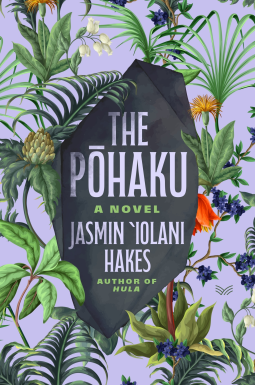
The Pohaku
A Novel
This title was previously available on NetGalley and is now archived.
Send NetGalley books directly to your Kindle or Kindle app
1
To read on a Kindle or Kindle app, please add kindle@netgalley.com as an approved email address to receive files in your Amazon account. Click here for step-by-step instructions.
2
Also find your Kindle email address within your Amazon account, and enter it here.
Pub Date Feb 3 2026 | Archive Date Mar 31 2026
Talking about this book? Use #ThePohaku #NetGalley. More hashtag tips!
Description
From the award-winning author of Hula, a dazzling saga about the generations of women tasked with protecting the history and place that made them.
A young woman lies comatose in a hospital, watched by her estranged grandmother. Mystery surrounds the woman’s fall—did she jump off the cliff, or was she swept away by a wave? Her grandmother suspects it is linked to the pōhaku, an ancient stone that their family was tasked with protecting.
In this novel spanning generations across Hawai`i and California, it soon becomes clear that the pōhaku’s story must survive if there is to be any hope of the family’s reconciliation with their home, with nature, and with each other.
Reminiscent of Yaa Gyasi’s Homegoing, Min Jin Lee’s Pachinko, and Tommy Orange’s There, There, The Pōhaku is an immersive and bold novel about the history, perseverance, and resilience of the Hawaiian people.
Available Editions
| EDITION | Other Format |
| ISBN | 9780063421134 |
| PRICE | $30.00 (USD) |
| PAGES | 320 |
Available on NetGalley
Available to Buy
Buy on Amazon Buy on BN.com Buy on Bookshop.orgAverage rating from 55 members
Featured Reviews
 Victoria B, Reviewer
The Pōhaku was such a poignant, reflective, beautiful/tragic story about a family of women throughout Hawaii's history from before the unification of the islands to kind-of-present-day (early 1990s) entrusted with the safekeeping of a special pōhaku - a sacred stone that connects the Hawaiian people to the spirits and voices of the land. This had a distinct and impactful voice and style, and deftly wove in the grandmother visiting her granddaughter in the hospital and telling her family's oral history woven in with key events in Hawaii's history, with taking us back in time and seeing the generations of women navigate their communities, connection with the land, inherited responsibility, and the big big changes brought by colonialism, capitalism, missionaries, and greed. Throughout the story and going between the islands, to California, and back, the story of the women and their lives gave meaning to history and reflections about identify, culture, heritage, and connection.
I feel like there's a lot more profound analysis and commentary that could be done, but I am 100% not the right person to do that -- but I found this book deeply resonant and meaningful, and I could not put it down as I was wholly absorbed. Also a small thing but I got a kick out of how drunk tūtū talked more local style in that one chapter. The book ends a bit abruptly/open-ended/ambiguously -- in a sense that, we've made it up to the current lineage of the grandmother passing down their family's story to her granddaughter as Hurricane Iniki approaches, and then the hurricane hits. For me, that made the story more emotionally resonant and devastating, and I bet it would make an excellent book discussion question.
Overall, well worth a read and I'm definitely picking up a copy when this publishes. Thanks to the author, HarperVia, and NetGalley for the ARC.
 Mariah F, Reviewer
A narrative about the trauma constructed from colonial conquest that seeks to erode identities. A story that spans across three generations from the beginning of Hawaii’s colonialism to the 1990s. Generational trauma weaved into a narrative to show the power of reconnecting to ancestral concepts after over a century of colonialist ideals. Deconstructing your identity after your culture has been forced into western ideals is the theme here. What does it mean to define your identity and how do you reclaim a heritage that society tries to erase?
The prose is poignant and eloquent. The distinction of time during each chapter helps to understand the perspective of the three women who pass down the the pōhaku. Each generation engages the struggle differently to maintain their identity – but each century opens a new pathway towards rejecting western ideals. This is the way to understand the negative impact of forcing christianity and western ideals unto people who were once freely living in their culture. Will be reading fhe author’s novel, Hula next! Thank you HarperVia and Netgalley for this electronic arc!
Read more recommendations and reviews https://brujerialibrary.wordpress.com
 Reviewer 1334686
“The Pohaku” is the latest novel by acclaimed author Jasmin 'Iolani Hakes, following her work “Hula.” This epic narrative spans centuries of Hawaiian history, starting from the era of Captain Cook and moving through the overthrow of the monarchy, all the way up to the 1990s. It tells the story of a lineage of women entrusted with sacred stones (pōhaku), symbolizing strength and cultural heritage.
Hakes depicts the impact of colonization and the struggles of each generation to preserve their identity and heritage. The novel has been likened to Yaa Gyasi’s “Homegoing” and Min Jin Lee’s “Pachinko,” capturing themes of identity and belonging amid the challenges of a society rooted in white supremacy.
I highly recommend “The Pohaku” for those interested in understanding our complex history and honoring marginalized voices. Thank you to HarperVia and NetGalley for the ARC in exchange for an honest review.
 Rachel D, Reviewer
This sweeping saga beautifully ties together Hawaiian history, myth, and family legacy. When a young woman lies in a coma, her grandmother begins to unravel the long-buried tale of the pohaku—a sacred stone entrusted to their lineage for generations. Spanning from the era of Captain Cook to the present day, the novel traces the women who protect the stone, showing how its displacement mirrors the fractures in both family and homeland. Lyrical and powerful, it’s a story of resilience, inheritance, and the unbreakable bond between people and place.
 Geoffrey S, Librarian
This saga tells of the history of Hawaii, a surprising amount of the history of California, and on a grander scale tells a story of the history of fighting to hold on to one's culture and community in the face of seemingly relentless outside pressure, and also a story of multigenerational trauma. "The Pohaku" is the kind of read that is achingly, painfully tragic, yet also so gorgeously written, and also so eye-openingly informative too that it's a genuine challenge to put down once one gets into the real flow of the story. Jasmin Iolani Hakes has once again knocked it out of the park with an absolutely top-notch work, and although this book hasn't even been published yet as of this review, I already am eager to see what she has in store for the future.
Celia D, Librarian
The Pohaku follows generations of a Hawai’i family and their caretaking of an ancient artifact in Hawaii and California. The story begins in 1992, with a grandmother telling her granddaughter the story of the pohaku while her granddaughter is in a coma after an accident. The story is told in flashbacks and flash forwards as the family moves between Hawaii and California. This gives the story depth and urgency.
Hakes’ writing about Hawaii is beautiful and conveys Hawaii’s magic and complexity. I loved the way she thoughtfully interwove words and place names in Hawaiian, as well as Hawaiian history. I love the parts of the book that took place in Hawaii.
To me, the parts of the story that took place in California did not give the same intimacy, so maybe that’s one downside of how perfectly Hakes captures Hawai’i in her writing. I also highly recommend Hula, also by Hakes if you want more of her portrayal of family and the complexity of the Hawaiian islands.
Readers who liked this book also liked:




Kumi Makimura
Children's Fiction, Children's Nonfiction, Comics, Graphic Novels, Manga

Kumi Makimura
Children's Fiction, Comics, Graphic Novels, Manga, Science