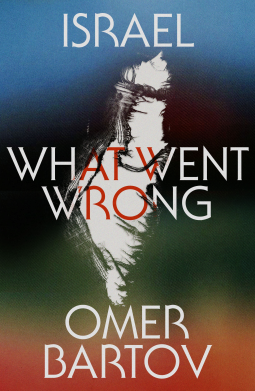
Israel
What Went Wrong?
This title was previously available on NetGalley and is now archived.
Send NetGalley books directly to your Kindle or Kindle app
1
To read on a Kindle or Kindle app, please add kindle@netgalley.com as an approved email address to receive files in your Amazon account. Click here for step-by-step instructions.
2
Also find your Kindle email address within your Amazon account, and enter it here.
Pub Date Apr 21 2026 | Archive Date Apr 21 2026
Description
A leading Israeli American scholar of the Holocaust explores and explains his native country's intensifying turn toward violence and exclusion.
The distinguished historian Omer Bartov was born on a kibbutz, grew up in Tel Aviv, and served in the Israel Defense Forces during the Yom Kippur War. He went on to become a leading scholar of the German army and the Holocaust, before turning his attention to his native country.
In Israel: What Went Wrong?, Bartov sketches the tragic transformation of Zionism, a movement that sought to emancipate European Jewry from oppression, into a state ideology of ethno-nationalism. How is it possible, he asks, that a state founded in the immediate aftermath of the Holocaust, an event that gave legitimacy to a national home for the Jews, stands credibly accused of perpetrating large-scale war crimes? How do we come to terms with the fact that Israel’s war of destruction is being conducted with the support, laced with denial and indifference, of so many of its Jewish citizens?
Tracing the roots of the violent events currently unfolding in Israel and the occupied territories, Bartov tracks his country's moral tribulations and considers the origins of Zionism, the intertwining of Israel’s independence with Palestinian displacement, the politics of the Holocaust, controversies over the term "genocide," and the uncertain future. The result is a searing and urgent critique that addresses today’s debates over Zionism and the future of Israel with rigor and depth.
A Note From the Publisher
Available Editions
| EDITION | Other Format |
| ISBN | 9780374618186 |
| PRICE | $28.00 (USD) |
| PAGES | 256 |
Available on NetGalley
Available to Buy
Buy on Amazon Buy on BN.com Buy on Bookshop.orgAverage rating from 24 members
Featured Reviews
 Michael A, Educator
Thrilled to see a work on this subject by an author the caliber of Bartov. As a former IDF soldier, and a renowned scholar of genocide, Bartov speaks with both clarity and authority on the issue of Israeli culpability in war crimes, and crimes against human decency. Bartov sees the rightward slide of Israel under Likud as a tragedy that eerily echoes authoritarian tactics from the past. His erudite examination of Israeli/IDF actions in Gaza should be mandatory reading.
 Monica R, Reviewer
This is a deeply personal yet analytical work that traces how Zionism evolved from a movement seeking to emancipate European Jewry into what Bartov characterizes as ethno-nationalist state ideology. Bartov grapples with a devastating paradox: how a state founded after the Holocaust now stands accused of large-scale war crimes. His exploration traces the intertwining of Israeli independence with Palestinian displacement, the politics of Holocaust memory, and debates over terms like "genocide."
The author's moral clarity is matched by scholarly rigor. Bartov doesn't shy from controversial questions, including examining how many Israeli citizens support what he argues are war crimes. While some will find his conclusions challenging, the book's value lies in its intellectual honesty and willingness to confront uncomfortable truths. Bartov offers the kind of moral reckoning that only someone who loves their country can provide. It's painful, necessary, and deeply informed.
Thank you to NetGalley and the publisher for the ARC in exchange for an honest review.
 Joe S, Educator
Given I’m reading this in the days of the fragile ceasefire where Hostages and prisoners are being released on both sides and they tiptoe towards fleshing out ‘Trump's Peace Plan’ - the author is one such voice I would want around the table
An incredible book, so balanced and informative that allows you to see the real history and therefore potential barriers going forward to lasting peace
Taking in the bredth of anti-semitism from Roman Empires times right up until the modern day, and seeing how that very term has changed and in some instances has been politicised
It was so insightful and helpful to get a real understanding of the situation, as finding the real ‘truth’ is becoming increasingly difficult in the media
A book that everyone should read
 eric p, Librarian
Israel: What Went Wrong? by Omer Bartov reads like a man arguing with himself in public—except the man happens to be a Holocaust historian with skin in the game, a long memory, and absolutely no interest in comforting anyone.
Bartov’s central move is brutal in its simplicity: he traces how a project born from the real, historic catastrophe of Jewish persecution can evolve into a state ideology that normalizes exclusion and escalating violence. That’s a hard thesis to write without turning it into either a slogan or a sermon, and what makes this book land is that Bartov keeps dragging the reader back to history—origins, institutions, narratives, and the slow moral weathering that happens when a nation’s founding story becomes a shield against accountability.
The book feels “urgent,” but not in the social-media sense. It’s urgent in the “a historian is watching the floorboards creak and telling you exactly which beams are rotting” sense. He doesn’t just point at current events and gasp—he walks you through the roots: Zionism’s early aims, the entanglement of independence with Palestinian displacement, how the Holocaust is invoked politically, and why words like “genocide” trigger both legitimate caution and strategic denial. You can disagree with his framing and still respect the seriousness of the project, because he’s actually trying to define terms, not just weaponize them.
It’s also not a breezy read. Bartov writes with moral pressure. He’s asking readers—especially Jewish readers, but really anyone invested in liberal democratic ideals—what it means when identity becomes a permanent exception clause. The most unsettling parts aren’t even the accusations; it’s the portrait of normalization: how denial, indifference, and tribal loyalty can become a kind of civic wallpaper.
If you want a book that praises, excuses, or “both-sides” its way into harmlessness, this isn’t it. Israel: What Went Wrong? is a sharp, historically grounded critique that treats the subject like something real people bleed over—not an abstract debate. Whether you end up agreeing with Bartov or arguing with him in the margins, you won’t walk away unchanged, and you definitely won’t walk away thinking the easy stories are enough.
Readers who liked this book also liked: