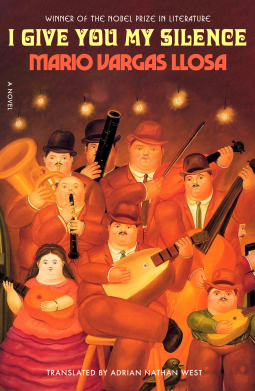
I Give You My Silence
A Novel
with Adrian Nathan West (Translator)
This title was previously available on NetGalley and is now archived.
Send NetGalley books directly to your Kindle or Kindle app
1
To read on a Kindle or Kindle app, please add kindle@netgalley.com as an approved email address to receive files in your Amazon account. Click here for step-by-step instructions.
2
Also find your Kindle email address within your Amazon account, and enter it here.
Pub Date Feb 24 2026 | Archive Date Feb 24 2026
Description
In his final novel, the Nobel Prize winner Mario Vargas Llosa returns to his native Peru.
Toño Azpilcueta, proletarian intellectual, writer of sundry articles, aspirant to the now-defunct professorship of Peruvian studies, is an expert in the vals, a genre of music descended from the European waltz but rooted in New World creole culture. When he hears a performance by the elusive guitarist Lalo Molfino, Toño is convinced not only that he is in the presence of the country’s finest musician, but also that his own love for Peruvian music, as he has long suspected, has a profound, provable social function. If he could just write the biography of the man before him and tell the story of both the vals and its attendant inspiring ethos, huachafería (Peru’s great contribution to world culture, as per Toño), he might capture his country’s soul and inspire his fellow citizens to remember the ties that bind them. Through music, the populace might come together, lay down their arms, and embrace a harmonious and unified Peruvian culture.
Both a send-up of parochial idealism and a love song to the culture of his homeland, Mario Vargas Llosa’s I Give You My Silence is the moving final novel of the Peruvian Nobel Prize winner, whose enduring works captured a changing Latin America. The tragic hero Toño and his belief in a democratic, proletarian music at odds with the culture and politics of a modern Peru scarred by violence is the writer’s last statement on the revelatory, maddening, foolhardy, yet irrepressible conviction that art has profound transformative power.
A Note From the Publisher
Available Editions
| EDITION | Other Format |
| ISBN | 9780374616250 |
| PRICE | $28.00 (USD) |
| PAGES | 256 |
Available on NetGalley
Available to Buy
Buy on Amazon Buy on BN.com Buy on Bookshop.orgAverage rating from 10 members
Featured Reviews
 Michelle W, Reviewer
The swan song of Mario Vargas Llosa (1936–2025), Le dedico mi silencio, is a love letter to Peruvian Creole music.
“A vision of Creole music as the key to defeating prejudice and opening hearts and minds.”
“Society would come together in such a way that no one was beneath consideration and all were treated as worthy human beings. Progress and respect would reign … ”
We follow Toño, a scholar who has dedicated his entire life to Creole music, having breakfast at the Bransa, interviewing people, and doing research at the National Library in Lima, Peru. One day, he hears the performance of the finest guitarist he has ever encountered, Lalo Molfino. This performance inspires him to finally write his only book about Creole music.
Creole music and its great musicians were born in the filthy alleyways where humans shared rooms with rats, true miracles of poverty in Peru. “For those who lived in the alleyways, Creole music was synonymous with home.” Later, Creole music took flight and became a national treasure, beloved by people of all classes. Thus, Toño’s hypothesis is that Creole music is the key to uniting Peruvian society, and perhaps even all of humanity.
“And if such a thing could happen in Latin America, why not in the entire world, to the benefit of humanity as a whole?”
His thesis seems proven by the Creole musician couple Toni and Lala. Toni, from a privileged background, against all odds marries Lala, who comes from a disadvantaged one. They remain married and content until their deaths, bound together by the glue of Creole music.
However, Toño himself allows Creole music to come between him and his wife. His own marriage becomes an antithesis to his ideal. I like how Toni gently reminds him:
“What happened with Lala and me, that was exceptional. Love, you know …”
No matter how enthusiastic and idealistic the book may be, it is not without doubt or disappointment. At some point, Toño accepts that he will not see his dream realized within his lifetime. Now that Mario Vargas Llosa himself is gone, reading this novel feels like reading his literary last will:
“… this book you hold in your hands, reader, will be the starting point of a true revolution that will pull our Peru up from poverty and sorrow, restoring its glory and creativity, making it a place where all are truly equal, and putting an end to the sad divisions of its people.”
Reading this book as a musician, a lover of German art songs, and a song collector for the Global Songbook (Lutheran World Federation), I found it deeply inspiring. It offered precious insights and much to reflect on regarding the meaning of song.
The English edition, translated from the Spanish by Adrian Nathan West, will be published on February 24, 2026.
Thank you to Farrar, Straus and Giroux (@fsgbooks) and NetGalley (@netgalley) for the eARC.
P.S. Peruvians celebrate Creole Song Day annually on October 31. This national holiday honors Peruvian Creole culture, a vibrant musical tradition born from the fusion of Indigenous, African, and Spanish influences.
 Emily S, Reviewer
This is a finely turned beautifully tuned final book. It is philosophical, funny, very Peruvian, nostalgic and lyrical. It follows Toño Azpilcueta, a music journalist, as he writes a book which is a love letter to Creole music, whilst being tormented by imagined rats. It made me nostalgic for a country I have never visited, a time in which I have never lived and for all the vals I have never heard. Mario Vargos Llosa was a great writer and his powers never left him. This is as fresh as Aunt Julia and the Scriptwriter which I read over 30 years ago and has made me nostalgic for the act of reading that book too. Thankyou to Netgalley and Farrar Strauss and Giroux for the digital review copy. .
Readers who liked this book also liked:

Kenneth Womack; Scott Freiman
Entertainment & Pop Culture, Nonfiction (Adult)

Will Kaufman
Entertainment & Pop Culture, Nonfiction (Adult), Politics & Current Affairs

Judi Dench; Brendan O'Hea
Biographies & Memoirs, Nonfiction (Adult)