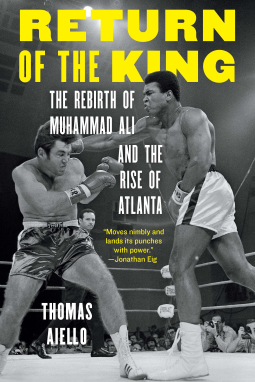
Return of the King
The Rebirth of Muhammad Ali and the Rise of Atlanta
This title was previously available on NetGalley and is now archived.
Send NetGalley books directly to your Kindle or Kindle app
1
To read on a Kindle or Kindle app, please add kindle@netgalley.com as an approved email address to receive files in your Amazon account. Click here for step-by-step instructions.
2
Also find your Kindle email address within your Amazon account, and enter it here.
Pub Date Dec 1 2025 | Archive Date Nov 30 2025
Talking about this book? Use #ReturnoftheKing #NetGalley. More hashtag tips!
Description
Winner of the 2026 Malcolm Bell Jr. and Muriel Barrow Bell Award
Return of the King tells the story of Muhammad Ali’s return to the ring in 1970, after a more than three-year suspension for refusing his draft notice as a conscientious objector during the Vietnam War. With Ali’s career still in doubt, he found new support in shifting public opinion about the war and in Atlanta, a city still governed by white supremacy, but a white supremacy decidedly different from that of its neighbor cities in the Deep South.
Atlanta had been courting and landing professional sports teams in football, basketball, and baseball since the end of 1968. An influential state politician, Leroy Johnson, Georgia’s first Black state senator since Reconstruction, was determined to help Ali return after his exile. The state had no boxing commission to prevent Ali from fighting there, so Johnson made it his mission for Ali to make a comeback in Georgia. Ali’s opponent would be Jerry Quarry, the top heavyweight contender and, more important, a white man who had spoken out against Ali’s objection to the war.
In Return of the King, Thomas Aiello examines the history of Muhammad Ali, Leroy Johnson, and the city of Atlanta, while highlighting an important fight of Ali’s that changed the trajectory of his career. Although the fight between Ali and Quarry lasted only three rounds, those nine minutes changed boxing forever and were crucial to both the growth of Atlanta and the rebirth of Ali’s boxing career.
Advance Praise
“Return of the King is a compelling social history, a story that moves nimbly and lands its punches with power. Thomas Aiello has written an important and original work exploring Muhammad Ali’s comeback and the making of modern Atlanta.”—Jonathan Eig, Pulitzer Prize-winning author of King: A Life and Ali: A Life
“You don’t need to be a boxing fan to love Thomas Aiello’s powerful and evocative portrayal of how Black Atlanta enabled Muhammad Ali’s career-defining comeback.”—David J. Garrow, Pulitzer Prize-winning author of Bearing the Cross: Martin Luther King, Jr., and the Southern Christian Leadership Conference
“Return of the King is essential reading for anyone interested in Muhammad Ali and boxing as transcendent figure and institution respectively. Aiello frames his treatment of the 1970 fight between Jerry Quarry and Ali, in the racial politics of Atlanta, the state of Georgia, and the nation. After reading this book no one can ever see Atlanta as ‘the city too busy to hate.’ This study is sports history at its best and reveals that when properly contextualized and theorized the discipline is invaluable to a clearer and more accurate understanding of the past.”—Jeffrey T. Sammons, author of Beyond the Ring: The Role of Boxing in American Society
“Both local and national in scope, Return of the King is a fascinating account of the Ali-Quarry fight. It offers a fresh look at the political culture of Atlanta through the prism of Leroy Johnson’s story and a closer focus on one of the most underappreciated periods of Ali’s career. This is an early contender for the best sports history books of 2025.”—Clayton Trutor, author of Loserville: How Professional Sports Remade Atlanta—and How Atlanta Remade Professional Sports
“Thomas Aiello’s book is an exciting and detailed account of Muhammad Ali’s return to the ring after three and a half years in exile, with a special focus on how Atlanta, with its sophisticated Black politicians like State Senator Leroy Johnson, was able to overcome racist opposition to present the bout against white hope Jerry Quarry in the heart of the Deep South.”—Lewis A. Erenberg, author of The Rumble in the Jungle: Muhammad Ali and George Foreman on the Global Stage
“Contrary to the beloved figure he would become years later, the Muhammad Ali of 1970 was a man under siege. Stripped of the heavyweight championship and exiled from the ring for 3½ years for evading the draft during the Vietnam War, he was hated by a large segment of white America for his perceived uppity attitude and his affiliation with the Black separatist Nation of Islam. Improbably, Atlanta stepped forward to provide him with a venue to launch his comeback in an event that would prove pivotal both for Ali and the city itself. In his thoroughly researched book, Return of the King, Thomas Aiello offers up an erudite study of that long ago encounter that is a welcome addition to the Ali canon.”—Mark Kram Jr., author of Smokin’ Joe: The Life of Joe Frazier
“In Return of the King Thomas Aiello deftly reconstructs Muhammad Ali’s boxing comeback after being exiled for refusing to serve in the United States military at the height of the Vietnam War. Aiello offers a compelling narrative that reveals why Ali's return could only have occurred in Atlanta, the Black mecca of the American South. This is the origin story of Ali’s second act: when the self-proclaimed King of the World found redemption in the ring, emerging as a triumphant symbol of Black Power.”—Johnny Smith, coauthor of Blood Brothers: The Fatal Friendship Between Muhammad Ali and Malcolm X
“Thomas Aiello rivetingly chronicles the powerful convergence of culture and politics, time and place, for cultural icon Muhammad Ali and Black powerbroker Leroy Johnson during a decisive moment in Atlanta. Anyone interested in exploring the possibilities and limitations of Black Power politics will admire Return of the King.”—Winston A. Grady-Willis, author of Challenging U.S. Apartheid: Atlanta and Black Struggles for Human Rights, 1960–1977
Available Editions
| EDITION | Other Format |
| ISBN | 9781496244185 |
| PRICE | $36.95 (USD) |
| PAGES | 352 |
Available on NetGalley
Available to Buy
Buy on Amazon Buy on BN.com Buy on Bookshop.orgAverage rating from 8 members
Featured Reviews
 Electra W, Reviewer
I loved reading this story in the context of Ali being essentially a civil rights icon. I feel like I knew about civil rights and I knew about Ali, but never overlapped the timelines to see how much influence one had over the other.
 Phil S, Media/Journalist
Aiello tells the story of Muhammed Ali’s return to the ring after his government imposed exile. It doubles as both a Boxing history book and a history of Black political power in Atlanta, with power broker Leroy Johnson as the co-protagonist. I have read multiple other books on Ali, but his life was so fascinating that there is still much more to learn, and all of the stuff about how Johnson maneuvered to hold the fight in Atlanta is really compelling as well.
 Lance S, Reviewer
boxing and know about his career in the sport, they are familiar with his story of activism, including refusing to be drafted to serve in the Vietnam War. This book by Thomas Aiello describes the circumstances when his conviction of avoiding the draft was overturned and he returned to boxing.
The title of the book is a perfect one as Aiello not only thoroughly discusses Ali’s legal issues, his alliance with the Nation of Islam and his training for returning to the ring, but also about the politics of Atlanta at the time, led by Georgia state senator Leroy Johnson, who was the first Black person elected to that office. Johnson had to balance the concerns of the white voters with the needs of Black voters to have equal access to items like quality housing, jobs and education. This review won’t go into the political details of Atlanta and Georgia at that time, but it should be noted that Aiello does an excellent job of presenting these issues in a balanced and informative manner.
There isn’t a lot of boxing text in the book, dealing more with Ali’s legal matters and activism. It doesn’t ignore all of Ali’s action in the ring, be it sparring or his official return to the ring against Jerry Quarry. The fight took place in Atlanta on October 26, 1970. However, that wasn’t Ali’s first action in the ring after getting his conviction overturned and his boxing license approved. That came in an exhibition at Morehead College in Atlanta. These events brought attention to the city in both sports and politics. For the former, it was to show that Atlanta was a “major league city”, even though it already had the Braves (MLB), Falcons (NFL) and Hawks (NBA). For politics, while it was mainly a show, there was the perception that Atlanta was more progressive on racial relations. Johnson played a very important role in getting the fight to be held in Atlanta and his political career was helped with this, even if only briefly.
There are many facts and items that might be surprising while reading the book. The biggest one I found was the revelations by Aiello that in his election to the governorship of Georgia, Jimmy Carter was appealing to white voters with the appearance of racism. He does give credit to the future President that he did support more progressive measures but reading that was surprising. This is just one example of those types of passages. This is a good book that is recommended for readers of racial relations, politics and yes, even boxing.
I wish to thank University of Nebraska Press for providing a copy of the book. The opinions expressed in this review are strictly my own.
Steve S, Reviewer
The 1996 Summer Olympics were the most significant sporting event ever held in Atlanta. The second most important event wasn’t a World Series, Super Bowl, or NCAA Final Four (all of which have taken place in Atlanta). It was a ten-minute heavyweight boxing match held in a 5,000-seat professional wrestling arena (the Atlanta Municipal Auditorium) between two fighters, neither of whom was a champion. Yet this fight between Muhammad Ali and Jerry Quarry on October 26, 1970, shaped the careers of both fighters, the sport of boxing, and Atlanta’s business and politics. Author Thomas Aiello examines the fight, what led up to it, and what happened afterward in his fascinating book, “Return of the King.”
At the time of the fight, Ali was the best-known boxer in the world and arguably the most famous athlete of any kind. Under his birth name of Cassius Clay, he had defeated Sonny Liston for the World Championship in 1964 and defended that title several times. However, he became a member of the Nation of Islam in 1965 and changed his name to Muhammad Ali. Later, he refused induction into the armed services because of his religious opposition to war. That decision, made at a time when the Vietnam War was becoming increasingly unpopular in the United States, led to various boxing authorities stripping Ali of his title and denying him a license to fight in many jurisdictions. He was also convicted of draft evasion in 1967, yet remained out of prison while his case was under appeal.
Ali had become a highly polarizing individual. He was highly outspoken, both about his boxing skills (his self-proclaimed nickname, “the Greatest,” stuck with him his entire life) and his opposition to the Vietnam War. Many believed Ali to be a hero, especially in the Black community, and wanted to see him fight the new heavyweight champion, Joe Frazier. Others opposed Ali, either on political grounds for his stance on the Vietnam War or because of the harsh racism he engendered. Most of the nation’s prominent news and sportswriters continued to refer to Ali as “Cassius Clay.” But as long as Ali, under either name, remained on the sporting sidelines, he remained a peripheral distraction.
Into this maelstrom stepped the other prominent figure in “Return of the King.” Leroy Johnson was the first elected Black state senator in Georgia since Reconstruction. After his election in 1962, Johnson, a wily politician and businessman, soon became known as a facilitator and dealmaker. He had contacts in both the white and black communities and did favors for leaders in both. He expected and received other favors in return, which helped him enormously in his negotiations to land the Ali-Quarry fight.
“Return of the King” recounts Johnson’s rise to prominence and how it coincided with Atlanta’s growing reputation as “the city too busy to hate.” In contrast to other Southern cities like Birmingham, Atlanta had seen little racial strife in recent years and much compromise between the white power structure and the Black business community (often at the expense of lower-class Blacks). Johnson’s support had led to the election of Atlanta’s current Jewish mayor, Sam Massell. When Johnson realized Georgia had no state athletic commission and that approval for an Ali fight depended only on the City of Atlanta, he reached an agreement with Ali’s representatives (who were eager for a fight anywhere).
“Return of the King” has been meticulously researched (including 40 pages of endnotes and a 13-page bibliography). Author Thomas Aiello, a history professor, goes back several decades before the actual fight to discuss the evolution of racial politics in Atlanta (along with Leroy Johnson’s rise to influence). The author also discusses Ali’s career from its earliest days and the controversies the boxer generated over the years. In his prologue, the author goes back to 1892, when the last prominent fight between Black and white fighters took place in the South. Although some figures mentioned in the book, like Ali, Frazier, and Jimmy Carter (who was running for Governor of Georgia at the time of the fight), remain household names, many names and places may be unfamiliar, especially to younger readers. However, the author generally does an excellent job of explaining so that readers never feel lost amid the decades of history. He includes over 20 pages of rare period clippings, drawings, and photographs, including vintage political cartoons, along with photos of Jerry Quarry after the fight (with his badly bloodied eye) and of Lester Maddox and friends standing in front of his infamous Pickrick Restaurant. These photos and drawings may be the most enjoyable parts of the book for some readers.
Although most boxing fans wanted to see Ali fight Joe Frazier, for reasons described in the book, Johnson couldn’t arrange that match for Ali’s return to the ring. Instead, the promoters signed the next best thing, the top-rated white contender at the time, Jerry Quarry. The fight soon gained the ire of Georgia’s openly racist Governor, Lester Maddox, who originally had given Johnson his tacit approval (more accurately, his declination to disapprove the fight openly). Maddox was ineligible under Georgia law to run for re-election as governor and was instead running for lieutenant governor. Although he had no legal authority involving the fight, Maddox subsequently pandered to his base. He declared the day of the fight a state day of mourning (leading to the incongruous spectacle of flags over the Municipal Auditorium flying at half-staff on that day).
The author describes in increasing detail the preparations for the fight, including the throng of Black celebrities (including such luminaries as Sidney Poitier, Bill Cosby, and Curtis Mayfield) who took over posh hotels like the newly opened Regency Hyatt, a few blocks from the fight venue. These details often include humorous bits of trivia, like the fact that fight promoters did not have the 20-foot boxing ring specified in the fight rules. Instead, they have to work all weekend, modifying a 19 1/2-foot ring to meet specifications. Similarly, Hugh Hefner agreed to make Atlanta’s Playboy Club available for private parties if promoters could arrange a private closed-circuit TV feed to the Playboy Mansion so Hef could watch at home. Not surprisingly, Hefner’s unprecedented request was granted.
The fight itself proved anticlimactic, both in real life and in “Return of the King.” The referee stopped the contest after three rounds because of a severe cut over Jerry Quarry’s eye. Similarly, the author’s discussion of the fight occupies a mere three pages in the book. However, the author continues with a concluding chapter that describes the effect the fight had on the principals, the boxing industry, and Atlanta’s business and politics. The fight’s most immediate impact occurred later that night, when a well-organized group of thieves issued invitations to dozens of Black high rollers (including some well-known mob figures) to a party where they were systematically stripped and robbed of over one million dollars in cash and belongings.
Most of the thieves came to a terrible end, as did Jerry Quarry, whose subsequent career decline and eventual early death related to dementia, which the author describes. Leroy Johnson’s career soon suffered setbacks as well, although not as thoroughly documented as those of Quarry. My biggest quibble with “Return of the King” is that the author skimps on his description of the later lives and careers of some prominent figures like Johnson, Lester Maddox, and Sam Massell. Maddox lived until 2003, Johnson until 2019, and Massell until 2022, and all three had interesting political and business events in their later lives. I wish the author had devoted a few more pages to these and other similar topics. However, the book fittingly concludes with the event that superseded the Ali-Quarry fight in the public consciousness. Muhammad Ali served as the final torchbearer at the 1996 Olympics’ opening ceremony, carrying the torch up the stadium stairs and lighting the Olympic cauldron. Many in the crowd and watching the ceremony on TV remembered the 1970 fight and found this event a highly satisfying conclusion to the story.
My review of “Return of the King” has been colored to some extent by my personal involvement with many of the events and places described in the book. I was a student at Georgia Tech at the time of the fight, and I spent considerable time at the downtown locations mentioned (including the Municipal Auditorium, where I attended several wrestling matches). At one point in the book, the author mentions the September 1970 football game between Georgia Tech and South Carolina. That game featured the debut of Tech quarterback Eddie McAshan, the first Black starting quarterback at a powerful, traditionally white Southern school. I was at that game, cheering for Tech, and later met McAshan and several of Tech’s other Black players. I realize others reading the book may lack my familiarity with the details or my enjoyment of recalling memories, but I believe my rating is as objective as possible.
“Return of the King” may remind some readers of Norman Mailer’s “The Fight,” his classic description of Ali’s 1974 fight with George Foreman. Thomas Aiello’s book lacks the full scope and literary quality of Mailer’s. But that’s understandable: Aiello is a historian; Mailer was an extremely gifted novelist and journalist. “Return of the King” is an excellent addition to the extensive historical library surrounding Muhammad Ali’s career and the not-so-extensive library surrounding Atlanta’s history in that era. Together, “Return of the King” and “The Fight” are suitable bookends to Muhammad Ali’s boxing career renaissance.
NOTE: The publisher graciously provided me with a copy of this book through NetGalley. However, the decision to review the book and the contents of this review are entirely my own.
Rebecca C, Reviewer
Thank you @netgalley for the Advanced Reader Copy of Return of the King by Thomas Aiello. This is an account of Muhammad Ali, and his return to boxing after he was convicted for resisting the draft in the 1970’s. The conviction was ultimately overturned, and he came back to his sport. He was an activist, and the book focuses more on this and the political climate than it does on boxing. This is actually a plus for me. #returnoftheking #thomasaiello #advancedreadercopy #netgalley #bookstagram #booklover #reader #bookblog #lovetoread #bookreview #bookrecommendation #readersofinstagram #bookloversofinstagram #takeapagefrommybook #readallthebooks #booksbooksbooks #booksofinstagram #bookwormproblems #bookaholic #booknerd #whattoread #readingtime #bookaddict #ilovetoread #ilovebooks #needtoread #readallday
Pat L, Reviewer
A good look at the rise of Muhammad Ali, from before the Olympics to when he fought with the government about not going to the Vietnam War. You also get a look into the people who were okay with taking his money up to the time when he began his fight with the government, which I thought was very enlightening. This book also looks at the other fighters during the periods when he was not fighting and provides a little background on each of them. I grew up in this time and had an uncle and a cousin fighting in Vietnam, also my father was a WWII and Korea Vet, lived on bases throughout the sixties and parts of the seventies, yet my father supported him, but would never go to a Jane Fonda movie after what she did. He felt that other people had left for Canada, yet here he was trying to earn a living, and they kept changing his status but not other people's. As I got older, I finally understood what he meant. I found this to be an excellent book, and it brought back many memories.
Shannan H, Reviewer
I am not a big sports person, but enjoy a good book regarding a historical figure. I did enjoy this book, especially since I learned a lot more about Mr. Ali that I hadn't read before. And the racial aspect, and all he had to deal with was an eye opener. The author did such a great job with this entire story and I'm so glad I had the chance to read it.
I received a copy of the book via the publisher University of Nebraska Press and am voluntarily leaving an honest review of my own thoughts and opinions
 Reviewer 1540197
Thank you for providing a copy of Return of the King for me to review! I thought it did an excellent job of showing how sports, politics, and the civil rights movement converged to relaunch Muhammad Ali’s career. Atlanta is my hometown, and this was a story about Muhammad Ali that I was unaware of until recently. I found this book to be so entertaining and powerful to read, and I made some notes of my highlights that I will share below.
Here are a few things I loved:
The Compelling Social History: The book does a great job of looking beyond the boxing ring to show how the political landscape of Atlanta made Ali's comeback possible.
Deep Dive into Local Politics: I found the focus on Leroy Johnson’s role particularly fascinating, shedding light on a crucial but often overlooked figure in this era.
Impactful of the fight itself: Even though the actual fight was short, the author successfully demonstrates how those few minutes changed the trajectory of both Ali’s life and the city of Atlanta.
Cultural Significance: The exploration of shifting public opinion during the Vietnam War adds a powerful layer of context to Ali’s return to the spotlight. This is also a story that I do not think gets talked about enough in Atlanta history. I appreciate the book shining a spotlight on this story.
I really appreciate the opportunity to read this book early, and I will be recommending it to all my friends and followers!
Readers who liked this book also liked:


Publishers Lunch
General Fiction (Adult), Nonfiction (Adult), Teens & YA

Lisa Kleypas
General Fiction (Adult), Historical Fiction, Nonfiction (Adult)