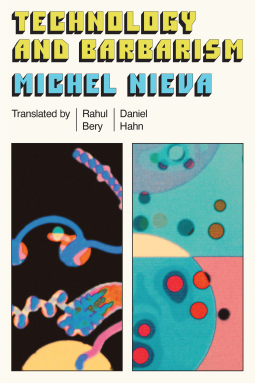
Technology and Barbarism
or: how billionaires will save us from the end of the world
This title was previously available on NetGalley and is now archived.
Send NetGalley books directly to your Kindle or Kindle app
1
To read on a Kindle or Kindle app, please add kindle@netgalley.com as an approved email address to receive files in your Amazon account. Click here for step-by-step instructions.
2
Also find your Kindle email address within your Amazon account, and enter it here.
Pub Date Feb 24 2026 | Archive Date Feb 17 2026
Astra Publishing House | Astra House
Talking about this book? Use #TechnologyandBarbarism #NetGalley. More hashtag tips!
Description
The nonfiction pieces included in Technology and Barbarism, as well as the long essay "Capitalist Science Fiction," constitute the nonfiction alternative to Nieva’s Dengue Boy and has similar potential to achieve cult-status. Equally fast and furious, grounded in deep research as well as far-reaching literary traditions, Nieva writes about the crossroads between civilization and barbarism through history, literature, and the incidence of genetics in the arts and humanities.
Could the inspiration for Kafka's stories have come from his visits to human zoos where he saw indigenous people kidnapped from Tierra del Fuego? Can an algorithm understand the verses of Rubén Darío? Can bacteria write literature? And can a monkey reproduce the complete works of Shakespeare? These are some of the questions that run through this collection of essays, which explores the almost always ambiguous threshold that technology and culture have drawn between what is understood as human and what is not, living and nonliving, and which is the seed of the biggest questions of this century.
From nineteenth century science fiction to contemporary art exhibitions, via a philosophical take on COVID, this book examines the impact of capitalism, indigenous extermination, medical policies in Latin America and elsewhere, in order to interrogate our very identity.
In "Capitalist Science Fiction," Nieva studies the influence of historical "hard" science fiction on technology and capitalism today, with a special focus on Silicon Valley, and a particular spin at the end on, of course, Elon Musk. The essay is totally timely and super smart.
Marketing Plan
MARKETING AND PUBLICITY PLANS • Excerpt to pitch ahead of publication • Pitch author interviews and original pieces • National media campaign including print, radio, podcast, and online coverage • Targeted outreach to reviewers and publications focused on SFF, politics, technology, science, and translation • Original interviews and craft-focused essays with the collection’s two illustrious translators • Select bookstore and festival events for New York-based international author • Academic outreach to translation studies, comparative literature, and creative writing departments • Book club outreach
Available Editions
| EDITION | Other Format |
| ISBN | 9781662603181 |
| PRICE | $20.00 (USD) |
| PAGES | 240 |
Available on NetGalley
Available to Buy
Buy on Amazon Buy on BN.com Buy on Bookshop.orgAverage rating from 12 members

Featured Reviews
 Reviewer 1906824
Thank you NetGalley and Astra Publishing House for sending this book for review consideration. All opinions are my own.
This book felt like a high pressured hose to face in terms of information density, and I loved it. Immediately after this review I will find everything Nieva has written in English and invite him over for tea to discuss technology and politics.
Each essay in this collection is thoroughly researched and herein lies my only complaint. Sometimes it felt like the narrative thread was compromised due to the depth of research. That is, I feel there is an art in choosing what not to write.
Having said that, the writing style was funny, thoughtful, insightful, honest and personal whilst retain objectivity. I would recommend to any one who wants to do Brain Day at the gym.
Also a note to the publisher, with scientific notation the indicie should be present in superscript. That is, with the 2 × 10 -6 on page 207 the -6 should be in superscript.
Librarian 876959
Not the easiest read (the essays were dense and very informative), but utterly fascinating throughout. Made me think, made me smile in more places than I expected, and I found myself raising similar questions with my colleagues and friends-- a mark of a great book and compelling ideas.
Educator 1720878
First essay on capitalist science fiction is incredible, well worth your time. Felt the second half was a little disjointed and not really about sf, but still an effective exploration of the contagion metaphor used historically to discuss indigenous people
 Emma P, Reviewer
4.5 - This was such a smart collection of essays by Nieva (and just makes me want to read his fiction even more than I did previously). Sci-fi has always been political and these essays have equipped me with new lenses to read it through. Thank you Netgalley for the ARC!
 Ian G, Reviewer
This book was incredibly insightful and connected to a number of things I'm reading and teaching right now. My galley has notes for days and this book has added so much to my nebulous "want to read list."
While I liked the structure and progression of ideas, I was a little confused by the final essays in which the author seems to express that genetic modification is okay as long as it's done for the sake of aesthetics and art.
Reviewer 1903196
This book is a timely and unflinching look at technology and society, which I could not put down. It offers an interesting view of different facets of technology, including racialisation, gendering, capitalism and more, effortlessly pulling your focus to the narratives of technology and its harms. I also appreciated how many new angles regarding technology were introduced to me, and it was a revelation to get an in-depth analysis of technology in the context of South America, particularly in the context of Argentina and its nation-building. The author also has a distinct voice and style, which gives the text a cadence and liveliness that emphasises the key arguments being presented and made. This book is perfect for people who want to engage with the issue of technology and contemporary society in a way that pulls focus to the Global South, and it delves into this topic from a myriad of angles, giving an engaged perspective on technology.
Reviewer 520901
Thank you to Net Galley and Astra House. I really enjoyed reading this and learned a lot about the history of science fiction as well as about Argentinian literature.
 Hestia I, Reviewer
The more I read the book, the more I think it suits with whatever we face right now. With advanced technology and the AI which disrupt our lives, Technology and Barbarism can be an essential read for us.
Readers who liked this book also liked:
Trevor Paglen
Arts & Photography, Computers & Technology, Politics & Current Affairs


Andi Watson
Comics, Graphic Novels, Manga, General Fiction (Adult), Humor & Satire





David Shields
Biographies & Memoirs, Essays & Collections, Nonfiction (Adult)