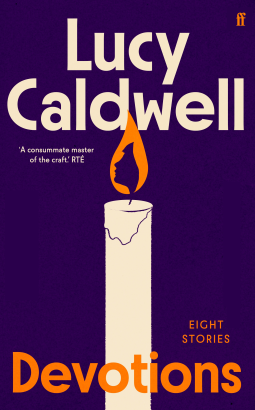
Devotions
This title was previously available on NetGalley and is now archived.
Send NetGalley books directly to your Kindle or Kindle app
1
To read on a Kindle or Kindle app, please add kindle@netgalley.com as an approved email address to receive files in your Amazon account. Click here for step-by-step instructions.
2
Also find your Kindle email address within your Amazon account, and enter it here.
Pub Date Jun 30 2026 | Archive Date Jun 12 2026
Talking about this book? Use #Devotions #NetGalley. More hashtag tips!
Description
A striking new collection from Lucy Caldwell, winner of the E. M. Forster Award from the American Academy of Arts and Letters, the Rooney Prize for Irish Literature, and the BBC National Short Story Award.
"There must be moments when we let go – let go of all that we do, all that we are."
In Devotions, “one of the finest short story writers at work today” (Wendy Erskine) explores yearning for distant pasts and unknown futures.
A woman recalls the time her grandfather claimed to have met Jesus.
A professional musician travels across the world and through her memories with a violin older than the United States.
A young Belfast theater troupe brings its experimental production of Hamlet to New York.
Transporting and profound, these are stories of love, grief, and the ways that lives can be haunted.
Advance Praise
Praise for Lucy Caldwell:
"One of our best short story writers." - The Times
"[Caldwell] holds the reader right up against the tender humanity of her characters." - Eimear McBride, author of The City Changes Its Face
"A next-level author of short stories." - The Herald
Available Editions
| EDITION | Other Format |
| ISBN | 9780571398256 |
| PRICE | $17.95 (USD) |
| PAGES | 208 |
Available on NetGalley
Available to Buy
Buy on Amazon Buy on BN.com Buy on Bookshop.orgAverage rating from 17 members
Featured Reviews
 Reviewer 1915331
I loved the emotional depth of these short stories, each packs a punch. As someone who grew up watching the Sound of Music every year because I had a teacher who loved it, I really enjoyed Little Lands. Hamlet, a love story, and All Grown Up were also favorites.
I hadn't read Lucy Caldwell previously and now want to go read her backlist.
One formatting note -- I read the ARC on my Kindle and there was no formatting to denote when you were moving in-between stories (no page breaks or story titles). I realized what was happening pretty quickly -- but it was still jarring every time it happened. Would recommend using a different reader, when I read it again through NetGalley, there weren't any formatting issues.
Thank you to Lucy Caldwell, Faber & Faber and NetGalley for the ARC.
 Lyndsey G, Reviewer
I have been a fan of Lucy Caldwell’s since I read her short story collection Intimacies, so I have been eagerly awaiting this latest collection! These 8 short stories are not connected by plot but rather shared themes of grief, loneliness, self-reflection, and love. A common thread is artistry - from a Choose Your Own Adventure-style production of Hamlet, to a tender study of the iconic dance scene in The Sound of Music, to the poignant nostalgia of a concert violinist’s first cardboard practice instrument. There is also a haunted castle, Jesus disguised as a traffic cop, a solstice live stream, and a possible pregnancy at an impossible time. Wherever she takes you, the quiet beauty of Caldwell’s writing shines through in every story. She takes everyday moments and makes them resonate, and her stories are reflective and emotional in a way that makes you want to take careful stock of your life. I can’t wait to read the rest of Caldwell’s works.
 Demetris P, Reviewer
Lucy Caldwell’s new collection, “Devotions,” begins in a posture that would have seemed, not long ago, almost embarrassingly unliterary: a woman in bed, phone balanced on her knees, watching a livestream. Below her, children argue over breakfast; beside her, a cat insists on its small, bodily claims. Onscreen, the chat floods with salutations from around the world, the bright, breathless fellowship of strangers gathering for the winter solstice at Newgrange. It is a scene of ordinary modern life – domestic, distracted, faintly ashamed of itself – and it is also a portal. Caldwell is very good at portals: not the fantasy kind, but the ones we live inside and rarely name, the thin places where the banal admits a pressure from elsewhere. By the time that livestream offers its beam of light – a narrow, ancient certainty cutting into an Irish tomb built before the pyramids at Giza – Caldwell has staged, with quiet audacity, a contest between contemporary speed and deep time, between the tyranny of usefulness and the human need to surrender to something that cannot be optimized.
“Devotions” is, on paper, a collection of eight stories. In practice, it reads like an argument for the form itself: not the short story as neat mechanism, but as a container capable of holding what our era most fears – duration, irresolution, reverence without doctrine, attention without pay-off. It is a book preoccupied with the ways we live amid forces we cannot fully interpret: grief that changes shape instead of ending, motherhood that is both miracle and depletion, history that doesn’t stay put, art that can be salvation in one sentence and extraction in the next. Caldwell has long been a writer of intimacy in the strict sense: not mere closeness, but the proximity at which a life becomes morally legible. Here, that intimacy widens into something more spectral. The stories are haunted – sometimes literally, often ethically – by what remains when we leave a room: the residue of despair, the stubbornness of love, the ache of what has been prayed for and what has not.
The title story’s virtuosity is its refusal to posture. Caldwell understands that contemporary spirituality tends to arrive through the side door: a forwarded post, a feed, a “just curious” click that turns into a quiet compulsion. The narrator is not a believer in any tidy way; she is a person trying to survive winter, parenthood, and the modern compulsion to translate living into productivity. The luminous sections in “Devotions” are not the most obviously “poetic” ones. They are the moments when Caldwell lets the mind do what it does under pressure: ricochet. A solstice becomes a meditation on marriage as a long metamorphosis, on the bodily fact of cellular renewal and the persistence of the self, on an archaeology article about Ice Age children drawing charcoal scribbles that earlier excavators mistakenly dignified as “enigmatic signs.” That last detail – the sober adult desire to decode what is, in truth, simply a child’s hand learning itself – could stand as a parable for the entire collection. Caldwell is fascinated by the interpretive impulse, by our need to make meaning, and by the violence we sometimes do in the act of making it.
You can feel, beneath the story’s solstice glow, a weather system of contemporary dread: climate instability named plainly, the slow darkening of winters, the way even summer can feel less like triumph than like a countdown. But Caldwell’s gift is that she will not convert dread into a speech. She understands that what we call “current events” is often, for most people, lived as atmosphere: a sense of the air changing, the pressure dropping, the light thinning. A livestreamed ritual becomes, in her hands, a secular sacrament and a study in the modern bargain: we crave awe, but we experience it mediated, miniaturized, framed by obligation. The narrator remembers, with the sting of an old wound, an earlier pilgrimage to “Stonehenge” that failed to deliver transcendence, as if the self’s inability to feel properly were a moral flaw. That fear – that there is something lacking in us, that we are not correctly calibrated for wonder – appears throughout “Devotions” in different guises. Caldwell treats it not as pathology but as a central modern ache.
If “Devotions” is the collection’s thesis on surrender, “The Lady of the House” is its thesis on appetite – the appetite of the past, the appetite of despair, the appetite of art. Written in the second person, it begins with a classic horror mechanism: you wake from a nightmare into a room that seems to have inherited the nightmare’s presence. The story’s setting is exquisitely chosen for a certain strain of contemporary longing: a converted gatehouse tower in Aberdeenshire, the ruin of an eleventh-century castle repurposed into an Instagrammable dream of sheepskins, tartan, antiques, and curated rusticity. Caldwell has a sharp eye for the aesthetics of refuge – and for how easily refuge curdles into a stage set. The narrator is a young actor, two years out of drama school, successful “on paper,” yet gnawed by the feeling that something inside her is closed, blank, insufficiently real. She has come north to her older sister – newly a mother after years of IVF – hoping for advice, for anchoring. Instead, she finds a landscape thick with history and a house that seems to store more than objects.
In less sure hands, “The Lady of the House” might have been satisfied with its ghost. Caldwell uses the supernatural as a lever to pry open a more disturbing question: what does it mean to “channel” someone else’s despair? Acting training teaches you to locate the harmonic inside yourself, the tiny seam of grief or fury that can be amplified into believable performance. Caldwell turns that pedagogy into a metaphysics: perhaps stories, too, seek their harmonics. Perhaps a woman’s old despair recognizes a latent frequency in a young woman and takes hold. Perhaps the past is not merely remembered but recruited. The apparition in this story is ambiguous in the best way: it might be a malign presence, or it might be the psychic residue of sorrow, or it might be the narrator’s own hunger given form. The ethical chill arrives when the narrator begins to imagine turning the “Green Lady” into art – a first play, a starring role, a story of “female despair” and “witches” that will, she believes, finally unlock her range. In that moment, the story pivots from Gothic to critique: of creative ambition, of the temptation to extract beauty from suffering, of how easily empathy can become a claim of ownership.
Caldwell’s intelligence is never simply conceptual; it is sentence-level. She can move from the tactile comedy of family memory – one leg self-tanned on a holiday, the rule that you must eat two nuts for every raisin – into the gutting revelation of what IVF has done to a person’s body and selfhood. She can sketch a sister’s exhaustion in a few details: thinning hair, hooded eyes, a gratitude so raw it hurts to witness. That exhaustion is not incidental. “Devotions” is full of people trying to keep themselves intact while caring for others: mothers, daughters, spouses, artists. The stories take place against a background that feels recognizably ours: overstretched time, porous boundaries between work and home, the modern shame of wanting to stop. There is a quiet politics in Caldwell’s insistence that devotion is not synonymous with productivity. Her characters are not seeking a brand of wellness. They are seeking, more modestly and more radically, permission to be human.
Caldwell’s affinities are visible, and she does not seem interested in disguising them. You can feel, in “A Family Christmas,” the long shadow of “The Dead,” not as homage but as a psychic argument with a predecessor: what does it mean, now, to stage a holiday gathering as a site of revelation when revelation itself can feel like an imposition? Across the collection, Caldwell’s sense of time – folded, recursive, porous – recalls the clean, listening architecture of Rachel Cusk’s “Outline,” where meaning arrives through attention rather than event. And in the best stories, particularly those that braid private life with history and ritual, there is something of Doireann Ní Ghríofa’s “A Ghost in the Throat”: that sense that devotion can be a form of haunting, and that to love a story is sometimes to risk being possessed by it.
But Caldwell is not a mimic. Her sensibility is distinctly her own: Irish, yes, but not parochial; lyric, but not ornamental; emotionally frank without confession as performance. The story about the professional musician traveling “across the world and through her memories with a violin older than the United States” is described, even in premise, as a kind of secular inheritance tale: the instrument as relic, as burden, as continuity. “Harmony Hill,” commissioned for the BBC Proms, is likewise concerned with music as devotion – discipline, lineage, the body as archive. One of Caldwell’s recurring miracles is her ability to treat craft not as mere detail but as a moral language. Music, acting, even the running of a household: these are presented as practices of attention, each with its own temptations toward vanity and its own possibilities for grace.
Grace is a word Caldwell handles carefully. In “Devotions,” grace is not a reward for virtue; it is an “unsought-for gift,” arriving, if it arrives, when the self stops clenching. This is why the book feels contemporary in a way that has nothing to do with topicality. We live in a culture that treats interior life as content and solitude as failure. We are taught to narrate ourselves in public – to produce meaning quickly, to turn experience into evidence. Caldwell’s stories resist that entire economy. They ask what it costs to live always translating, always extracting, always trying to make one’s life legible to an imagined audience. The stories are interested in social media and livestreams not because Caldwell wants to be “relevant,” but because these are now among the primary sites where people seek ritual, community, and consolation. A solstice livestream is not a gimmick; it is, for many, the only available altar.
That said, the book’s virtues occasionally create their own risk. Caldwell’s intelligence can, at moments, drift toward explicating its own wonder. A few passages in the title story flirt with the essayistic, with the voice stepping slightly ahead of the lived moment to name the theme. This is not a fatal flaw – the writing is too alive for that – but it is the reason the book does not reach the icy perfection of a Munro at her most ruthless. Caldwell’s generosity sometimes shows its seams. She wants, you feel, to bring the reader along, to make the coordinates “real and precise,” to use her own phrase, and the impulse can lead to a touch of overillumination.
Yet even this is consistent with the collection’s moral atmosphere. Caldwell is a writer of responsibility. Her stories are not content to be beautiful; they want to be accurate. They want to be fair to the mess of living, to the contradictory truth that a person can be exhausted and grateful, skeptical and yearning, ambitious and afraid of ambition. The collection’s hauntedness is not merely about ghosts; it is about inheritance in the broadest sense – the ways family stories lodge in the body, the ways history persists in place names and ruins, the way a mother’s fear migrates into a child’s future. “Devotions” is full of such migrations. It understands that what we call “faith” often survives the death of doctrine. It becomes, instead, a practice: showing up, listening, holding hands, waiting in the dark for a beam that may not arrive.
The finest achievement of “Devotions” may be its refusal to treat devotion as a virtue-signaling posture. In these stories, devotion is sometimes tender and sometimes terrifying. It can be a mother’s attention, a musician’s discipline, a writer’s loyalty to the sentence, a community’s midwinter gathering, a young actor’s desire to be inhabited by something “real.” It can also be a hunger that takes what it wants. “The Lady of the House” ends with a shiver of precisely that ambiguity: the suspicion that a story, once invited in, may not remain a story. Caldwell leaves us in that unsettled space – the space where art, memory, and the past press too close – and she does not resolve it into reassurance.
A great deal of contemporary literary fiction is either anxious to prove its relevance or determined to float above the mess of the moment. Caldwell does neither. She writes as if relevance were an insufficient aim and timelessness a kind of avoidance. Instead, she offers something rarer: a book that behaves like an instrument, tuned to the frequency of now without being trapped by it. Read “Devotions” in a year of climate dread, post-pandemic fatigue, and exhausted belief systems, and it feels not like commentary but like companionship. It reminds you that people have always lived with darkness, always tried to build structures – monuments, stories, rituals – that might hold them through it.
That is why, as a work of short fiction, “Devotions” earns a 91/100. It is not perfect, but it is deeply accomplished: intellectually serious without being stiff, emotionally bracing without being coercive, formally controlled while allowing mystery to remain mystery. It does what the best books do – it doesn’t merely tell you what devotion is. It changes, almost imperceptibly, the angle at which you look at your own attention, your own longing, your own winter.
 Jess K, Librarian
I was already a huge Lucy Caldwell fan, so my expectations were high, and yet she still exceeded them. This felt like a real evolution of her craft. As is the case with all the others, there are several stories here that I will continue to think about for some time.
 Danielle D, Librarian
Lucy Caldwell remains one of my absolute favorite writers of all time, and dare I say this is my favorite of her short story collections yet... Each story is distinct and moving, yet the emotional through-line felt clear. These characters are devoted in an all-consuming way, to their art or their families or their inner lives. The writing in every single story is gorgeous -- a masterclass in the short story, from opening lines to satisfying endings (even when open-ended).
Thank you to Faber & Faber and NetGalley for the chance to read these stories early. I was not going to make it to mid-2026!
Reviewer 1915829
I’d seen that Lucy Caldwell was from Belfast, but I still didn’t expect so many of the stories in this book to feature Northern Irish characters. I grew up in N.I., so it was really lovely to see words like “banjaxed” or “baltic” written on the page. I’ve been craving a book like this, casually set in a place that is special to me. The market for Northern Irish stories (which is already very small) is oversaturated with books about the troubles. That’s not to say that those stories shouldn’t be told, it’s important to talk about N.I.’s history, but N.I. Is also so much more than that! It’s a place full of ordinary people living ordinary lives, sometimes tragic ones unrelated to sectarian violence. Devotions tells these stories. I’ll have to look into more of Lucy Caldwell’s work.
 Nicholas A, Reviewer
I requested and received an eARC of Devotions by Lucy Caldwell via NetGalley. In this collection of stories by the Northern Irish author Caldwell, readers are offered an intimate glimpse into the everyday rituals that transcend into personal acts of devotion. In "Hamlet, a Love Story" a widowed actress navigates loss and the waves of grief, while another story offers a close reading of the The Sound of Music. "All Grown Up" tells the story of a man who returns to Northern Ireland to clear out his childhood home following his mother's death, while "The Lady of the House" acts as a modern ghost story.
This is my first encounter with Caldwell’s writing, so I didn’t approach the text with any sort of notion about what I would be getting. I found it surprisingly easy to be lured in by Caldwell’s prose, which she clearly has a very strong command of. Each of these stories was emotionally resonant and packed a punch in a different way. The collection opens with “Hamlet, a Love Story”, which I think was a wise decision. This particular story really hooked me with the beautiful musings on art and grief and paired very nicely with the story that followed, “A Family Christmas.” I personally connected less with “Harmony Hill” and “Little Lands” but still found value in them within the collection as a whole.
“The Lady of the House” and “The Day He Met Jesus” were both tremendously interesting to me, especially the former. I will be thinking about both of them for some time to come. I really found the titular story, “Devotions”, to be quietly lovely. The real centerpiece of this collection, however, was “All Grown Up.” This story really struck me somewhere deep in the core. Ultimately, I really enjoyed Devotions. These are beautifully written stories that find profundity in the ordinary and take the reader on an emotional voyage.
Oliver D, Bookseller
This title is a selection of vignettes tied so closely to the reality of devotion, it was both impossible to stop reading and difficult to continue on. Each sentence is purposefully tactile and even can find itself leaning toward essay when the situation calls for it. Beneath every character is an awareness of the state of the world. Instead of making these stories about this dread, Caldwell understands that for the vast majority of us, this is simply an atmosphere we all exist in as we must keep living our lives. And live, these characters certainly do. This collection is sure to resonate, as it manages a beautiful reflection on the everyday in an impressively short amount of time.
Reviewer 1852317
A charming collection of sharply observant, acid-sketched short stories exploring the emotional and psychological nuances of the ways we express and experience devotion, attention, and love. I’ve been a fan of Caldwell for years and was delighted to get to read this new collection. As always, her prose is gorgeously precise and her stories exquisitely crafted. Devotions is a thought-provoking and compelling read.
Susan D, Reviewer
Devotions is a collection of eight short stories by Lucy Caldwell, all either set in or with a nexus in Northern Ireland which is Caldwell’s home. The stories are quite varied in subject but reveal characters at vulnerable points in their lives where physical, emotional, spiritual or other problems are overwhelming them. She handles each story individually in a way arising from the situation. I’m struck by her skills and plan to seek out her earlier collections.
My favorite stories here are “Hamlet, a love story”, in which a punk version of Hamlet brought from Northern Ireland is ending its run in New York; “Little lands”, a fly’s eye view of the making of The Sound of Music— one scene in particular; “Harmony Hill”, a story of music; “All grown up”, a man’s reaction to his mother’s death; and “The lady of the house”, which seems to be a search for inspiration.
Recommended for short story readers.
Thanks to Faber & Faber and NetGalley for an opportunity to read an eARC of this book.
Readers who liked this book also liked:




Publishers Lunch
General Fiction (Adult), Nonfiction (Adult), Teens & YA