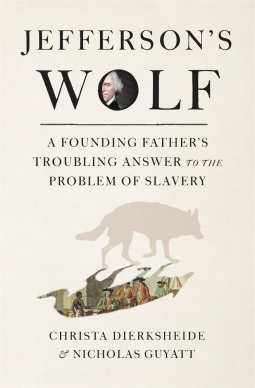
Jefferson's Wolf
A Founding Father's Troubling Answer to the Problem of Slavery
This title was previously available on NetGalley and is now archived.
Send NetGalley books directly to your Kindle or Kindle app
1
To read on a Kindle or Kindle app, please add kindle@netgalley.com as an approved email address to receive files in your Amazon account. Click here for step-by-step instructions.
2
Also find your Kindle email address within your Amazon account, and enter it here.
Pub Date May 5 2026 | Archive Date May 5 2026
Harvard University Press | Belknap Press
Talking about this book? Use #JeffersonsWolf #NetGalley. More hashtag tips!
Description
A decisive reassessment of Thomas Jefferson’s long-debated views on slavery, showing that his chief antislavery strategy was racial exclusion: the removal of emancipated Black people from the United States.
Toward the end of his life, Thomas Jefferson made his most famous statement about American slavery: “We have the wolf by the ear, and we can neither hold him safely, nor let him go.” Presenting abolition as both necessary and perilous, the phrase has long been relied upon to explain an apparent paradox: despite publicly opposing slavery for four decades, Jefferson had made no progress toward Black freedom in his political career by the time he died in 1826. Nor had he done so in his expansive household, where he enslaved more than 600 people, including Sally Hemings and the four children he fathered with her.
Christa Dierksheide and Nicholas Guyatt argue that the key to understanding Jefferson’s antislavery position is his commitment to racial exclusion. Jefferson believed that the principal reason to abolish slavery was the threat of a massive slave revolt, but he viewed the presence of free Black people in the new nation as no less dangerous. To avert racial violence, Jefferson argued, the gradual abolition of slavery had to be paired with Black exile. Even when challenged by white and Black contemporaries with more expansive views of American belonging, Jefferson held fast to his vision for a white republic.
Neither an egalitarian antiracist nor a proslavery apologist, Jefferson became the most influential advocate for racial separation in the early United States. Charting the evolution of his thought across the nation’s formative decades, Jefferson’s Wolf is a surprising and provocative account of the problem of slavery in the founding era.
Christa Dierksheide is Brockman Foundation Jefferson Scholars Foundation Professor of History at the University of Virginia. She is the author of Beyond Jefferson: The Hemingses, the Randolphs, and the Making of Nineteenth-Century America and Amelioration and Empire: Progress and Slavery in the Plantation Americas, 1770–1840. Formerly the Historian at the Robert H. Smith Center for Jefferson Studies at Monticello, she has curated and contributed to numerous related exhibitions. Nicholas Guyatt is Professor of North American History at the University of Cambridge. He is the author of The Hated Cage: An American Tragedy in Britain’s Most Terrifying Prison, Bind Us Apart: How Enlightened Americans Invented Racial Segregation, and Providence and the Invention of the United States, 1607–1876. His writing on American history and politics has appeared in the New York Times, the London Review of Books, the New York Review of Books, and elsewhere.
Advance Praise
"With insight, honesty, and eloquence, Christa Dierksheide and Nicholas Guyatt have given us an invaluable study of the troubling complexities of Thomas Jefferson's views on race and slavery. The story is neither simple nor heroic—but history, like human nature, is rarely simple or heroic. This is an important and illuminating account of forces that remain deeply relevant today: power, race, and the aspirations as well as the derelictions of American democracy." - Jon Meacham, Pulitzer Prize–winning author of Thomas Jefferson: The Art of Power
"A provocative and necessary book. The United States was founded in the period when modern European notions about race—shaped by the enslavement of Africans—were coalescing. Offering an insightful account of how the nation's third president viewed slavery, Jefferson's Wolf illuminates this era of American history in ways that still resonate today." - Annette Gordon-Reed, Pulitzer Prize–winning author of The Hemingses of Monticello: An American Family
Available Editions
| EDITION | Hardcover |
| ISBN | 9780674278325 |
| PRICE | $29.95 (USD) |
| PAGES | 256 |