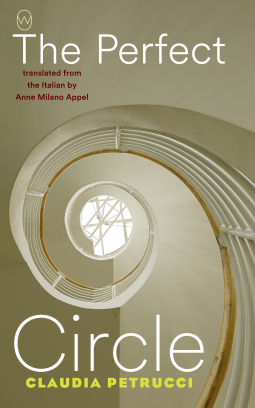
The Perfect Circle
This title was previously available on NetGalley and is now archived.
Send NetGalley books directly to your Kindle or Kindle app
1
To read on a Kindle or Kindle app, please add kindle@netgalley.com as an approved email address to receive files in your Amazon account. Click here for step-by-step instructions.
2
Also find your Kindle email address within your Amazon account, and enter it here.
Pub Date Apr 7 2026 | Archive Date Apr 14 2026
Talking about this book? Use #ThePerfectCircle #NetGalley. More hashtag tips!
Description
"A thrilling study of time that playfully intertwines birth and death, motherhood and human extinction." —Kirkus Review
In the round house on Via Saterna, its Palladian square exterior nothing but a trompe-l’oeil, the sun pierces through the central skylight. Its rays pass three floors unobstructed, before reaching the circle below at the heart of the house: four fingers of water filling a little silver basin. It is here that young Lidia dies, setting an end to her clandestine love affair with the ambitious architect. It is this house that real-estate agent Irene is asked to sell, decades later, as the climate catastrophe escalates, cloaking the divided city in a permanent orange haze. Returning to her native Milan for the sale, Irene feels the brunt of her father’s judgement. He is a proud Italian and prouder architect—how could his own daughter make a living selling cultural patrimony to the highest foreign bidder? As she faces this new Milan and the old family tensions she had avoided while living in Rome, Irene throws herself into the impossible sale, getting to know Via Saterna intimately—this space that is as unsettling as it is hostile, with the slowly emerging traces of Lidia’s interrupted life. In every room of the house, the burden of a mysterious, unresolved past can be felt, remnants of a selfish and manipulative love.
The Perfect Circle tackles themes like time, death, and repetition with depth and originality, while carrying its philosophy lightly. Through it all, the novel is a subtly disturbing page-turner, every new page adding a new layer and twist.
Advance Praise
Praise for The Perfect Circle
“Claudia Petrucci makes climate emergency a literary motif, in a story that spirals, like the interior of the house in the novel, before closing in ‘a perfect circle.’” —Lorenza Gentile, La Stampa
“Claudia Petrucci gave the plot of her book a circular pattern. It can be seen in the constant alternation between the two timelines of the novel, which unfolds like concentric circles—a story perfectly told.” —La Lettura, Il Corriere della Sera
“A refined revenge story … A satisfying novel that keeps you guessing and in suspense until the very end.” —Il Piccolo
Praise for The Performance
“All the world’s a stage … In this English-language debut, Claudia Petrucci provides a fresh take on an age-old issue: the blurred lines between art and life. In the novel, set in Milan, a woman working in a grocery store returns to the acting profession she once loved. She is an incandescent actor but soon suffers a complete breakdown, showing signs of life only when reading scripted scenes. What follows is a tangled Pygmalion story in which her boyfriend and her theater director conspire, each with his own motives, to shape her anew according to their own script.” —The Millions Most Anticipated
“An unsettling and stunning tale … Petrucci’s captivating character-driven debut explores the boundary between reality and illusion in the theater world.” —Publishers Weekly, starred review
“What’s left of an actor when she leaves the stage? Who is she when she takes off her mask and is no longer just a character? These are some of the questions running through Claudia Petrucci’s debut novel, The Performance, and they make for a very intense and original story.” —La Republica
“A daring, staggering debut novel.” —Elle
“Lush, relentless and fast-paced, The Performance is a story that lingers in the mind long after the curtain falls.” —Literary Review
“Claudia Petrucci’s debut novel is a dazzling story that straddles the line between fiction and reality, between love and possession.” —Esquire
Marketing Plan
- Advance galleys and digital reader copies
- Digital assets including trailer & author video
- Signed book plates available
- National TV, radio, print, and online review campaign
- Consumer-facing national advertising campaign on Shelf Awareness, Lithub, NPR, Foreword Reviews, Goodreads
- Virtual or in-person author events
- Book club discussion guide
- Bookstore co-op available
- Excerpt placement
- Social media campaign & Goodreads Giveaway
Available Editions
| EDITION | Other Format |
| ISBN | 9781642861631 |
| PRICE | $19.99 (USD) |
| PAGES | 242 |
Available on NetGalley
Available to Buy
Buy on Amazon Buy on BN.com Buy on Bookshop.orgAverage rating from 31 members
Featured Reviews
 Andrea D, Reviewer
There is something hypnotic about this dystopian novel. Petrucci builds a story inside a house that feels alive, a Palladian square hiding a perfect circle at its center. That image stayed with me the entire time I was reading.
The novel moves between two women separated by decades. Lidia, trapped in a love that burns, dies in that circular room at the bottom of the house. Irene, a real estate agent returning to Milan, is asked to sell the mansion in a city drowning in an orange haze and the effects of climate change. The house becomes the hinge, a space that holds everything unresolved, everything unspoken. Petrucci includes the house like a character.
Irene’s chapters felt especially sharp. Her father’s judgment, the pressure of returning to her hometown, while Milan itself feels on the verge of collapse. Her sections are claustrophobic. Meanwhile, Lidia’s story grows in haunting fragments, each new detail revealing the manipulation that shaped her last days.
What I loved most was that the book is that the story works like a slow echo between the two women. Every time Irene steps deeper into that house, she steps closer to Lidia’s unfinished life. Every page adds one more layer.
This one is quietly unsettling and beautifully constructed. Perfect for anyone who likes their literary fiction with a ghostly undertone.
#worldedition #bookstagram #claudiapetrucci #ThePerfectCircle #italianfiction #netgalley #readingcommunity #booksbook
 Reviewer 1911600
Lots of shapes in this; circles (titularly), triangles, squares? Maybe.
Anyway I loved it, this had everything I could have wanted: mystery, real estate, lesbians? Maybe.
I really enjoyed the structure of this, moving forwards in the ‘present’ while backwards in the ‘past’ to unwind a story in both directions to come together to a shocking, satisfying but believable ending. I found all the character arcs engaging and well combined together to create a believable web of relationships that drive the story forward. The setting was also immaculate, dropping enough hints to the setting without feeling the need to explicitly tell us what’s happened and what it all means. I don’t know if there’s other stories coming from this world but I’m eager for it!!
Definitely a recommended read from me
 The Secret B, Reviewer
✨🏛️ The Perfect Circle by Claudia Petrucci is a beautifully eerie story where two women in different timelines become connected through one strange and unforgettable house in Milan.
Irene returns home to sell an unsellable mansion, only to find the place pulsing with traces of Lidia, a young woman who died there decades earlier in the middle of a secret and destructive love affair.
As Irene navigates family tension, climate chaos and her own doubts, the past begins to surface in ways she cannot ignore.
I loved the structure of this book. The present moves forward while the past moves backward, each chapter revealing another secret until both timelines meet in a clever and satisfying ending.
The characters feel rich and real, their lives intersecting in a web of ambition, betrayal and desire. The setting is immaculate too, full of subtle clues that build an atmosphere of quiet dread without ever over explaining.
If you enjoy literary mysteries with a touch of the uncanny, layered storytelling and stories where houses keep their memories close, this one is a brilliant pick.
Read more at The Secret Book Review.
 Denise I, Reviewer
This is a beautifully written book that takes on multiple themes.
This book is about longing. Longing for a feeling you expect to have after doing everything right, and realizing it never arrives. Longing for a connection that is supposed to be there, but fades away. Longing for a future that never came.
This book is about, to borrow a term from Henrike Kohpeiß, the bourgeois coldness of a woman who has the privilege to ignore the environmental crisis around her, an emotional detachment, an indifference to the perpetual fog hovering over Milan, protected by the social and material privilege that allow her to remain untouched by the crisis she is living in.
But, more than anything, I think this book is about memories. The persistence of it. How intricately it is tied to objects and imbues meaning to it, to otherwise cold concrete or stagnant water or dusty paintings. And yet how it persists even after an object is destroyed, long after people have come and gone.
I absolutely recommend this book. Thoughtful, elegantly written, and reflective.
Thank you to NetGalley and the publisher, World Editions, for providing an ARC of this book.
 Sheila L, Reviewer
There are so many layers to The Perfect Circle. Dystopian, disturbing, intriguing, I enjoyed the storyline. I admit, I did not see where it was going. Very well.done.
 Gillian M, Reviewer
⭐️⭐️⭐️⭐️
The Perfect Circle is a beautifully written, atmospheric novel that lingers long after the final page. Rich in setting and mood, it weaves together architecture, memory, and unresolved grief with quiet intensity. Thought-provoking and original, this is a reflective, immersive read that rewards patience.
Brooke P, Reviewer
I was SUPER excited to receive the ARC for The Perfect Circle, but I’ll admit, I was a little skeptical for about the first 20% of the book. The dialogue at times felt a little awkward, but I think that may be due to this being a translation from Italian to English and not necessarily the writers fault (or maybe that’s just how Italians speak lol). There was also a conversation in the beginning with Irene and her friend that essentially went - Francesca: you should have kids Irene: I don’t want kids Francesca: but you should look into ivf Irene: well I guess now’s the time to get pregnant, I should look into ivf. Like I said, I think the translation may be part of the problem, but the complete 180 in Irene’s attitude was really confusing and not explained at all at that point.
HOWEVER, once I got about 20-25% and the plot really started developing I completely forgot about all of that. Dual timelines that connect in certain aspects is one of my favorite types of narratives and I really think Claudia Petrucci did a great job. All of the female characters felt very alive and complex, while the male characters often felt kind of flat and weren’t super integral to the plot, almost like they were just there to help progress the women’s stories and nothing else. It was obvious you were supposed to care and pay attention to the women, and it was refreshing.
Overall this was my first translated read, so I’m not too sure how to feel about the quality of the writing as it’s not in the authors native language, but the plot and characters were amazing. I would definitely recommend this to anyone.
 Kell X, Reviewer
This speculative literary novel is slow to start, but the story crept up and astonished me.
Petrucci’s writing is subtle, meticulous, with a detached quality that mirrors her present-day protagonist, Irene. In a second plot line set in 1985-6, Lidia owns the house that Dario is rebuilding, and the two are involved in a passionate affair. The emotional prologue is so unlike the restrained introduction to Irene’s character as to be jarring. Lidia and Dario’s story is told is reverse order, beginning the book with her tragic death and ending with their first meeting. When this affair is at its most passionate, Irene is almost a blank; set against each other, the former seems overwrought while the latter struggles to be interesting.
Once Irene is in Milan, the book begins to come alive. This coincides with a closer look at 7 Via Saterna, the same house Lidia once owned. Irene’s work auctioning grand buildings is fittingly removed from the creation process, instead focused on precise re-creation of how the space looked when occupied. Scenes of Irene cataloguing 7 Via Saterna’s contents and setting it to rights are fascinating, and further demonstrate her controlled character. Also in this space is Lidia, a student who mysteriously shares a name and age with the former owner. This Lidia temporarily resides in the house and begs Irene for permission to stay, Irene thaws while they share the work of restoration, and soon the young woman is taking Irene to Milanese monuments outside the checkpoints of her family’s and Via Saterna’s wealthy neighbourhood.
Petrucci’s spatial descriptions are wonderful. The house is a primary setting, distinguished by spiral staircase lighted by skylight three floors above is a grand image, made alluring by the glimmer of water from a central pool. In the present day, thick smog clouds the air over Italy and the skylight is ineffective. Outside, the fog obscures buildings that once thrust into the skyline. Petrucci invites the reader to reflect on human design as a way of adapting the natural environment: controlling light, water, the body through the use of concrete materials. Irene attempts to separate the people from the environment, but later seems to sense this conflict, for when she takes display photos of the property, she places the second Lidia back into them, capturing the body like it is part of the building’s anatomy.
Through the female characters (Lidia and Lidia, Irene, a friend and a sister), Petrucci choreographs a motif of youth and aging. Irene peeks at Lidia with a yearning for lost time that surfaces also when she contemplates pregnancy and when her sister urges vaginal botox. The book seems to say that Irene can remember the sun, but is inert; Lidia is plagued by hopelessness, but could do and be far more. There is the dead girl, who has the everything, sun included, but doesn’t live; and there is Carla, Dario’s wife, who is defined by her adherence to a heteronormative family role.
Where all of Petrucci’s characters are hazy as the fog outside, there is greater uncertainty around the men. Lidia’s one-time fiancé has little influence on her. Irene notes her father’s disappointment without much reaction. She leaves her boyfriend’s messages unread. Via Saterna’s patriarch became embroiled in debt and disappeared. Dario is a major player only in the single context of Via Saterna; without Lidia as lover and muse, he’s obscure. It’s a novel of confident women navigating space constructed by absent men. Petrucci is masterful in describing the edges and adding details until we see the whole design.
The Perfect Circle is an intelligent and convincing story that explores its themes well. I look forward to a reread and/or more by the author.
I received an advance reader copy of this book in exchange for an honest review. Thank you to NetGalley, World Editions, Claudia Petrucci, and Anne Milano Appel for the opportunity.
Mandy J, Reviewer
This intriguing and atmospheric novel centres on a mysterious house in Milan and the secrets hidden within its unusual design. The story follows Irene Sartori, a real-estate agent who specialises in selling historic Italian properties to wealthy international buyers. When she is asked to find a buyer for a strange, long-unsold mansion, she becomes drawn into the building’s unsettling history. As Irene investigates the property and its past, another narrative slowly emerges from decades earlier, involving a tragic death and a complicated love affair linked to the house. Decades earlier, a young woman named Lidia died after falling down the stairwell of the same house, ending a secret relationship with an ambitious architect. All this is set against climate change which has resulted in the city being cloaked in a strange orange case, adding to the unsettling atmosphere. The novel moves cleverly between the two timelines, but although I was intrigued by the premise at the start, by the end I was getting confused and found the plot more and more unconvincing. Intriguing and atmospheric, yes, but overall it didn’t work for me.
Reviewer 1694782
This was a fun and well-structured book. We get to to see two storylines, one set in the 1980s and one in the near future, one going up a spiral staircase and the other coming down, intertwining and neatly coming together. Finishing the book gave the satisfaction of putting in place the last stone of a beautiful home that was carefully made according to its blueprint.
The protagonist of the main storyline is a real-estate agent, working through the ever-present yellow fog of climate collapse to sell expensive buildings that will soon be taken over by nature anyway to the ultra-wealthy. Her pride in her work leads her to take on the sale of a strange home, a house that reveals its origins in the other storyline.
I really liked how climate change and threatening political developments created a realistic backdrop for this story. It's not just a good drama about connection, love and betrayal. It's also about privilege and about who's being hit earlier and harder than others due to our changing climate. It's about whether it's ethical to bring forth children in a world like this. And what kind of actions are justified to have a chance at saving yourself?
I think the opening chapter was written a bit too dramatic, which was a pity, but I quickly got sucked into the story anyway in the pages afterwards. A few conversations felt a little stilted, but it wasn't too jarring.
Overall I had a great time reading this. If you like unlikeable main characters, climate fiction, tales of revenge, and/or architecture getting woven into stories, you might like this too.
Reviewer 1831605
Beautiful self-referential story that spirals in and out of itself with its structure and themes. Set alternatingly between between a lightly dystopian near future where the enviromental degradation of global warming has caused extreme weather including a pervasive fog and 1985 in Milan, the central story revolves around an architecturally interesting house. The future timeline progresses linearly but the 1985 timeline is told in reverse with the stories converging finally to a dramatic and satisfyingly interconnected finale at the end.
The setting — foggy Milan and the circular house are vividly illustrated while the characters are at time distant and lost in the metaphorical and physical fog of their memories and personal lives. At times this sense of detachment was frustrating to read but it created a unique and compellingly memorable atmosphere.
The Perfect Circle combines deeper themes surrounding aging and the passage of time (personal, architectural, global), class privilege in the face of environmental destruction and temporal/spacial construction with propulsive and intriguing storytelling.
 Nicole C, Reviewer
The Perfect Circle by Petrucci is a smart, atmospheric novel that blends architecture, mystery, and social commentary. Irene Satori, who auctions off crumbling mansions in Rome and Milan, is given the opportunity to sell a striking house in Milan: square on the outside, a perfect circle within, crowned by a skylight and anchored by a pool of water below. We know from the start that its first owner fell (or jumped) to her death there, and that she was entangled with the architect, Dario. The story moves between the 1980s, when the house was built, and the present-day investigation, slowly revealing what really happened.
I loved the dual timeline and the slow layering of secrets, especially Irene’s unexpected connection with Lidia, a squatter she discovers inside the home. The larger backdrop also adds depth: persistent fog in Milan, subtle but pointed nods to climate change, and a Europe of walled cities keeping refugees out. I didn’t see the major reveal coming, which made the ending especially satisfying.
 Catherine O, Reviewer
I've noticed that everyone else seems to have reviewed this book as a piece of art. I am afraid I am all about the plot, which is also very clever.
Set in two timelines The Perfect Circle is the story of a house - 7 Rue in Milan. In 1985 Lidia is engaged to be married and has been given a house by her father but she wants big changes and employs architect, Dario, to bring a fresh new look to the building. But as time passes Lidia and Dario begin an affair despite Dario being married with children.
At some unnamed time in the future Irene Sartori, a real estate agent, has been charged with getting the house on Rue Saterna ready for auction. Sartori is an expert at selling historically important houses and sets about organising the unusual but unused house. However she soon finds the house has a resident - what should do about the frightened girl she finds there and what is her real story?
This book brings in so different elements, weaving the history of the house along with the girl's story and Irene's own personal circumstances with her parents and desire for a child. The book is quite short but feels like a slow burn right up until the explosive end, which took me completely by surprise.
The characters of Irene and Lidia feel quite ethereal throughout and Milan itself almost feels like another character as the strange fog that descends over the city changes the nature of everything that happens.
I really did enjoy the book and the end is excellent. Definitely recommended.
Thankyou to Netgalley and World Editions for the digital review copy.
 Mel J, Reviewer
The Perfect Circle is an atmospheric and thoughtful novel that blends mystery, family tension, and a quiet sense of unease. The setting—a haunting, architecturally striking house in a climate-scarred Milan—is one of the book’s strongest elements, creating a mood that lingers even in its quieter moments. As Irene uncovers fragments of the past, the story gradually reveals themes of loss, ambition, and the complicated ties between people and the places they inhabit.
At times, the pacing is slow, and the philosophical reflections may feel a bit heavy, but the novel’s reflective tone and eerie atmosphere keep it engaging. While not every thread feels fully resolved, the layered storytelling and sense of melancholy make it a worthwhile read for those who enjoy literary fiction with a touch of mystery.
The publisher provided ARC via Netgalley in exchange for an honest review.
Jessie D, Bookseller
In the Perfect Circle you follow two women far apart in time as their two lives start to overlap and things begin to unravel. This is a book about longing, privilege and more than anything else, memory. The Perfect Circle had everything that I loved: a winding structure, an immaculate setting and satisfying character arcs. The writing was beautiful, the characters interesting and the overall tone incredibly engaging. I'll definitely be recommending this one.
Dmitry P, Reviewer
The book follows Irene, a 42-year-old Italian real estate agent who specialises in selling heritage houses to wealthy investors, just as the first signs of environmental collapse begin to affect the world around her. The story unfolds across two timelines: the book’s “present” (sometime in the 2030s), when Irene takes on the sale of an unusual house built by an architect in 1985, and the story of how that house came to be.
In 1985 we witness the architect’s growing romance with the house’s owner, a woman much younger than him. In the present, Irene grapples with ageing and loneliness while trying to decide whether she still wants children. Her life becomes further unsettled when she discovers a young woman squatting in the house she has been hired to sell.
The story is deeply engaging and intimate. The writing is intense and almost visceral. There is something almost architectural about the way the narrative is constructed. Irene’s personality, with all its layers, is exquisitely shaped. Each layer reveals something unexpected while remaining entirely consistent with what came before.
The ending perhaps should not have surprised me, but it absolutely did. I was genuinely taken aback, which rarely happens to me anymore. The author builds a narrative web that quietly draws the reader in, and the skill required to achieve that is remarkable.
The only element I liked less was the broader climate-crisis setting. It never felt as though it meaningfully contributed to the story itself. At times the prose also felt slightly too clinical and distant. It is difficult to explain precisely why, but the tone seemed less warm and empathetic than the subject matter might have warranted.
I would strongly recommend this book, especially to readers who enjoy stories with unexpected turns and those interested in the inner lives of successful single women in their forties, and the fragile worlds they build for themselves.
My thanks to NetGalley and the publisher for providing a copy of the book in exchange for an honest review.
 Adeana L, Reviewer
Thank you to NetGalley, World Editions, and Claudia Petrucci for giving me access to this eARC!
The Perfect Circle follows Irene, a woman who auctions off large estate-like properties to wealthy investors in a climate-ravaged Italy. She is tasked to sell a very unique property called Via Saterna, a property in which a young woman named Lidia died over 40 years ago. The narration jumps from the 80s, focusing on Lidia and the architect of Via Saterna, to modern times with Irene and a young woman found living in the house who also happens to be named Lidia. The house ends up taking over Irene's life in a way she did not expect with many twists and turns abounding. There were so many times where I thought I knew exactly where the book was going but the last third absolutely had me with my jaw hinged wide open. Petrucci knows how to set the reader up for a shock. She is also wonderful at building a very immersive setting, from the beauty of the property to the eeriness of the smog-laden Milan. There were some aspects of the plot that got weird real fast, but I do think that each bizarre moment had a proper place in building to the finale of the novel.
Once again, World Editions has picked to translate a phenomenal book and I cannot wait to read more!
4/5 stars!
Reviewer 1604627
The Perfect Circle was a delightful surprise, defying a neat genre categorization and subverting my expectations at every turn. It is set in a near-future/parallel-present dystopian world shaped by climate catastrophe and (unique among the speculative fiction I've read at least) changes in policy around the ownership of historically significant buildings. But the dystopia is the setting, not the point.
The narrative itself is a gorgeous little puzzlebox that managed to keep me both engaged and guessing straight through to the end. I won't say anything further about the story here, as I think the most enjoyable way to experience the book is to go in with as little knowledge as possible and discover it as you go - there is something incredibly special about a novel that gives its readers the gift of discovery, and The Perfect Circle is a perfect example of how to do this well.
 Logan W, Reviewer
Thank you to NetGalley and the publisher for this ARC in exchange for my honest review.
This was a captivating read. I loved a lot about this book, the dystopian Milan, touching on climate change, the circular pattern of the story unfolding, and the satisfying revenge plot that kept you guessing until the end. Things really came full (perfect) circle. What I didn’t like is that I wanted more details and answers. I’m pretty sure that was the point though, to leave certain things vague and up for interpretation. Overall I really enjoyed this one.
 Ash T, Reviewer
THE PERFECT CIRCLE by Claudia Petrucci (translated from Italian by Anne Milano Appel) is a dark dystopian and intricately built suspenseful thriller that had me hooked from the first page!
I really don’t want to give much away about this one because going in with little prior knowledge is absolutely the way to go for it to have impact. BUT I will say it’s centered around an unusual house in Milan built in the 1980’s and a handful of people with a special interest in it - Dario, the architect of the house; Lidia, the owner of the house and Dario’s lover and muse; Irene, who is tasked with preparing the dilapidated house for auction decades later; and a mysterious girl Irene finds squatting in the deserted house.
The story jumps back and forth between the 80’s and decades later where we follow Irene, a time when climate change has led to an everpresent fog and wild fires have decimated huge parts of the world. We slowly circle around and around these people and the house until revelations come to light and we are catapulted to a shocking end. I couldn’t read the last 30 or so pages fast enough!
What I really appreciated about this was Petrucci’s ability to spin an intriguing and thrilling story while weaving through issues ripe for social commentary - climate change obviously, but also whether historical buildings and sites ought to be preserved for public access or can be made private property - these didn’t distract from the story but added a nice depth.
Really enjoyable read and glad I checked this one out!
 Michael B, Reviewer
A literary fiction tale, The Perfect Circle (2026) by Claudia Petrucci, is translated from the Italian by Anne Milano Appel. A dual-timeline narrative, it depicts events in 1985 and present-day Rome. Irene Sartori is a real estate broker tasked with selling a deceased estate villa, in Milan. The mansion, built in 1985, has a tragic history, and its unusual design and décor, make it difficult to sell. Irene discovers Lidia, a student staying in the round house, as she prepares to auction the property. An interesting mix of a novel, with its dystopian aspects, friendship and subtle underlying tension, which switches back and forth in time. Overall, it's an enjoyable enough character story with an interesting, ambiguous twist of a finale, with a three star read rating. As always, the opinions herein are totally my own, freely given and without any inducement.
 Jada D, Reviewer
The Perfect Circle by Italian author Claudia Petrucci reads like an endless downwards spiral that makes us question: “how did it come to this?”
Whilst reading this novel which is set in Italy, I was reminiscing on lunching in Roma this time last year, trying to stare through the buildings from my spot on a piazza. Nosing a glass of riesling and nibbling absentmindedly on some cheese, I couldn’t stop wondering what was behind the shuttered windows left ajar to let in the height of the midday sun; watching the shadows grow on the symmetrical archways, cut up by iron bars; sitting on the stoop of grand wooden doors that looked as heavy and ancient as marble. That is the appeal of Rome: crooked cobblestones and curiosity. At home, cheese boards don’t quite feel like this. Here, in the afternoon sun, reading Irene’s story begin in Rome felt like my own round circle moment, perfected by memories of the promise of a riposo.
But this book was not a respite. I read it in the very early hours of the morning before another scorching hot day in Perth, where the heat keeps you indoors and unable to nap unless the aircon is assaulting you in the face. A mixture of dystopia, drama, intrigue, mystery was achieved through eerie and spacial writing that granted the reader the detachment of being a bystander alongside the intensity of being a witness, like watching a fire break out and feeling the heat on your face. The artful prose of Petrucci’s writing created a story that shocked me into contemplating a near-future version of Milan shrouded in fog, devoid of sunlight because of the festering effects of climate change. Of an alternate (but perhaps very real) reality where the next time I visited my family in Rome, I would be able to see behind those closed doors in exchange for never seeing the sun again.
In The Perfect Circle, readers are not given any answers as to how the world has come to be like this, but told a story of how regret, betrayal, greed and selfishness linger in physical spaces; the climate crisis’ impact on Italy (and therefore, the world) is superimposed to a smaller scale in the round house on Via Saterna, Milan that sports a central skylight designed to shine three floors down. But Milan is shrouded in a chthonic, orange fog, and instead, the now useless skylight is the eye of a deeper narrative about time, death and repetition
What of a time when you could see the sun through the skylight? Unfortunately, you don’t know what you have until it’s gone. Until there is no sun, no home, no point of buying houses in darkness. Two narratives about two women separated by time, but connected by the house, alternate and circle each other throughout the novel. Eventually, like a spiral, the two stories converge in the middle.
Irene, a real estate agent based in Rome, returns to Milan when she is commissioned to sell a house on Via Saterna, a Palladian square housing a perfect circle at its centre. To avoid the scrutiny of her architect father, whom questions the morality of selling cultural patrimony to foreign bidders, Irene busies herself by avoiding her not-boyfriend in Rome, contemplating motherhood in this world, and scouring the house from top to bottom to achieve the impossible feat of selling it.
My curiosity sitting on the piazza is satisfied here, where Irene’s discoveries are told in chronological order, and the unfolding tale of Lidia, the house’s previous occupant, is told in reverse. The inverted narrative reveals what is behind the closed doors of the piazza: how and by whom the house on Via Saterna was built, and the mystery behind its odd layout. If the skylight wasn’t rendered useless by a sunless sky, it would have shined on the spot where Lidia fell to her death.
The entire narrative and composition of Petrucci’s writing is concentric. I was thoroughly impressed with how every single theme was added to this elusive whirlpool of mystery. The book begins with Irene’s return and Lidia’s death, and it transpires with the skylight as the radius closes in, further and further, like fog, fire and water; like a planet heating up; like the blaring quiet of an abandoned house. Except, in a crisis like this, abandoning Earth is not an option. So what of Via Saterna?
“The future is frightening without a home.”
I am thoroughly obsessed with this book, which will be published next week on April 7. I was also so pleased to find out that the author is based in Perth, and am hoping to connect with her so that I can continue writing about this book!
Thank you to the publisher, World Editions, for providing me with an advanced reader copy!
 Cathy J, Reviewer
The book alternates between two timelines – one set in the near future and the other in the 1980s – which progress in opposite directions chronologically.
In the storyline set in the near future, Milan is a city shrouded in dense fog, the result of climate change. There is social unrest prompting calls from some for construction of a wall to separate the crime-ridden parts of the city from the rest. All this gives an unsettling feel to the book, a suitable backdrop as it turns out to events in the house on Via Saterna. Irene has been commissioned to sell the house at auction by a lawyer named Ferrari. A specialist in selling heritage properties to wealthy investors, Irene is confident she can get a good price even given its unusual design. Ferrari is not so sure about its arcihtectural merits, adding ‘I would venture a certain amount of bad luck looms over this property.’
Irene sets about researching the history of the house and making an inventory of its contents. What she comes across both surprises and alarms her. And there are things that just don’t make sense. As she spends more time in the house, it starts to exert a strange pull on her.
The second storyline unfolds in reverse chronological order, gradually revealing the events that led up to the death in 1986 of Lidia, the young woman who once owned the house and commissioned its ambitious redesign. As the reader discovers, it’s a tragedy born out of a betrayal whose consequences will be played out in a most unexpected way decades later.
There are very many clever touches such as the fact the design of the house on Via Saterna is centred around a skylight through which the sun illuminates a silver basin filled with water at certain points of the day, whereas Milan is now shrouded in fog so dense that sunlight rarely penetrates it.
The Perfect Circle is a very cleverly plotted story with an ending that reflects the book’s title in a most satisfying way.
Reviewer 1730437
“Is knowing that something else will survive us really the worst that can happen? Is being forgotten really the worst thing? And even if the end is irreversible this time, what difference does it make?”
.
I usually read two books on the go, one non-fiction and one fiction, with hopefully very different themes so as not to confuse my simple mind, but occasionally and serendipitously books do have a habit of merging in themes and concepts. There’s a moment in this book in which wildfires are approaching Milan and many other places, in a similarly terrifying way as outlined in the book Fire Weather by Johnny Vaillant.
.
It is hard to talk about this book because I think it is best to read with no prior knowledge. Petrucci has created a dying world in which cities are divided and the property market is thriving with international buyers. Because it’s set in the near future, it does feel sort of Black Mirror-esque; fortunately, it doesn’t reach the same levels of bleakness. There is affection and love in the book too, and despite the hinted-at world that hovers in the background, there is a level of warmth that I really connected to.
.
There is an absolutely fantastic book in this, and most of it is very good. There is an atmosphere to the book that feels wonderfully murky. I just feel there were perhaps one too many strands on the go that ultimately diluted the story; the ending felt somewhat rushed and unfulfilled. For all that, though, it is a very solid and, importantly, really intriguing read.
.
With thanks to world editions and netgalley for the advanced copy.
Reviewer 1451561
All rich families are alike; every bankrupt family fails in its own way.
He wishes he could control time and stop before the mistake.
This book follows two women in the same house at very different times. We follow one woman in the near future, in a world slipping closer to environmental collapse, as she prepares the house to be sold at auction. Decades earlier, the other woman falls to her death in the house, and then we follow back into her past to see how she came to her fate. As the two timelines unspool in opposite directions, possible connections between the women are uncovered.
This was an odd, atmospheric book where half the time I was sure I knew what was going on and how everything tied together, and then the rest of the time was certain I was wrong. The fascination with the house over all else is really interesting in the ways it’s shown in both timelines. The way Irene is so unconcerned with, even oblivious to, the destruction that is happening around her as long as she gets pulls off a successful auction on the house; the carelessness of the wealthy who want to own a historical building as the rest of the city suffers; an architect who is determined to see his vision brought to life. I definitely think I’ll need to read this again, especially after the ending!
Reviewer 1491639
this is one of those great reads that feels really hard to write a review for. at first i felt like it might be too clever a book for me if that makes sense. i was so intrigued by it but also wondered if i didn't quite get it. but then i quickly found myself involved and wanting to know more. and i like the title came full circle into just really enjoying what it explored.
i was really interested in Jen's character and the job she does. taking on houses that need help, that are on the brink of collapsing and selling them on. and then how we learn of another timeline too. the one that take us to when the architect who built the house has their story to tell.
in the past we then learn of the life of the architect and his own romance with the much younger woman. and one that you feel immediately will bring complications. and it certainly does with what happens there. this story is one of the death of the owner the woman who fell there. or did she fall? i love the descriptions of this house. how it was too a circle.
i really like how each story was revealed in past and present and also the little moments that feel linked for not just us but also the two timelines. this becomes even more intriguing when you see what Jen finds left in the house. who who she finds should we say.
this is one of this book that somehow creates a whole mood to it. in the colours, the feelings, the characters and the telling. there is unease there, somehow a foreboding. but is there? the climate element to it certainly made me feel that, almost sad in a way.
i love the complex nature to our characters. the woman all has their own voice, story and feeling around them and somehow still fit perfectly around the story of a whole.
a really enjoyable read and very different for me which felt exciting in itself. and even if it was too clever for me it never felt it and im glad i could soak it in as i did. im sure others might see a wider knowledge to its themes. and ill let them write their reviews.
Readers who liked this book also liked: