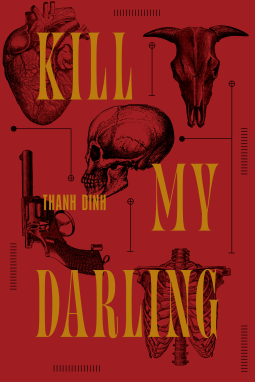
Kill My Darling
This title was previously available on NetGalley and is now archived.
Send NetGalley books directly to your Kindle or Kindle app
1
To read on a Kindle or Kindle app, please add kindle@netgalley.com as an approved email address to receive files in your Amazon account. Click here for step-by-step instructions.
2
Also find your Kindle email address within your Amazon account, and enter it here.
Pub Date Jan 31 2026 | Archive Date Jan 29 2026
Writerly Books | Writerly Books Press
Talking about this book? Use #KillMyDarling #NetGalley. More hashtag tips!
Description
Angela is not running from the body.She is walking toward it.
When the novel opens, she is already disposing of her lover—Bambi Raymond, a famous rapper, a cultural idol, a beautiful ruin. The man the world adored is now a secret rotting beneath her hands. Fame does not die quietly. Neither does love. And neither, it turns out, does guilt.
Told in fractured timelines that shimmer between past and present, Kill My Darling traces the anatomy of a relationship that burned too bright to survive. Angela meets Bambi at the edge of his myth: a rising star with a god complex, a poet of destruction, a man adored by crowds and devoured by his addictions. He is charismatic, brilliant, cruel, and terrifyingly tender. He is the kind of man people excuse until it is far too late.
Angela knows better.She stays anyway.
What unfolds is not a romance but a collision—between desire and self-preservation, between art and annihilation, between the woman Angela wants to be and the woman she is becoming. Drugs blur memory. Love mutates into obsession. Violence slips in quietly, like a lover who knows where you hide your knives. As Bambi spirals deeper into madness, Angela begins to fracture, haunted by hallucinations, doubling identities, and a voice that refuses to let the past stay buried.
The novel moves with cinematic precision—from dim Toronto cafés and neon-lit studios to hotel rooms thick with smoke, paranoia, and unspoken threats. It is glamorous without mercy, poetic without apology. Every scene glitters; every sentence cuts. The city itself becomes an accomplice, pulsing with desire and decay.
At its core, Kill My Darling is a psychological portrait of a woman pushed past the edge—by love, by power, by the myth of men who are allowed to destroy everything and still be called geniuses. It interrogates celebrity culture, gendered violence, and the romanticization of male self-destruction, asking a dangerous question: What does it cost to love a monster when the world insists he is a god?
As Angela’s grip on reality loosens, the narrative tightens—spiraling toward a revelation that reframes everything: the murder, the love, the lies she tells herself to survive. Nothing is clean. No one is innocent. And redemption, if it exists at all, comes with teeth.
Blending literary noir, psychological thriller, and poetic confession, Kill My Darling will appeal to readers of dark, stylized fiction that refuses to look away—fans of glamour-soaked tragedy, unreliable narrators, and stories where love is both the crime and the motive.
This is a novel about women who survive by becoming dangerous.About beauty that bruises.About love that kills—and what remains when it does.
Pretty.Witty.Bloody.
A kiss with a knife hidden behind the smile.
Available Editions
| EDITION | Ebook |
| ISBN | 9781069499899 |
| PRICE | $19.99 (USD) |
| PAGES | 288 |
Available on NetGalley
Available to Buy
Buy on Amazon Buy on BN.com Buy on Bookshop.org Buy on KoboAverage rating from 31 members
Featured Reviews
 Demetris P, Reviewer
A book like “Kill My Darling” arrives already wearing its own warning label – not only the explicit preface that lays out the psychic weather ahead, but the prose itself, which moves with the glittery volatility of a streetlight reflected in a puddle: seductive, unstable, and always one step from going dark. Thanh Dinh’s literary noir is, at its core, a story about how people narrate themselves into a livable shape. That shape may be a lover’s body, a dead man’s name, a mother’s role, a saint’s patience, a criminal’s swagger, a doctor’s authority. It may also, more frighteningly, be a performance so persuasive that the performer forgets where the costume ends. The novel’s central trick – and its most serious question – is whether self-invention is a means of survival or merely another kind of violence.
Angela, its narrator, begins with a corpse and a certainty: she has disposed of her lover, Bambi Raymond, a famous rapper, and she will tell you how to die. But the book’s pleasures are rarely those of plot, in the conventional sense. The suspense here is psychological and theological: a thriller whose engine is not simply what happened, but who gets to decide what it means. Angela’s voice is the book’s signature – feverish, lyric, mordant, sometimes perversely funny, and always a little hallucinatory, as if she is speaking to us from inside a smoke-filled room where confession and performance are indistinguishable. She narrates like someone trying to control the shape of the story before the story controls her.
Dinh writes in a register that might be described as glamour-soaked grief. Toronto, Montreal, Chinatown bakeries, hospital corridors, highway exits, club interiors – these spaces aren’t merely settings but stages, lit in neon and moral fog. The book understands, in a distinctly contemporary way, how the modern city can feel like a machine designed to keep you anonymous until it suddenly demands proof of who you are. Angela’s world is full of institutions that claim to be neutral – hospitals, police stations, bureaucratic forms, “verification” protocols – and yet the book repeatedly shows how the body is never neutral inside them. A pregnant woman’s weakness becomes spectacle. A patient’s history becomes a shorthand. A person’s credibility is weighed by the people who have the power to write the notes.
If “Kill My Darling” were only a stylish noir about celebrity, obsession, and murder, it would still be an accomplished piece of atmosphere. But the novel’s ambition is stranger and more morally complicated. Its true drama begins when Bambi’s absence refuses to stay absent – not as a ghostly metaphor, but as an active presence that migrates. Angela’s relationship with Pierre, Bambi’s twin, is the book’s most unsettling invention: a triangle where one point is dead, one is living, and the third is a name that can be worn like a mask. Pierre is a psychiatrist, intelligent, brittle, and increasingly unmoored – a man whose professional language (diagnosis, constitution, dosage, protocol) becomes one more dialect of control. Angela, meanwhile, is a woman who both resists and craves control, who mocks sentimentality even as she longs for its shelter. Their bond is at once a romance, a conspiracy, and an argument with God – the kind of argument that doesn’t end in faith so much as exhaustion.
Dinh’s most incisive theme is substitution: the idea that in a world built to punish certain people more than others, you might survive by becoming someone else. The book returns to this motif with a ferocity that feels less like clever plotting and more like lived desperation. Pierre lives in his brother’s shadow and then, in a late and sinister twist, discovers that the shadow has been cast deliberately. Angela lives in the aftermath of her own choices, but also in the aftermath of systems that have taught her to expect judgment before help. Even love, in this novel, is a kind of substitution – not a pure exchange between two souls, but a barter between two damaged people trading what they have: attention, safety, the fantasy of being seen as “good.”
The Chinatown chapter is a miniature of what Dinh does best: a scene that is simultaneously physical and performative. Angela enters the bakery sweating, nauseated, hungry, counting down to an engineered fainting fit like a director timing a cue. The sensory detail is lavish – black tea, powdered sugar, egg tarts, the imagined squish of dough – and then the scene turns, as if the sugar has curdled. Angela’s hunger becomes both literal and metaphoric: hunger for food, for care, for the right to be unobserved. Her staged collapse is a small act of criminal theater, and yet it is also an indictment of how easily a woman’s distress becomes public property. Dinh keeps the reader in the double bind: we recoil at the manipulation even as we recognize the logic that produced it. In this world, you perform illness because the system rewards performance, not truth.
The hospital sequences, similarly, are among the novel’s sharpest pages. Dinh has a keen ear for the cruelty that can hide inside professionalism – the way pity can masquerade as empathy, the way “patient first” can become a slogan rather than a practice. Lucille, the doctor who flirts with Pierre while policing Angela’s moral worth, is drawn with the book’s most biting satirical touch. She is not a villain in the melodramatic sense; she is something more recognizable: a person who believes in her own decency, and therefore cannot see the harm she does. The older OB-GYN, by contrast, offers the rare relief of competence without contempt, a reminder that institutions do contain individuals capable of dignity. That tension – between the system and the person inside it – gives the book some of its most contemporary resonance. In an era of understaffed wards, fraying safety nets, and public arguments about what care should look like, Dinh’s hospital is not a backdrop but a moral arena.
And then there is Pierre’s unraveling, which Dinh handles with an unusual combination of theatricality and restraint. The book is careful, in a way that feels ethically deliberate, not to turn mental illness into a mere twist. Pierre’s instability is woven into his identity as a healer who has absorbed too much suffering and mistaken it for his responsibility. His monologues about guilt, faith, and the ghosts of patients – especially the story of the 17-year-old on suicide watch – are some of the novel’s most direct writing. They are also, at times, where Dinh’s ambition risks tipping into excess. The prose loves intensity; it loves the declarative sentence that arrives like a verdict. Often that intensity is earned – it feels like the only language Angela has left. But occasionally the book reaches for metaphysical grandeur when the scene would be more devastating if it trusted plainness.
Still, one of the novel’s strengths is its refusal to clean up its own mess. “Kill My Darling” is a book that understands that ugliness can be part of the truth. Angela is not written to be likable. She is written to be legible. Her cruelty is not excused, but neither is it fetishized. The book keeps asking: what happens when a person has been trained, by experience, to believe that tenderness is a trap? Angela’s narration is full of self-scorning jokes, sudden tenderness, and the kind of metaphoric thinking that feels like a survival strategy – if you can turn your life into art, perhaps it won’t destroy you completely.
In that sense, Dinh’s novel belongs to a lineage of women’s noir and psychological confession – books that are less interested in solving a crime than in anatomizing the desire that made the crime possible. There are echoes here of “Gone Girl” in the way the narrative weaponizes intimacy and performance, though Dinh is less interested in twist mechanics than in the spiritual hangover of obsession. There are shades of “My Year of Rest and Relaxation” in the narrator’s acid humor and refusal of moral uplift, though Dinh’s stakes are more overtly violent and tender. The book’s atmosphere – neon, sex, club culture, hallucination – might make some readers think of “Drive” or “Uncut Gems” in its sense of forward-leaning dread, but Dinh’s sensibility is more literary, more hymnlike in its recurrence of motifs: God, forgiveness, punishment, the body as evidence, love as poison, love as shelter.
The novel is also very much a book of our era in its quiet preoccupations. It is interested in how reputations are manufactured and monetized; how celebrity creates a god-shaped void that people try to fill with attention; how women’s bodies become contested sites – medically, legally, morally. Its undercurrent of trafficking and exploitation is not treated as mere sensational garnish, but as a shadow economy that thrives on indifference. And its recurring skepticism about institutions – who gets believed, who gets helped, who gets labeled – feels attuned to a moment when public trust is thin and systems are visibly strained. Dinh never turns these concerns into slogans. They are embedded in Angela’s lived experience: the suspicious stares, the procedural delays, the casual cruelty of people who assume the worst because assuming the worst is easier than offering care.
If the first half of the book is a kind of noir fever dream – murder, disposal, seduction, hallucination – the latter chapters pivot into something stranger: domesticity as thriller. The scenes of Angela and Pierre in their condo, arguing about love and identity while preparing for parenthood, have a claustrophobic power. Dinh is astute about the ways “normal life” can be its own kind of performance, especially for people who have never been safe inside it. When Pierre proposes – not as a grand romantic gesture but as an insistence on the possibility of ordinary happiness – the moment lands with genuine complexity. We can feel Angela’s recoil. We can also feel the temptation: the relief of being offered a structure, a name for what they are, a promise that the story might end in something other than punishment.
The epilogue’s structure – its slow slide from postpartum terror into a police procedural into an almost mythic “miracle” – is where the book’s contrivance is most visible. Evidence arrives. Plans are made. A postal strike becomes a plot hinge. A dead man, once again, seems to be pulling strings. Some readers will find these mechanics too neat, too engineered. Yet it’s worth considering that “Kill My Darling” is not trying to be realistic in the manner of a courtroom drama. It is trying to be realistic in the manner of trauma: the way life can feel orchestrated by forces you do not control, the way coincidence can read like fate, the way the dead can seem to direct the living because the living cannot bear the randomness otherwise. In Angela’s world, the miracle is not that a plan works. The miracle is that anyone survives long enough to want a future.
The book’s final image – a naming that is also a benediction, a child positioned as an argument against the past – is where Dinh’s impulse toward mythmaking pays off. The name “Jeannet Pauline Raymond” is not just a plot detail; it is a thesis: a refusal to let the dead remain only dead, a refusal to let the living remain only guilty. Dinh’s ending insists, with a kind of bruised optimism, that the future is not obliged to repeat the past – though it will certainly inherit it. The book’s title, “Kill My Darling”, becomes a command not only about murder but about surrender: kill the old attachments that keep you trapped, kill the fantasies that make you return to the same pain, kill even the idea of a “darling” ending if it prevents you from living.
That is, ultimately, what the novel offers: not moral clarity, but moral electricity. Its best pages crackle with intelligence and danger. Its weaker moments – the occasional overstatement, the occasional flattening of a secondary character into a function, the plot’s dependence on precisely timed revelations – are the price of a book that refuses moderation. Dinh writes like someone who does not trust subtlety to survive the night. And yet, when the book is at its most controlled, it can be quietly devastating: an old doctor defending a patient’s individuality; a woman realizing love can feel like a burden; a man who has spent his life saving others discovering he might deserve saving too.
For all its baroque flourishes, “Kill My Darling” has a surprisingly classical core. It is a tragedy with an insurgent belief in ordinary happiness – the kind that arrives not as a reward for virtue but as a stubborn choice made by people who have very little virtue left to spend. If perfection is too clean a word for a book this messy, then perhaps the more honest praise is that it is alive. It is messy in the way living is messy, and in the way surviving is messier. It is not a book that asks to be liked. It is a book that asks to be believed – and, more unsettlingly, it asks what belief costs.
In the end, I found myself admiring the novel’s nerve as much as its craft. Dinh has written a noir that is also a love story, a psychological case file, a theological argument, and a satire of the performances we call adulthood. It is a book that understands how easily “care” can become control, how easily “love” can become addiction, how easily “identity” can become a weapon. It also understands something rarer: that even after the worst things, people still want the simplest ones – a warm body beside them, a child’s hand grasping a finger, a life that does not require constant explanation.
For its lyric intensity, its moral daring, and its refusal to offer easy absolution, I would place “Kill My Darling” at 83 out of 100 – a flawed, forceful, strangely tender novel that leaves a bruise where a blessing might have been, and makes you consider how often the two are the same.
 Sarah R, Reviewer
Kill My Darling is a beautiful tragedy that has you engrossed in the despair of three different characters, their past, present, and how they intend to ultimately change their future—if there is one. The relationship between Bambi and Angela is so heartbreakingly toxic that you only hope that something can go her/their way. Dinh did a phenomenal job at depicting the hurt, growth, and bleeding scars of the characters that you almost find yourself the therapist in the story uncovering the truth and where the ending will take us.
 Heather G, Reviewer
Thank you Writerly Books Press for providing Kill My Darling by Thanh Dinh for review consideration via NetGalley. All opinions are my own
⭐️3.75/5⭐️
This book is about a crazy love obsession. Love of life and the sweet release of rest. Freedom and the endless pursuit. Living, dying, being reborn. Choice. Separation. It's about searching for a different path in life. To kill your old self and chase after a new one. It's about suffering. So much suffering and to what end. It's about being thrust into a role you were and weren't wanting, trudging down it, surviving and persisting, even when you don't want to.
Bambi and Angela are star crossed lovers. The world rejectd them, they don't want that world anyway. They are running full force to live a life of their own. Driven by obsession, desire, passion they are both running from their past. To reinvent themselves amd just be.
Bambi had a bad upbringing. Angela did not. They meet one another one night and never part falling down a tragic existential rabbit hole.
Bambi is and enigma in his own right. Angela just want to seen, to be something else. Angela thinks he's god, but he's really a devil in disguise, but Angela devours his darkness. Following a misguided journey of the rejected just looking for salvation in whatever form they can grasp onto. They find freedom in self destruction.
Boy, Angela can cry. 85% of this book is this girl in tears.
Bambi was a monster, manipulative, narcissistic, and gas lighted Angela into his path to freedom, leaving her there to suffer the consequences. But she was not without freedom of choice, she chose to be. She chose to follow when she could have carved her own destiny. Angela's relationship with Bambi is the epitome of love is blind.
Did I like it, absolutely, but I was getting so bored reading Angela's waxing philosophical about literally everything. Oh, and her perpetual sobbing. But in the end, it was a beautiful story, so tragic and gritty and dark. A story about those who do not choose the "normal" path and the fight for survival.
Readers who liked this book also liked:

James Trevino; Elizabeth Sagan
Mystery & Thrillers, Sci Fi & Fantasy, Teens & YA



Bonnie Quinn
General Fiction (Adult), Horror, Sci Fi & Fantasy