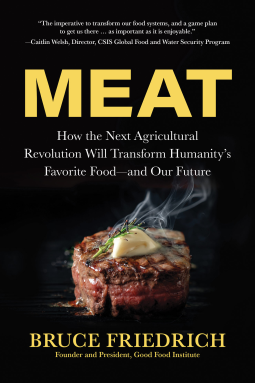
Meat
How the Next Agricultural Revolution Will Transform Humanity's Favorite Food—and Our Future
This title was previously available on NetGalley and is now archived.
Send NetGalley books directly to your Kindle or Kindle app
1
To read on a Kindle or Kindle app, please add kindle@netgalley.com as an approved email address to receive files in your Amazon account. Click here for step-by-step instructions.
2
Also find your Kindle email address within your Amazon account, and enter it here.
Pub Date Feb 3 2026 | Archive Date Mar 31 2026
Talking about this book? Use #Meat #NetGalley. More hashtag tips!
Description
The human love of meat appears to be hard-wired. The world consumes more than 550 million metric tons of meat and seafood each year. That number has been climbing for decades and is expected to continue to rise through at least 2050.
What if we could give humanity the meat it craves, but produced differently? Plant-based and cultivated meat that are just as delicious as the meat you love, but more affordable and healthier.
Think it’s not possible? With examples ranging from the “horseless carriage” (car) to the smart phone in your pocket, Meat reminds readers that scientific innovations often move from disbelief or opposition to inevitability and ubiquity, much faster than almost anyone expects.
Envisioning a future where meat is both a delight and a force for good, Friedrich explores:
- Humanity’s 12,000-year-old practice of raising animals for meat, and why we need to figure out a better way.
- The science and scientists behind the efforts to create plant-based and cultivated meat that is indistinguishable from conventional animal meat, but less expensive, more nutritious, and safer.
- How plant-based and cultivated meat can preserve forests and biodiversity, mitigate climate change and ocean pollution, and lower antimicrobial resistance and pandemic risk.
- The economic and food security benefits of making meat more efficiently, which include trillions of dollars in economic output annually, tens of millions of good jobs, and the possibility of a revitalized farm economy.
Meat offers a vision of the next agricultural revolution that is optimistic, achievable, and delicious.
Advance Praise
“Bruce’s book is an impressive tour d’horizon of the need for alternatives to animal-based protein and how we can make alt-meats—with taste and price parity—a reality . . . This book explains the imperative to transform our food systems and lays out a game plan to get us there . . . Meat is as important as it is enjoyable. I hope you’ll be as inspired to help create an alt-meat future as I am.”
—Caitlin Welsh, director of the Global Food and Water Security Program at the Center for Strategic and International Studies
“Terrific, fun, humane, and inspiring. Friedrich shows that a better future, with alternative meats, is coming—and that we're going to love what we eat.”
—Cass R. Sunstein, Robert Walmsley University professor at Harvard University and author of How Change Happens
“Bruce Friedrich’s Meat is an engaging treatise on using science to make meat far more efficiently. If it works, and Friedrich is convincing that science is up to the challenge, these alternative meats will slash humanity’s adverse impact on our natural world, including our oceans, forests, and climate. Friedrich includes fascinating observations in every chapter, including his analysis of ‘ultra-processed foods’ that are actually super-healthy and a final chapter that is a compelling and practical guide to what each of us can do to help.”
—George Church, professor of genetics at Harvard Medical School, lead for synthetic biology at Wyss Institute of Biologically Inspired Engineering, and author of Regenesis
“Meat is a fascinating exploration of the consequences of modern meat production and a road map to a better future for meat manufacturing. With clarity and conviction, Meat charts a path toward a world where our appetites and our ethics can finally align.”
—Steve Jurvetson, founder and managing director of Future Ventures and board member of SpaceX
“Our food system is both an overlooked national security vulnerability and a powerful catalyst for the next wave of American innovation. In Meat, Bruce Friedrich reveals the fragile underpinnings of global meat production and the immense risks it poses to geopolitical stability, public health, and the environment. With rigorous research, sharp economic analysis, and real-world stories that span boardrooms and battlefields, Friedrich rightly reframes the problem as a generational opportunity. This is the rare book that speaks to investors, policymakers, technologists—and anyone who eats.”
—Matt Spence, global head of venture capital and managing director at Barclays, deputy assistant secretary of defense (2012–15), and member of the National Security Council (2009-2012)
“Alternative proteins offer a promising path to addressing global challenges including hunger, climate change, and pandemic risk. Meat highlights the case for how science, innovation, and smart policy can help bring these solutions within reach. It contributes to an important and timely global conversation.”
—Michael Kremer, professor at the University of Chicago and co-recipient of the 2019 Nobel Memorial Prize in Economic Sciences
“An unflinching case for reinventing meat, so that we can feed a growing world without feeding the climate crisis.”
—Christiana Figueres, chair of the Earthshot Prize Foundation, cofounder of Global Optimism, and 2010–2016 executive secretary of the UN Framework Convention on Climate Change
“In Meat, Bruce Friedrich makes a compelling case for alternative proteins as a globally scalable solution to some of our most urgent public global health and ecological crises. He also shows how we get there: by focusing on the economic and food security benefits of protein transition. The best global health policy book of the decade turns out to be about remaking meat. Essential reading for policymakers, and for anyone who eats.”
—Michael Greger, MD, founder of NutritionFacts.org and author of How Not to Die and Bird Flu: A Virus of Our Own Hatching
“This book is an eye-opener that could help save the world . . . The topic is crucial, and Friedrich’s presentation is clear, persuasive, and entertaining. Meat of all kinds will never look or taste the same—along with everything else, you can eat with a dash of hope to taste.”
—Kim Stanley Robinson, winner of the Hugo, Nebula, and Locus Awards and author of The Ministry for the Future
“I really love that Meat invites everyone to the table. The alt-meat scientific challenge has support from a broad array of Republicans and Democrats in the US, as well as from policymakers globally across the range of ideologies. What’s more, the current meat industry will be, according to Bruce Friedrich, a big part of the solution. Equal parts urgent and optimistic, Meat is meticulously researched, fast-paced and fun to read, and full of the kind of ideas that could actually work. A landmark contribution to the future of food.”
—Paul Wesley, actor (Star Trek: Strange New Worlds; The Vampire Diaries)
“Meat offers a bold reimagining of how we can make the ‘meat’ people love—more affordably, more sustainably, and more equitably. With insight and wit, Bruce Friedrich explores diverse solutions that preserve cultural traditions and taste while confronting the urgent challenges of climate change, global health, and food insecurity."
—Ertharin Cousin, founder and CEO of Food Systems for the Future, visiting scholar at the Stanford University Center on Food Security and Environment, and 2012–2017 executive director of the United Nations World Food Programme
“In this important book, Bruce Friedrich shares his expertise and his passion for making meat better. He makes a powerful case that, with innovation and investment, we can meet the world’s growing demand for meat that is delicious, nutritious, and affordable while also protecting human and planetary health. A fascinating and inspiring read!”
—Charlotte Pera, executive director of Stanford University’s Sustainability Accelerator and senior fellow of the Bezos Earth Fund
“Bruce Friedrich has a unique talent for making radical change feel not only possible, but inspiring and near at hand. Our future depends on people like him, and books like this.”
—Jonathan Safran Foer, Lillian Vernon Distinguished writer-in-residence at New York University and author of Everything Is Illuminated and Extremely Loud and Incredibly Close
“Friedrich tells an engaging story of the visionaries who are inventing a new way to produce meat by combining proteins, fats, and nutrients. The idea might sound far-fetched today, but as he shows in a quick tour of past breakthroughs—cars, airplanes, computers, smartphones—what once seemed unimaginable can soon become commonplace.”
—Kathryn Aschheim, deputy editor of Nature Biotechnology
“In 2018, I accidentally heard a talk by Bruce Friedrich that fundamentally changed my eating, teaching, philanthropy, and investing. Bruce provided compelling logic on how we can improve the environment, our health, and animal welfare, as well as how to feed the world’s population. This book provides broader access to his vision on how to make the world better. But be careful; reading this book could change your life.”
—Max Bazerman, Straus Professor at Harvard Business School and author of Inside an Academic Scandal and Negotiation: The Game Has Changed
“Bruce Friedrich is a close friend of mine. Years ago he took me out to dinner to persuade me that plant-based meat is just as succulent as beef, and is the inevitable future of haute cuisine. We did a blind taste test. His contention fell apart, miserably, and I joyfully wrote about it in The Washington Post. I am now convinced he wrote this book entirely to prove to me that I was a blind, ignorant, cynical, arrogant fool who understood nothing about alternative meats and their potential. So I just read it. He is right.”
—Gene Weingarten, two-time Pulitzer Prize winner for feature writing at The Washington Post and author of One Day: The Extraordinary Story of an Ordinary 24 Hours in America
“The heart of this book is a fascinating story of scientific and entrepreneurial exploration. Trying to alter ancient eating habits is hard, but perhaps not impossible. And it would be extremely useful for the world if they can bring this tale to a successful climax.”
—Bill McKibben, author of Here Comes the Sun
“Today billions of animals are raised to provide us with meat. This harms the environment and is often unspeakably cruel to farmed animals, yet for many the idea of a main meal without meat is unthinkable. The good news, as Meat explains, is that you can now enjoy real meat that was made without killing any animal. Please read this book: it is engaging, informative, and gives us hope for a kinder future.”
—Jane Goodall, PhD, DBE, founder of the Jane Goodall Institute and UN Messenger of Peace
“Bruce Friedrich shows why, if we are to avoid pandemics, feed the poor, and mitigate the severity of climate change, we need to scale up the production of meat that does not come from animals. He also gives us hope that this is possible.”
—Peter Singer, professor emeritus of bioethics at Princeton University and author of Animal Liberation
Available Editions
| EDITION | Hardcover |
| ISBN | 9781637747933 |
| PRICE | $29.95 (USD) |
| PAGES | 320 |
Available on NetGalley
Available to Buy
Buy on Amazon Buy on BN.com Buy on Bookshop.orgAverage rating from 6 members
Featured Reviews
 Connie B, Reviewer
"What if we could give humanity the meat it craves, but produced differently? Plant-based and cultivated meat that are just as delicious as the meat you love, but more affordable and healthier."
Within the first few paragraph's of the description you become very aware that this book is about the future of meat and how it is in our best interests to come up with products that are plant based, taste good and are better for the environment.
As a vegetarian, I wanted to see what the author's thoughts were and how he and others hoped to move forward with this idea. .I found this book to be interesting and full of information. The ideas here seem to be a good way to move forward as there are a great number of people who want to move away from eating pieces cut from dead animals.
5 stars.
 Librarian 1974129
Full disclosure: I’ve been slowly working towards a vegetarian diet in recent times, driven by a combination of health concerns and ethical considerations. That context inevitably shapes how I approached Bruce Friedrich’s latest book examining how meat is produced—and how it could be done differently.
From the very first page, Friedrich makes an important clarification: this book “isn’t about policing your plate.” He isn’t interested in telling readers what they should or shouldn’t eat. Instead, "Meat" is a clear-eyed exploration of how meat is currently made, why that system is deeply flawed, and what realistic alternatives might look like. This framing makes the book far more accessible than a prescriptive manifesto; it invites engagement rather than defensiveness.
The heart of "Meat" lies in its unflinching presentation of facts. Friedrich lays out statistics and research on industrial meat production that are, at times, confronting. They are meant to be. The environmental toll, the health implications, and the economic inefficiencies of our current system are presented in a way that is difficult to ignore. Friedrich argues persuasively that human production and consumption of meat must change—not just for ethical reasons, but for the long-term good of the planet, public health, and global food security.
What strengthens the book is Friedrich’s focus on improvement rather than absolutes. The question isn’t whether meat will disappear overnight, but how it can be made better: through alternative proteins, technological innovation, and structural changes to how food systems operate. This pragmatic approach gives the book a sense of momentum and realism.
That said, "Meat" is not without its weaknesses. While the book is consistently informative and well-argued, it does at times feel repetitive. Key points are revisited frequently, which reinforces Friedrich’s thesis but may test the patience of readers already sympathetic to his position.
Overall,"Meat" is a convincing and thought-provoking read. It doesn’t demand that readers abandon meat altogether, but it does make a compelling case that the status quo is untenable. Whether you’re a committed omnivore, a curious flexitarian, or—like me—gradually moving toward vegetarianism, Friedrich’s book offers valuable insight into one of the most urgent and complex food conversations of our time.
Readers who liked this book also liked: