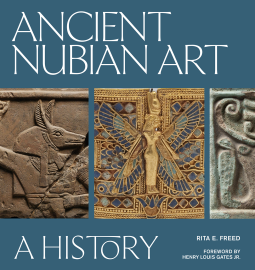
Ancient Nubian Art
A History
This title was previously available on NetGalley and is now archived.
Send NetGalley books directly to your Kindle or Kindle app
1
To read on a Kindle or Kindle app, please add kindle@netgalley.com as an approved email address to receive files in your Amazon account. Click here for step-by-step instructions.
2
Also find your Kindle email address within your Amazon account, and enter it here.
Pub Date Mar 3 2026 | Archive Date Feb 22 2026
Talking about this book? Use #AncientNubianArt #NetGalley. More hashtag tips!
Description
Lushly illustrated with stunning artifacts, this volume is the first comprehensive and accessible publication to explore the art, architecture, and material culture of ancient Nubia.
Kings and queens of Nubia reigned over one of the largest empires in the ancient world and had contacts extending north to Greece and Rome, south to sub-Saharan Africa, east to the Red Sea, and west across much of the Sahel. Even a quick look at Nubia’s artifacts reveals the incredible creativity of its artists, architects, craftspeople, and thinkers. Despite their significance, the achievements of ancient Nubia are little known to the public and are often viewed as a subculture, a derivative offshoot of Egypt, Nubia’s northern neighbor. Nothing could be further from the truth. During its over eight-thousand-year lifespan (beginning around 8000 BCE), Nubia indelibly shaped the art and architecture of the ancient world, an influence still felt today.
Ancient Nubian Art is the first comprehensive and accessible treatment of Nubian artistic culture and showcases its vast range—from ceramics, sculptures, and jewelry to tombs, temples, and palaces. Rita E. Freed, curator emerita at the Museum of Fine Arts, Boston, which has the largest collection of Nubian artifacts outside the Nile Valley, contextualizes the development of Nubian art against a vivid backdrop of kingship, power, worship, identity, gender, technology, and internationalism. Her text is accompanied by a foreword by Henry Louis Gates Jr. and sidebars by expert voices from the field.
Available Editions
| EDITION | Other Format |
| ISBN | 9781606069813 |
| PRICE | $50.00 (USD) |
| PAGES | 288 |
Links
Available on NetGalley
Average rating from 21 members
Featured Reviews
 Angharad S, Reviewer
I received this free advanced reader copy from NetGalley in exchange for my honest opinion. My thoughts are my own
This stunning book covers art and art history, religion, and culture in a beautiful and respectful way. I think it would make a great coffee table book for anyone interested in ancient Nubia or ancient Egypt. (That's certainly what I'm planning to do with it!) The text inside is informative and formatted in a really pleasing way that makes it accessible to your average person as well as your armchair historians like myself. The full color photographs of the artifacts, ruins, statues, jewelry and pottery are very clean and easy to discern what they are. I was especially enamored by some ivory inlays of animals like giraffes and lions.
Overall I found this book to be very charming and well done, I look forward to potentially owning a physical copy for my collection of books on ancient history.
 Katherine M, Reviewer
Ancient Nubian Art gives readers an in depth look into art history of Nubia and the effect it has on the world. It was extremely well researched and presented in a way that kept me interested throughout the entire book.
 Miles L, Educator
Ancient Nubian Art: A History, by Rita E Freed, is an attractive book that is also a wonderfully informative and accessible read.
Being the nerd I am I read my coffee table books (or ones I call end table or sofa table books, of which I consider this one) as well as appreciate them for their appearance. Many true coffee table books, the large oversized ones, have great information in them that often gets overlooked because people flip through them and perhaps read a few pages leaning over a table or in their lap. But, honestly, they can be cumbersome to read the way you do a standard hardcover. The one I happen to have on my side table by my desk is 9x11, not what most people read propped up in bed. I am saying all this because one of the things I love about slightly oversized books like this one, 8.5x9, is that they lend themselves more easily to someone actually reading the text as well as enjoy the pictures. And this volume is worth a close and careful reading.
The pictures are fascinating and well worth putting out for display in your home. The illustrations are described wonderfully and the history is presented in an engaging style that really piques your curiosity to dive deeper. Like so many books, taking advantage of all the information available online to supplement your particular areas of interest can make the experience even better. Names, places, keywords, there are a wide range of things in the book you can use to go deeper into whatever caught your imagination.
The foreword by Henry Louis Gates Jr is an excellent gateway into the book that also reflects back into our contemporary world. By the time I finished his short piece I was ready to jump right into the book.
Highly recommended for anyone interested in art history, ancient art, Nubian art/culture/history, as well as those who simply enjoy a beautiful book. I don't say this often about art history books, but I can see myself rereading this one again in addition to thumbing through it regularly.
Reviewed from a copy made available by the publisher via NetGalley.
 Ankit S, Reviewer
⭐️⭐️⭐️⭐️✨ (4.5/5.0)
Ancient Nubian Art by Historian and archaeologist Rita E. Freed is a richly researched and visually rewarding exploration of Nubia’s artistic legacy. The author skillfully weaves historical context with detailed analysis of sculpture, architecture and decorative arts, making the subject both accessible for learning and deeply informative. The high-quality images greatly enhance the reading experience, allowing the art to speak alongside the scholarship. It should be published as a Coffee-Table-Book.
While the book occasionally leans toward an academic tone, it never loses its sense of purpose or fascination. Overall, this is an outstanding and enlightening work that gives Nubian art the attention it truly deserves—highly recommended for students, art lovers and history enthusiasts like me.
 Reviewer 1128563
Excellent account of the ancient Nubian Art: description of the art forms, regions, history and notable details. Great scholarly and comprehensive research. For students of history, a fascinating and engrossing overview. The narration is accompanied by examples of artifacts and maps to illustrate the era and its artforms. I thoroughly enjoyed the book.
Elizabeth R, Reviewer
Ancient Nubian Art is an outstanding and long-overdue scholarly intervention into a field that has, for far too long, been marginalised, oversimplified, or framed through an Egyptian-centric lens. Rita E. Freed’s work is both intellectually rigorous and deeply corrective, offering a comprehensive reappraisal of Nubian artistic culture as autonomous, innovative, and historically consequential in its own right.
What makes this volume particularly impressive is its ability to balance accessibility with serious academic substance. Freed does not merely catalogue objects; she situates Nubian art within its full political, religious, technological, and cultural contexts across millennia. The result is a nuanced narrative that treats Nubia not as a peripheral “influence zone” of Egypt, but as a dynamic civilisation whose artistic traditions shaped — and were shaped by — complex networks of exchange extending across Africa and the Mediterranean world.
One of the book’s greatest strengths lies in its examination of Nubian–Egyptian entanglement. Freed handles this relationship with scholarly care, resisting reductive narratives of domination or imitation. Instead, she traces how Nubian identity evolved through periods of contact, invasion, resistance, and rule — including moments when Nubian kings governed Egypt itself. The analysis of artistic hybridity, adaptation, and deliberate differentiation is particularly strong, demonstrating how Nubian artists negotiated imperial power while maintaining distinct aesthetic and ideological traditions.
The visual programme deserves special mention. The illustrations are not merely decorative but integral to the scholarly argument, allowing readers to engage directly with form, material, scale, and iconography. The careful integration of objects, architecture, and landscape reinforces the book’s central claim: that Nubian art must be understood on its own terms, across time, geography, and social structure.
From an academic perspective, this book represents a significant contribution to the study of ancient art history. It has clear value for students, scholars, and museum professionals, but it also holds immense potential to inspire further research — particularly in areas such as Nubian women’s history, cross-cultural imperial aesthetics, and Africa-centred approaches to antiquity.
In short, Ancient Nubian Art: A History is a landmark publication. It challenges entrenched hierarchies within art historical discourse, restores depth and dignity to a civilisation too often sidelined, and sets a new standard for how Nubian art should be studied, taught, and understood. I hope it becomes foundational reading in the field — and a catalyst for many more studies to follow.
 Krissy S, Reviewer
This book was really educational. I learned a lot and the pictures were very clear and helpful. If you are interested in Nubian or Egyptian history, you will enjoy this book a lot.
Thank you NetGalley for the eARC.
Andrea C, Reviewer
Equally informative for ancient history lovers, like myself, and casual readers just curious about the subject. Wonderfully researched and presented with plenty of photographic material to make for an engaging read. Highly recommended.
 Katelyn E, Reviewer
Beautiful pictures and such detailed, well researched information! I love all things Egypt. I traveled there a couple years ago, touring many sites and museums throughout my trip, and this guide brought me right back to moments from that trip.
Thank you to NetGalley and the author for the ARC!
 The Sassy B, Reviewer
Book Review: Ancient Nubian Art: A History by Rita E. Freed
Rating: 4 Stars
As someone who loves diving into history and exploring cultures beyond the usual narratives, *Ancient Nubian Art: A History* by Rita E. Freed was a refreshing discovery. This book is a beautifully crafted tribute to the rich artistic legacy of Nubia—an ancient civilization often overshadowed by its neighbor, Egypt, but clearly a powerhouse in its own right.
What really stands out about Freed’s work is how thoroughly it showcases the incredible diversity of Nubian art and architecture, from intricate jewelry and pottery to grand tombs and palaces. The book is packed with stunning full-color images that bring these artifacts to life—whether it’s a delicate sculpture or imposing temple ruins, each piece tells a story of creativity and cultural significance stretching back over eight thousand years.
One of the best things about this volume is how accessible it is. Freed thoughtfully frames Nubian art within broader themes like kingship, identity, worship, and technology, making it easy to grasp even if you’re not an expert. There’s a real sense of respect and admiration for Nubia’s influence, which extended far beyond its borders—from Greece and Rome to sub-Saharan Africa and beyond.
The book also benefits from a foreword by Henry Louis Gates Jr. and insightful sidebars from other scholars, adding extra depth without bogging down the main narrative. Plus, the layout is inviting—the text flows well and pairs nicely with the visuals, making it an ideal coffee table companion for history enthusiasts or anyone curious about ancient cultures.
If I had one minor critique, it’s that at times I wished for even more detailed stories behind certain artifacts or a bit more exploration of Nubia’s interactions with neighboring civilizations. But overall, *Ancient Nubian Art* succeeds brilliantly in bringing this remarkable civilization to wider attention.
In short, if you’re fascinated by ancient history or art, or simply want to admire some breathtaking artifacts while learning something new, this book is definitely worth a read. Four stars for its gorgeous presentation, engaging content, and the spotlight it shines on a truly extraordinary culture.
⚠️This review was written based on personal opinions and experiences with the book. Individual preferences may vary⚠️
Reviewer 647588
Prior to reading this book, at the mention of Nubians I would have thought "Oh, south of Egypt. Um, did they attack or were they slaves?" The Nubian civilization deserves much more respect than that, as Rita E. Freed makes clear, and their art gives us an outline of who they were. That art is presented beautifully in this book and is made meaningful with Freed providing context. It's very informative on the three distinctive eras of Nubian culture, their pottery, clothing, adornments and sculpture. It's another example of an overlooked culture that was skilled and creative. This book showcases the Nubians as they deserve.
 Jessica S, Reviewer
The book consists of 8 chapters in addition to the introduction: Beginnings; Expanding World: A-Group; C-Group and Pan-Grave Cultures Move In; Nubia’s First Empire: Kerma; An Interlude with Egypt; Nubia’s Second Empire: The Napatan Period; Nubia’s Third Empire: The Meriotic Period; and Beyond the Meroitic Empire. There’s a forward by Henry Louix Gates, Jr. that explores what Nubia and Egypt meant to enslaved Africans in America, and why learning about ancient African nations and their accomplishments was so important to black Americans.
The book follows the chronological history of Nubia, as we can piece it together through archaeological evidence. The early chapters are fairly short, as there isn’t much evidence or material objects. There are at least a few photos per chapter illuminating the text. The chapters get more detailed as empires rose, since they left significantly more behind. The book constantly compares the artwork, homes, clothing, and habits (as well as can be determined) to the more well known Egyptian one. So we’re told that Egyptian artwork is more formulaic, while Nubian artwork has more of a naturalistic look, with freer forms and curvier figures. I was especially interested to learn the ways Nubian metalworkers experimented with enamel to create mixed forms much earlier than appeared elsewhere in the world.
In addition to images of artworks, the book also has some floor plans for palaces and temples, diagrams of houses, etc.
It’s fascinating learning about such a little known culture. Their artwork deserves to be known in its own right, separate from that of Egypt. Hopefully this book will encourage people to learn more about the Nubians and their culture.
Rachel D, Educator
Ancient Nubia gets lumped into Ancient Egypt way too often. But in truth, it was a wildly different culture, and spanned hundreds of years and had its own eras, and at points it influenced Egypt instead of the other way around. This book is a very readable intro to Nubian art and culture and it has a lot of beautiful full color images as well.
 Hannah W, Reviewer
This was a good comprehensive coverage of the whole of Nubian history. It was more descriptive than analytical and so I would say this is well-suited to beginners, although of course any level can benefit. The material culture depicted is copious, definitely useful for those looking for artefacts for a research project etc. The chapters were broken up into a clear, logical structure, and the subsections of these flowed well. Any 'jargon,' of sorts was explained and clear to the reader; I did however notice that the countries listed that make up the Levant was missing some of the key countries, using modern terms for this location.
The bibliography is extensive, as is the index, both of which are well laid out.
It was a pleasure to read and review this work; thank you to NetGalley and Getty Publications for the advanced review copy!
Reviewer 725763
Ancient Nubia possessed a rich and distinctive artistic culture that significantly influenced the ancient world. This book offers a comprehensive and accessible exploration of Nubian art, showcasing its diverse forms and contextualizing its development within the framework of Nubian society, power, and global interactions. This richly illustrated volume beautifully blends history and art for a fascinating and informative reading experience.
Thanks, NetGalley, for the ARC I received. This is my honest and voluntary review.
 Mariama T, Reviewer
Very informative book about a people and culture that does not get its due attention. Not only is the text detailed, the artwork and images of ruins are incredible. Physical evidence of people that are often reduced to slogans or imagined ideas of what Africa is. Caveat: this is not everyday reading, even though it's written in that manner. One should have a rudimentary idea or concept of who the Nubians are and what they represent. Definitely a must-read for anyone with a genuine interest in the topic.
Thanks to the author, publisher, and NetGalley for access to this ARC.
 Annie B, Reviewer
Ancient Nubian Art is a layman accessible monograph on ancient Nubian art and culture collated and written by Dr. Rita E. Freed. Released 3rd March 2026 by Getty Publications, it's 288 pages and is available in hardcover and ebook formats.
This volume would make a good selection for students of ancient art, history, anthropology, arts, and ancient language and culture. It is written in an everyday, layman accessible way which everyone can understand.
It's beautifully illustrated throughout in color. The plates are accompanied by short explanatory captions.
Five stars, this is a lovely introduction to a civilization which has always seemed like a footnote in her neighbor Egypt's dynastic lineage and deserves to stand on its own merits.
Disclosure: I received an ARC at no cost from the author/publisher for review purposes.
Librarian 1348830
Ancient Nubian Art is a fantastic look into the Nubian culture and the objects it produced. The image reproductions are great and it will be an invaluable resource for those studying art history or archeology of the region.
Reviewer 1987217
This is a wonderful guide to Nubian Art. Thoroughly explains in geographic, historic and art historian terms, with many colorful and professional pictures. For anyone who is interested in ancient history and culture, this book is a must-read.
 Anna W, Librarian
This is a fascinating, if academic, book on the art of ancient Nubia. Not for the public library in general, but this is so interesting. If I had the budget, I would purchase.
 Annelisa J. P, Reviewer
In this lovingly crafted and generously illustrated book, Dr. Rita E. Freed introduces readers to the artwork of a significant yet unfairly overlooked civilization: Ancient Nubia. Through a combination of historical analysis, ethnogenesis development, archaeological study and art history, the author demonstrates how the civilization's art developed over time, reflecting the stages of their empire and their sense of identity. This is the type of work that my younger self would have gobbled up were it laying around my home library. I was obsessed with Ancient Nubia as a child and looked for any information that I could find about them, even going so far as tracing their dress styles from period illustrations. Dand the fact that this has been added to the list of works makes me even happier. When I saw that this title was available here, all of those good feelings came back, and I was happy to receive it.
I was also happy to see Henry Louis Gates Jr. authoring the foreword, although I can't say that I'm surprised; I can't think of anyone else better suited to do so. He's correct in his analysis of how the representation of Nubia plays an important and understudied role in Black American culture. Little me's introduction to them was also through the Bible via the references to Cush. Part of this affinity for Ancient Nubia is due in part to the fact that phenotypically, we found resemblance between them and ourselves. And as such, no one could ever deny or attempt to demur (as they've done so with other groups, which I'm not going to discuss in this review) about the fact that the Nubians were a Black people, and that their accomplishments came from an obviously Black nation. Dr. Freed also discusses this continued relevance in Black American thought towards the end of the book.
It's always welcome to see authors excited about the subject matter and to see them connect with readers and researchers who share their interest. I can tell that Dr. Freed truly loves history, not just for its own sake, but because of what it can reveal about the peoples whom one studies. I love how she imagines what different historical figures may have thought, what their daily lives were like and their relationship to the people and events around them. I do this frequently, so it's nice to see a kindred spirit. She interjects some of these asides via parenthesis throughout the book, which adds to the book's readability without taking away from its scholarly nature. The language is clear and never dry, making the flow of information across centuries easy to follow and understand. I like the way that Dr. Freed frequently dispenses acknowledgements to her colleagues who helped her with the book, such as when they point out different analyses or details. I also like that the references and notes for each themed chapter are listed at the end of said chapters, versus at the end of the book overall. This makes it easier to refer to them versus flipping back and forth while reading. The references in the bibliography have made me want to seek out the recent published scholarship on Ancient Nubia, as well as the public domain works. I was previously aware of some of them, which I downloaded from the Internet Archive, but I'll happily search for the others. (Shout out the New York Public Library's Digital Collections.)
This book serves a much-needed purpose in adding to the scholarship about Ancient Nubia, while continuing to debunk long-held misconceptions. Dr. Freed doesn't refrain from discussing the reasons as to why Ancient Nubian art and cultural expression isn't discussed as widely today. In addition to the historical reasons such as the disappearance of the Meroitic script (and music?), the impact of invasions and the loss of trading partners, she underscores the anti-Blackness present in later scholars' and historians' assessment of the region, and their tendency to handwave away the Empire's accomplishments as arbitrary footnotes, rather than a complex, multifaceted civilization. This is a practice common when discussing empires and nation-states across the African continent (with the exception of Ancient Egypt), one that historians are still working to correct today. I can attest to the way that African empires have been downplayed in my textbooks, to the point that the same few were mentioned over and over across different units. There's an irony in the fact that the rise and expansion of the Aksumite Empire also contributed to the Nubian Empire's fall. Ethiopia and its history has also long held a special significance to Black Americans, so the connections between the two, which make sense given the geography, is fascinating to note.
One key fact that the author establishes from the outset, and one of the many things I love about the text, is that the Nubian Empire had longevity. They were an autonomous, multifaceted civilization with their own distinct customs and societal structures, and not simply an offshoot of Ancient Egypt. And as such, it deserves to be analyzed with the same regard and respect as other ancient civilizations, rather than as an anomaly. Continuing in this vein, she also outlines how the Ancient Egyptians could be bullies in their attempts to subjugate and impose their artistic style, which she refers to as "static," on the Ancient Nubians more idiosyncratic, realistic representations. (Improvisation and syncopation have been a cultural trait for millennia, it seems.) Dr. Freed's analysis of the way that they subsequently "Nubianized" Egyptian culture as a form of preservation and rebellion, creating an impact still seen today, speaks to the Ancient Nubians' resilience. She also emphasizes that the Nubian people have always maintained a presence in the historical record, but that it's often been glossed over, such as the presence of Maiherperi in the Book of the Dead. This also encourages readers to take a closer look at historical documents that they may have encountered before to see what they might have missed.
The artwork itself is stunning to view and analyze; it's fortunate that we're able to see what has been preserved, even those items that have missing elements. The author stresses the Ancient Nubians' commitment to decoration. Their items were utilitarian and built to last, but they also wanted them to be beautiful regardless. The huge inlaid black box at the end of Chapter 7 is one of my favorite artistic pieces that exemplifies their philosophy. Dr. Freed discusses in depth the methodology behind the Nubians' art creation and their temple construction processes. I especially enjoyed reading about the house designs of middle-class families, and the animal motifs that recurred through their clothing, accessories and statuary, such as the abundance of rams. A study of the plenary of animal life that they had around them could constitute a book of its own. I also would have liked to read more analysis of children's toys and general amusements.
The Ancient Nubians' love of body adornment is a common trait of Black folks across the diaspora, which continues to this day. They were committed to the craft of making their body decorations as well-fashioned as possible, regardless of the material. Looking at the jewelry was another of my favorite elements of the book. Some of these jewelry designs look so modern, such as the belts and teh dangling squiggle earrings, as well as the ear plugs. I was unaware that the Ancient Nubians made torques; this is another example of why this book is important to add to the historical record, to show that the practice was not confined to Europe. I also enjoyed learning about the way that they fashioned their hair ornaments from seashells. I have seen the distinctive keyhole-adjacent ornaments in photographs before but was curious as to how they hooked them on. I'd try these out in my own hair.
Another fascinating, permeating fact is that the women of Ancient Nubia were the bearers of history and culture; the ones who passed down that knowledge of self to their children. This is evidenced not only in the hgh status that Ancient Nubian women held, but also in the statuary, where women are never depicted as lesser than men. The usage of men as fertility figures further underscores their egalitarian outlook. The author states that modern Nubians have held on to many of these cultural elements since antiquity, including in the visual arts. I wonder how this practice of women as culture bearers continues to manifest in current Nubian society, and whether external forces have had an impact on them.
Books from Getty Publishing always have a great interactive element to them, and there is no shortage of that here. Some printable activities on the website or digital downloads, such as screen backgrounds, would have been nice to see. There's a lot of potential here for Nubian-inspired art projects.
Seeing a people's art reveals much about who they are and what they value. And Nubia's art deserves to be added to the pantheon of ancient artworks that are esteemed and analyzed. This is an absolute purchase for me, as well as a book that I would purchase for my history-loving friends as a gift. I've long had a desire to visit these archaeological sites in person; reading this book has strengthened my desire to do so. I also need to take a trip to the Museum of Fine Arts in Boston, and I'd love to meet Dr. Freed personally. It's obvious that a great deal of research went into the creation of this text, and the results are stunning. This is another of one of the best titles that I've read this year.
Thank you to NetGalley and the publisher, Getty Publications, for this DRC in exchange for a fair and honest review. The thoughts and opinions expressed here are my own.
Readers who liked this book also liked:
Alexandra Bracken
General Fiction (Adult), Romance, Sci Fi & Fantasy





Rachel Joyce
Historical Fiction, Literary Fiction, Women's Fiction