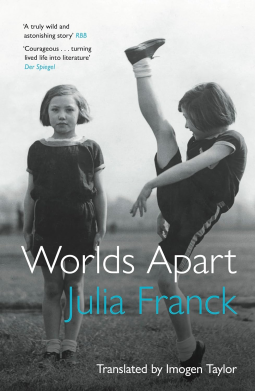
Worlds Apart
This title was previously available on NetGalley and is now archived.
Send NetGalley books directly to your Kindle or Kindle app
1
To read on a Kindle or Kindle app, please add kindle@netgalley.com as an approved email address to receive files in your Amazon account. Click here for step-by-step instructions.
2
Also find your Kindle email address within your Amazon account, and enter it here.
Pub Date Feb 5 2026 | Archive Date May 21 2026
Talking about this book? Use #WorldsApart #NetGalley. More hashtag tips!
Description
Two Germanies and two different lives are depicted in this powerful Bildungsroman of family, escape and first love, by award-winning Julia Franck.
Born in East Berlin, Julia is eight when her actress mother uproots her family of four girls, by different fathers, heading West in search of a better life. Their eventual landing in the remote countryside of Schleswig-Holstein solves no problems for this fractured household.
Desperate to escape a childhood of rural poverty, neglect and shame, the lonely child becomes addicted to writing. Aged 13, she leaves her family. At school in West Berlin, she finally encounters love.
In this novel based on her youthful diaries and early life, Julia Franck shows why and how a great writer found her voice.
Advance Praise
'This memoir is an astonishing chronicle of recent German history...The road from bourgeois respectability to anti-bourgeois defiance is realised with an acuity that makes this book hard to put down.' Julia Pascal, London Grip
‘Radically personal ... a stirring book in prose that captivates and engages’ Berliner Zeitung
‘This book (in which the characters have the same names as in real life) is truthful by duty and beautiful by choice’ Die Zeit
‘Worlds Apart is a fascinating piece of prose and a rousing story of self-empowerment’ Brigitte magazine
‘This family history hinges like a swinging door on key dates in twentieth-century German dictatorship.' TAZ
Available Editions
| EDITION | Paperback |
| ISBN | 9781917593021 |
| PRICE | £12.99 (GBP) |
Available on NetGalley
Available to Buy
Buy on Amazon Buy on BN.com Buy on Bookshop.orgAverage rating from 7 members
Featured Reviews
 Roman C, Reviewer
<I><blockquote>To the villagers, our cottage in the middle of Schacht-Audorf was not so much a Pippi Longstocking house as a mad house, a spectacle, a loony bin.</I></blockquote>
This is a chaotic recounting of a family of strong and difficult women set against twentieth century Central European history, and with a close-up view of Julia's coming of age and emergence as a writer. I say 'chaotic' in a good way: there's no easy, linear way to convey the fragmented lives and Franck's technique gives a wavering, partial narrative that is as effective as something more conventionally chronological.
I have a partiality for offbeat upbringings of women and so this ticked so many boxes for me: absent fathers and reluctant mothers, the entertwining of family history with a national one, insights into post-war Berlin, both East and West, a young and powerful love. Writing is Julia's method of processing the myriad tangled emotions she experiences, allowing her to shift through time, conveying both strength and vulnerability of voice.
Readers who struggle with broken timelines and storytelling should think again - me, I'll be filing this alongside early Annie Ernaux.
 Katy W, Reviewer
Julia Franck has taken her memories and diaries of her early life and turned it into this generous, beautifully realised work of fiction in which young Julia struggles to make sense of her chaotic, bohemian upbringing, where the word bohemian does a lot of heavy lifting. At times her treatment by adults is neglectful and abusive and yet Julia persists in staying true to herself, which at times takes an enormous toll on her. This is a novel that looks at identity, home and family and is strongly shaped by the politics of place. I was utterly absorbed in the world Franck creates.
 Lachlan F, Reviewer
This book has been described in numerous ways. A novel, literary fiction, a memoir, autobiographical. Many if not most of the people named in the book seem to be real. Some are dead, many are alive. Some are very famous, many are probably known in certain circles, while others are ‘ordinary’ people, known only to their friends, family and community. The author provides if not clarity then explanation in the introduction to the book:
“Our stories, our perceptions, are often worlds apart. We remember events and loved ones differently…That is why no real person will recognise themselves in any of the characters in this book.”
“We each see the world from our own perspective: we know those close to us in a way that’s all our own; we know things about people they may not know themselves.”
I thoroughly enjoyed this book. A remarkable tale of a girl, later a young woman growing up in difficult circumstances. Some imposed by the East and also West German State in the years before and soon after unification. Other circumstances are difficult due to family issues, particularly a mother who is portrayed as selfish, self-obsessed, irresponsible and casually cruel. A move from the Socialist East to the Capitalist West does little to improve the life of the author and her family.
The book moves forward and backward in time, fluidly and frequently. Sometime the author recalls events in the first person, while at other times observing in the third person. Sometime this reflects direct memories, sometimes distant events, forgotten but recalled via her diaries.
The author’s family history is recounted. As this is Germany, the family has experienced generations of conflict and turmoil. Wars, religious persecution and state control. Leading to death, family dysfunction, separation, migration, poverty, hardship and a number of damaged individuals. Always in the background seems to be an overwhelming uncertainty of what life holds. There are some fascination relatives, both living and long-passed away. Some of them play a role in the authors childhood life. Love and affection is meagre if present al all. Trauma and the ongoing repercussions seem to have been passed down through the generations in one form or another. The author has a much older sister, a twin sister and a baby sister. The three fathers are mostly absent and when present in the book are distant and for the most part useless.
Thus we have the story of a girl, later a young woman, growing up amongst considerable historical and present day issues. There is little to balance the bleakness. Libraries help, as does the occasional adult figure. Writing and diaries become an escape from her life, perhaps a coping mechanism. It is a story of grit and determination. Resilience and ambition. A desire for something, anything better than where she finds herself. A desire for a life, education, career, friends, love. Few of the ‘adults’ emerge from this story deserving any admiration or praise. They tend to be too often oblivious of others, irresponsible and concerned with their own self-interest. Sadly one of the worst offenders is the young girl’s Mother. She is quite something. Perhaps a reader should not be too judgemental. One wonders if it is not only circumstances but also mental health issues that play a role in the irregular parenting she exhibits, not just occasionally but constantly.
One also wonders just why the social-welfare authorities seem to be almost completely absent regarding care of not only the author as a young girl, but also that of other more vulnerable siblings. Much of the author’s hardships and difficulties are presented through the eyes of a child, who perhaps does not know she is neglected and mistreated. Other times, the author recounts events and emotions through adult eyes, and people are portrayed more bluntly and truthfully.
The heart of this book is the growing up of a young girl, becoming an adult in a world of mostly useless adults and institutions. The author seems to see her predicament clearly and over time realises there can be a better future. She is brave, tenacious, and resourceful. But also caring, nurturing and understanding of others, particularly her close siblings who also suffer from parental neglect. One scene recounted is the author’s baby sister taking her first steps, their mother distracted, oblivious:
“All morning I’d led her around, teaching her to walk and keep her balance, trying to persuade her to let go of my hand. I can see her now, clinging to our mother’s knees as our mother speaks to someone. …I see her see laughing as she reaches out her other arm to me. She treads on the spot, pointing first one foot and then the other in my direction, and I lure her, arms spread wide - until all at once she lets go of our mother’s knees, flails with her little arms, sets one foot in front of the other and comes tottering towards me, her tiny body tense with delight and excitement. I remember our joy when I caught her.”
And if that isn’t heartbreaking enough, the author follows with:
“We twins hadn’t learnt to walk in our mother’s presence. At that stage in our development, we were living with a foster family.”
She exhibits considerable maturity for someone so young in age. Ultimately she leaves her family and enjoys a better life. She finds independence, education, friends and love. But her difficulties continue, fate not family plays a dominant role as her life is put on hold.
I really enjoyed a lot of this book. Particularly the family dynamics and state influences on the author’s young life. Once she is older, but still a relatively young adult, her story becomes more normal, less compelling. This is not to disparage what has come previously. Events as a young adult bookend her life at this point. A life of challenges overcome, entering adulthood, developing values and an outlook on life that is to be admired. Love largely absent in her young life is found in her adult life.
The authors life-experiences clearly informs and explains some of her other works of fiction. At the end of this book, one is left with something quite memorable. Amongst the shady, undercover cold-war world of Germany, there were people on both sides of the border living life as best they could, striving for something better, apparently unaided and unnoticed by the relevant authorities and officials. Maybe many individuals in East Germany had similar family dynamics in the 1980s and 1990s, and did not care to remember them, moving on and forgetting. I am pleased this young woman became a writer. She reflects:
We cannot choose what we remember and what we forget. The older I grow, the more mysterious and divine the grace of forgetting becomes.
I look forward to reading more from this author. Fiction or Non-Fiction. Quality writing that comfortably or uncomfortably fits in between.
Addendum
This book is translated from German to English. While reading it, I wondered about some of the choices the translator made, particular the slang expressions. Moaning minnies…dawdling doras…namby pamby…gobsmacked ! Surely these were not literal translations. Indeed not. There is a Translator’s Note at the end of the book, which explains some of the process followed and decisions made during translation. An interesting addition and in our world of AI, it is reassuring to know that quality literature still requires human input.
 Mandy J, Reviewer
This wonderfully compelling book, whether fiction, memoir, autobiography or 'autofiction' as Julia Franck describes her newest work herself, is based on her diaries and memories of her early life, and is both evocative and often deeply moving. It explores childhood, family, and identity against the backdrop of a divided Germany. She reflects on growing up in East and West Berlin with a mother who seemed to care little for her children and describes how the siblings were left largely to their own devices in an unconventional and chaotic household. A
reflective and emotionally rich work it transcends genre boundaries, and shows how personal history intersects with political history. I found it a challenging yet rewarding read, beautifully written, deeply human, and quite unforgettable.
 Madeleine F, Reviewer
This is a beautiful, strange, heart-felt chronicle of coming-of-age in a divided Germany. While charting Cold War absurdities and curiosities, it also explores universal themes of love, family and suffering in a really compelling way. A wonderful read.
 Tess P, Reviewer
Reading about Germany before the wall fell is a personal favourite genre of mine. Raised in East Berlin, Julia (this is a memoir) is still a child when her mother moves Julia and her sisters to the West in search of a better life. They land in the remote countryside but the chaos and messiness continue.
Julia turns to writing before running away in her early teens and ultimately finding her voice as a writer as well as finding love.
Very evocative of time and place, this has encouraged me to look for some of Julia’s fiction.
Readers who liked this book also liked:
Christopher M. Faulkner; Raphael Parens; Colin P. Clarke
History, Nonfiction (Adult), Politics & Current Affairs