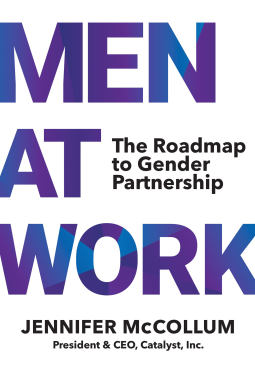
Men at Work
The Roadmap to Gender Partnership
This title was previously available on NetGalley and is now archived.
Send NetGalley books directly to your Kindle or Kindle app
1
To read on a Kindle or Kindle app, please add kindle@netgalley.com as an approved email address to receive files in your Amazon account. Click here for step-by-step instructions.
2
Also find your Kindle email address within your Amazon account, and enter it here.
Pub Date Mar 3 2026 | Archive Date Mar 1 2026
BenBella Books | Matt Holt Books
Talking about this book? Use #MenatWork #NetGalley. More hashtag tips!
Description
Inclusive workplaces are essential to build high-performing teams, fuel collaboration and innovation, spark trust and belonging, and attract and retain the best people. Yet even today, women continue to be left behind. How can we fix this?
The surprising answer: By shifting the conversation to include men.
In Men at Work, Jennifer McCollum, President and CEO of Catalyst, a nonprofit that helps companies create high-performing workplaces by advancing women and accelerating inclusion, shares the secret: engaging men as gender partners. Drawing from both honest human stories along with original Catalyst research data, McCollum demonstrates that we can’t advance women without the participation of men as mutually accountable partners.
Men At Work centers on freeing men from the pressure to exclusively behave in ways that reinforce rigid masculine traits and behaviors—being competitive, aggressive, and stoic. Without blaming or shaming anyone, McCollum shows men how enriching it is to break free of norms and how to do it. She presents takeaways from interviews with men and women at leading companies around the globe who have successfully created inclusive work cultures. She also shares insights from Catalyst’s MARC (Mutual Accountability, Real Change) initiative, which provides the understanding, language, and behaviors men—and everyone—can use in their day-to-day work as they move toward becoming gender partners.
The great news is that men want to experience inclusion and belonging, which everyone deserves. Men at Work gives them permission and the practical tools for doing so, in a way that helps men and women alike to thrive at work.
Available Editions
| EDITION | Hardcover |
| ISBN | 9781637748077 |
| PRICE | $30.00 (USD) |
| PAGES | 240 |
Available on NetGalley
Available to Buy
Buy on Amazon Buy on BN.com Buy on Bookshop.orgAverage rating from 1 member
Featured Reviews
 Demetris P, Reviewer
A Book That Doesn’t Just Support Women – It Explains What Men Gain, What Organizations Keep Losing, and How Culture Actually Changes
By Demetris Papadimitropoulos | February 16th, 2026
Watercolor Piece by Demetris Papadimitropoulos
“Gender partnership” is a phrase that sounds, at first blush, like a committee’s compromise – a term polished until it reflects no one in particular. Jennifer McCollum, the CEO of Catalyst, knows this risk. Her second book sets out to prove that the phrase is not corporate weather but a lever: a way to move a stubborn system by changing the grip. If “allyship” has often been performed as a posture – earnest, applauded, optional – McCollum argues that “gender partnership” must be practiced as an operating principle, shared and reciprocal, with consequences that show up in calendars, promotions, meeting rooms, and the quiet moments when someone decides whether to speak.
The book arrives in a season when the workplace has begun to feel like a live wire. Hybrid life is no longer a temporary accommodation; it is the new normal’s chronic negotiation. Artificial intelligence has accelerated the pace of work while flattening the prestige of pure IQ. In several boardrooms, “DEI” is spoken the way people say “budget cut” – as a word that might summon litigation, backlash, or a memo with the edges sanded off. Meanwhile, employees keep voting with their feet, and not subtly. McCollum’s wager is that gender equity does not survive this climate by being defended as a moral add-on. It survives by being rebuilt as a mutual advantage – the kind of advantage that makes men feel invited rather than indicted, and makes organizations feel not “woke,” but competent.
McCollum’s method is a blend of research, narrative, and executive coaching cadence. She writes with the brisk clarity of someone who has spent years translating human pain into management language and then translating management language back into human terms. Her sentences prefer doors to mirrors: they open quickly, they move you along, they try not to trap you in abstraction. The heart of the book is its “5 B’s” framework – “Begin with You,” “Break Down What’s Not Working,” “Build Up What’s in It for Men,” “Bridge the Gender Gaps,” and “Bring Humanity to Work.” The mnemonic is simple in the way good slogans are simple: it is less a map than a set of directions you can carry in your pocket when the meeting turns strange.
The most countercultural chapters are not the ones that scold men for the “man box,” but the ones that insist men have something to gain by leaving it. “Build Up What’s in It for Men” is, in effect, a chapter about permission. McCollum borrows the vocabulary of inclusion, then pivots it toward a demographic that has often been treated as the unmarked default in corporate life. She argues that policies designed to support women – parental leave, schedule flexibility, the normalization of caregiving – are not “women’s issues” with a male footnote. They are life policies, and men have been living without them or living guiltily alongside them.
Her examples are chosen with the precision of a seasoned storyteller. Paul Hudson, the CEO of Sanofi, becomes the book’s emblem of a certain modern executive virtue: not grand empathy, but structural fairness. Hudson praises a gender-neutral parental leave policy that makes it unremarkable for men to take time off – so unremarkable that no one’s commitment is questioned, no one’s masculinity is policed, and a woman’s career is no longer quietly docked for biology. McCollum’s point is not that enlightened leaders exist, but that systems can be designed to make enlightenment irrelevant. When everyone is expected to take leave, no one is punished for it.
McCollum is at her best when she shows how culture hides in the micro. The book is full of those small weather reports: the informal chatter before meetings shifting from sports to children’s dance festivals; the discipline of ending afternoon meetings on time; the difference between a leader who says “do what you need to do” and a leader who says it and still demands the deliverable by 5 p.m. These moments do not read as trivia. They read as the real architecture of belonging.
“Bring Humanity to Work,” the book’s culminating “B,” widens the argument beyond gender arithmetic and into a larger claim about leadership in the age of machines. McCollum introduces a useful triad of empathy – cognitive (thinking), affective (feeling), and behavioral (doing). It’s an old idea, reintroduced with a practical spine: empathy is not merely a disposition but a skill set that can be practiced, assessed, and, crucially, modeled. She offers the image of CEO as “Chief Empathy Officer,” a slogan that could have been cringe but is saved by its context. McCollum is not asking leaders to become therapists. She is asking them to stop confusing “toughness” with silence-inducing brutality.
The book’s research claims – that senior leader empathy correlates with higher innovation, engagement, and inclusion – are presented with the tone of a person who knows the corporate reader’s allergy to sentiment. It helps that she does not worship empathy as a vibe. She treats it as a business capacity: the thing that allows disagreement to surface before it becomes sabotage, the thing that keeps people from spending their best hours pretending to care. Ron Carucci’s four workplace questions – Do I matter? Do I belong? Is my work connected? Do I have an equal chance to succeed? – function in her telling like a diagnostic panel. If the answer to any of them is no, performance becomes theater.
McCollum’s strongest narrative technique is the unplanned moment. She understands that culture is often changed not by slogans but by a leader’s accidental authenticity. David Simmonds, a senior executive, watches a CEO choke up while describing his son’s youth football game; the emotion opens a room that had been braced for stoicism. Later, Simmonds shows up on a serious deal call with shimmering aubergine nails during Pride weekend, and the anecdote becomes a permission slip for others. McCollum is too shrewd to present these moments as formulas. Their power lies precisely in their spontaneity – the way they bypass the corporate immune system that rejects anything that feels programmed.
If this all sounds overly sunny, the book is not blind to resistance. It spends time on the fear that keeps men quiet: the worry that they will say the wrong thing, lose status, or be seen as performative. It also names the skepticism some women feel when men enter equity work as “fixers.” McCollum’s answer is mutual accountability. The best illustration is a small story: a woman colleague tells a man, calmly, that he took credit for her idea; he owns it, changes his behavior, and then starts noticing the pattern elsewhere. The book insists that creating an atmosphere of safety – including safety for honest mistakes – is not the soft side of fairness but the engine of it.
And yet the book’s optimism is not naïve so much as tactical. It is written for the reader who still has meetings to run. Like “Dare to Lead” and “Good Guys,” it tries to make vulnerability usable in fluorescent light. Like “The No Club,” it is attuned to the invisible labor women perform in organizations – the name tags, the note-taking, the always-being-helpful. Like “Invisible Women,” it hints at the systemic nature of bias even when it narrates it through individuals. And like “Lean In,” it understands the seduction of advice; it differs by being less interested in confidence and more interested in conditions.
McCollum’s most convincing argument for gender partnership is also her most politically savvy: she frames the stakes as retention in an era of scarcity. In her conclusion, she cites data suggesting that employees are more likely to stay when inclusion efforts continue, and that a sizable minority would quit if those efforts retreat. Even without the numbers, the reader can feel the truth of the claim. You can’t build the workplace of the future using the social rules of 1997. The book’s macro frame – aging populations, fewer new entrants, women’s rising education and spending power, demographic change – is the kind of context that executives understand because it sounds like risk.
The question, for a critic, is what the book leaves out in order to stay readable to its intended audience. McCollum writes as a builder, not a prosecutor. She does not linger on the organizations where the man box is not merely cultural but remunerative – where aggression is rewarded, where “toughness” is a performance metric, where empathy is treated as a brand asset but not a leadership requirement. She gestures toward legal risk and backlash but does not dwell in it. In a period when some companies are quietly rebranding equity work to avoid attention, a reader may wish for more on the mechanics of cynicism: how to keep “gender partnership” from becoming another initiative that lives on posters and dies in promotions.
Even so, the book’s practicality is its virtue. The “Chevron blueprint” in the appendix reads like a case study you can steal without stealing. “Win, Build, Send” – win people over, build skill, send employees out to practice – is culture change described as a relay rather than a speech. It includes the unglamorous details that most books skip: predictable meeting cadence, small-group trust, data to sway skeptics, scripts to reduce fear, and a long runway to avoid checkbox theater. McCollum is at pains to show that culture change is not an event but a frequency.
There is also, threaded through the book, a quiet insistence that gender partnership is not only about women’s advancement but about men’s liberation. The “man box,” in McCollum’s telling, is not merely an explanation for male dominance; it is a cage with benefits and costs. Men are pressured to be aggressive, independent, competitive – and many do not feel like their authentic selves when asked to perform that narrow script. Her term “flexible masculinities” is an attempt to unfreeze the category. It is also a strategic move: when men can participate without losing status, participation becomes possible.
McCollum also keeps widening the lens whenever the conversation risks collapsing into a simple men-versus-women ledger. The section on intersectionality is the book’s reminder that the category “woman” is not a single experience but a set of overlapping positions in power: race, caregiver status, sexuality, age, disability, immigration history. Her “Walk the Line” exercise – colleagues silently moving across a room in response to statements about poverty, othering, addiction, or hidden identity – is described with enough restraint to avoid the self-congratulatory tone these workshops can slip into. The point is not confession for confession’s sake. The point is pattern-recognition: you cannot build fairness for “everyone” if you only understand the version of “everyone” that looks like you.
One of the book’s most useful offerings, especially for leaders who fear they’ll say the wrong thing, is its insistence on scripts and norms. McCollum doesn’t fetishize spontaneity. She advocates for agreed-upon meeting practices, for language that makes interruption visible without making the interrupter a villain, for structures that distribute voice. The emphasis is less on awakening than on rehearsal: practicing how to ask, how to listen, how to repair.
Still, the reader may crave more on measurement – not only the moral metrics (representation, pay equity) but the operational ones (turnover by manager, promotion velocity, the unspoken cost of “emotional tax”). McCollum believes, rightly, that what gets measured gets managed. Yet her book is more fluent in stories than in dashboards. A company looking to operationalize the “5 B’s” will still need to translate the framework into KPIs, incentives, and consequences – the unromantic systems that determine whether empathy is rewarded or merely admired. That gap isn’t fatal; it just reminds you a book can start culture change, not finish it.
A reviewer is supposed to ask, at some point, whether the book changes the reader or merely reassures them. McCollum’s best chapters do more than reassure. They sharpen perception. After a few pages, you start noticing who takes notes, who gets interrupted, who is assumed to be “helpful,” who is praised for “confidence,” who is penalized for needing to leave on time. That perceptual shift is one of the book’s real gifts: an education in the patterns that hide in plain sight.
What makes McCollum’s book distinctive is its refusal to treat empathy as an aesthetic. In the age of AI, when every company can automate the polite sentence, she argues that the competitive advantage is the human capacity to make someone feel safe enough to tell the truth. Not a sentimental truth – a useful truth: that a model is wrong, that a safety risk exists, that a teammate is burning out, that a client is being underestimated, that an idea came from someone whose name keeps getting lost.
The book’s style is the style of Catalyst itself: research-backed, story-forward, and relentlessly applied. McCollum is less interested in dazzling the reader than in equipping them. Her acknowledgments, unusually revealing, read like a small portrait of the modern leadership author: the legal reviews, the project plans, the team that checks every citation, the editors who ensure no nugget is left unsaid. This is not a book born of solitary genius. It is a book produced the way culture change must be produced – collaboratively, methodically, with a kind of stubborn hope.
My lingering thought after finishing is that “gender partnership” is, in McCollum’s hands, an attempt to change the emotional weather of work. Not by denying conflict, but by making conflict survivable. Not by moralizing, but by redesigning the defaults. The book does not pretend that empathy solves everything. It suggests, more modestly and more radically, that without empathy, nothing else works for long.
That’s why the book feels so timely now, when organizations are tempted to retreat into compliance language and employees are tempted to retreat into cynicism. McCollum offers a third option: partnership as a discipline, practiced in the smallest rooms where the future is decided – the interview panel, the one-on-one, the meeting where someone repeats a woman’s idea and gets credit, the moment a father asks to pick up his child and wonders whether he is allowed to be a whole person.
It is not a perfect book today. It can be managerial in its optimism, and its metaphors are sometimes as neat as its frameworks. But it is a serious one – serious about the real lives inside corporate systems, serious about the cost of silence, serious about the possibility that the workplace can be redesigned to make more people more free. For a reader looking for a field guide rather than a sermon, McCollum has written one. And in a moment when fairness is being litigated in courts and in comment sections, that kind of grounded guide feels like a form of courage.
Rating: 86/100.