To read on a Kindle or Kindle app, please add kindle@netgalley.com as an approved email address to receive files in your Amazon account. Click here for step-by-step instructions.
2
Also find your Kindle email address within your Amazon account, and enter it here.
Talking about this book? Use #TheReverseCentaursGuidetoLifeAfterAI #NetGalley. More hashtag tips!
Description
A short, provocative guide to what's good, bad, and stupid about AI and the discourse around AI, by the author of Enshittification.
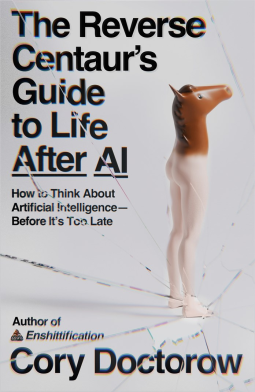
In modern tech parlance, a centaur is a person who is able to use technology to be a better, more productive version of themself. A reverse centaur is a person who is forced by technology to work at an inhuman pace—a driver made to deliver all day long, nonstop; a warehouse worker made to work without food or bathroom breaks; a programmer made to crank out impossible amounts of code.
The Reverse Centaur’s Guide to Life After AI is not another anti-AI screed. Cory Doctorow uses AI in his work every day. As a creative person, he has no moral or dogmatic issue with AI—he thinks the technology is useful, even exciting, and full of potential. And yet.
AI has arrived surrounded by unprecedented hype driven by a tech industry desperate to maintain its unprecedented valuation based on its own promises of endless financial growth. Despite the fact that almost all of AI’s real-world implementations have proved underwhelming, AI is projected to be worth more than $16 trillion—a number that only makes sense if AI replaces vast swathes of the wage-earning human workforce. To justify that level of “value,” every story about AI must be presented as inevitable, world-changing disruption. Even the tales of the robot apocalypse are a calculated attempt to bolster the fearsome power of AI.
For Doctorow, it is imperative to see through that hype to the real story, to understand the technology not just for what it does, but for who it does it to and who it does it for. From that point of view, the story of AI is indeed dramatic and unprecedented, having generated an investment bubble so big that it endangers the entire world economy. In The Reverse Centaur’s Guide to Life After AI—as he so successfully did in Enshittification—Doctorow recounts both how we found ourselves in this dire situation and how we can get through it, to a life “after” AI in which the tools work for us, not the other way around.
A short, provocative guide to what's good, bad, and stupid about AI and the discourse around AI, by the author of Enshittification.
In modern tech parlance, a centaur is a person who is able to use...
A short, provocative guide to what's good, bad, and stupid about AI and the discourse around AI, by the author of Enshittification.
In modern tech parlance, a centaur is a person who is able to use technology to be a better, more productive version of themself. A reverse centaur is a person who is forced by technology to work at an inhuman pace—a driver made to deliver all day long, nonstop; a warehouse worker made to work without food or bathroom breaks; a programmer made to crank out impossible amounts of code.
The Reverse Centaur’s Guide to Life After AI is not another anti-AI screed. Cory Doctorow uses AI in his work every day. As a creative person, he has no moral or dogmatic issue with AI—he thinks the technology is useful, even exciting, and full of potential. And yet.
AI has arrived surrounded by unprecedented hype driven by a tech industry desperate to maintain its unprecedented valuation based on its own promises of endless financial growth. Despite the fact that almost all of AI’s real-world implementations have proved underwhelming, AI is projected to be worth more than $16 trillion—a number that only makes sense if AI replaces vast swathes of the wage-earning human workforce. To justify that level of “value,” every story about AI must be presented as inevitable, world-changing disruption. Even the tales of the robot apocalypse are a calculated attempt to bolster the fearsome power of AI.
For Doctorow, it is imperative to see through that hype to the real story, to understand the technology not just for what it does, but for who it does it to and who it does it for. From that point of view, the story of AI is indeed dramatic and unprecedented, having generated an investment bubble so big that it endangers the entire world economy. In The Reverse Centaur’s Guide to Life After AI—as he so successfully did in Enshittification—Doctorow recounts both how we found ourselves in this dire situation and how we can get through it, to a life “after” AI in which the tools work for us, not the other way around.
A Note From the Publisher
Cory Doctorow is a science fiction author, activist and journalist. He is the author of many books, including The Lost Cause, a solarpunk science-fiction novel of hope amidst the climate emergency. His nonfiction book The Internet Con: How to Seize the Means of Computation is a Big Tech disassembly manual. Other recent books include Red Team Blues, a science fiction crime thriller; Chokepoint Capitalism, nonfiction about monopoly and creative labor markets; the Little Brother series for young adults; In Real Life, a graphic novel; and the picture book Poesy the Monster Slayer. In 2020, he was inducted into the Canadian Science Fiction and Fantasy Hall of Fame.
Cory Doctorow is a science fiction author, activist and journalist. He is the author of many books, including The Lost Cause, a solarpunk science-fiction novel of hope amidst the climate emergency...
Cory Doctorow is a science fiction author, activist and journalist. He is the author of many books, including The Lost Cause, a solarpunk science-fiction novel of hope amidst the climate emergency. His nonfiction book The Internet Con: How to Seize the Means of Computation is a Big Tech disassembly manual. Other recent books include Red Team Blues, a science fiction crime thriller; Chokepoint Capitalism, nonfiction about monopoly and creative labor markets; the Little Brother series for young adults; In Real Life, a graphic novel; and the picture book Poesy the Monster Slayer. In 2020, he was inducted into the Canadian Science Fiction and Fantasy Hall of Fame.
Informative, thought-provoking, and EYE-OPENING book from the author of Enshittification. I worry that because the title is less catchy than Enshittification people won't be as interested, but I really hope this takes off!
Doctorow believes that being a "good AI critic" means 1) identifying which aspects of AI are actually pathological and 2) "target[ing] the financial basis of the AI bubble." The book does a really good job explaining why AI is being pushed on us so hard even though the tech itself falls far short of what it's supposed to do and is so unsustainable, both environmentally and financially. The book also makes some interesting (and new to me) arguments about the best ways for creatives to protect themselves and their rights in the age of AI, including the idea that we should not advocate for more restrictive interpretations of copyright law (i.e. we shouldn't try to argue that training AI on creative works is copyright infringement), as this is unlikely to benefit artists and creatives. Doctorow also writes (somewhat optimistically!) about what we will be able to salvage from the wreckage of the AI bubble's collapse.
Essential reading, in my opinion!
5 stars
5 stars
5 stars
5 stars
5 stars
Was this review helpful?
Hannah K, Reviewer
5 stars
5 stars
5 stars
5 stars
5 stars
A thorough, deeply fucking sick of it all guide about the impending burst of the AI bubble and what AI can and can't actually do as of publishing. Happily, since publishing, Sora has imploded, which is a very good sign. Either way, man, if your work fucking makes you interact with AI this is a good guide to know how realistic and or desperate their claims are.
5 stars
5 stars
5 stars
5 stars
5 stars
Was this review helpful?
Emma C, Reviewer
5 stars
5 stars
5 stars
5 stars
5 stars
Hard to describe this as anything other than an absolute slam dunk by Cory Doctorow. Nonfiction from science fiction authors always hits different -- I'm rapidly learning nonfiction from anticapitalist leftist science fiction authors is in a whole other class. Doctrow's treatise on AI is cleverly named for the machine learning concept of the <I>reverse centaur </I>--an extended metaphor used here to describe the subordination of large groups of people to an energy-and-money sucking machine that serves little (if any) benefit to society.
If you, like me, have experienced the vague sentiment that all this AI stuff seems too good to be true and its potential benefits have already been overshadowed by the twin evils of capitalism of a facist surveillance state - this book is for you! If you haven't had these thoughts, but just generally want to get a picture of the AI landscape not biased by people who want your money or have poured all of THEIR money into making AI succeed - this book is also for you! I've noticed that a lot of AI-critical writers fall prey to fear-mongering and/or sweeping generalizations that limit the impact of their (often valid) core points. Doctrow dodges these pitfalls and strikes a balance of dry humor, frank words of warning, and ultimately cautious optimism that left me feeling both angry and energized. Catch me assigning sections of this to my undergraduates next semester after it hits the bookshelves later this summer.
5 stars
5 stars
5 stars
5 stars
5 stars
Was this review helpful?
Jane P, Librarian
5 stars
5 stars
5 stars
5 stars
5 stars
After last year's Enshittification (about the shittiness big companies inflict on us when in a regulatory vacuum), Doctorow narrows the focus on AI. I particularly appreciate this because as a librarian, all I hear all day every day is AI - from hysteria to raptures. Myself, I'm a conscientious objector, although I very much do not want to be a closed-minded Luddite.
Enter this book, which lays out a bunch of reasons why AI itself is not the enemy - it's the financial (and, again) regulatory environment that AI exists in that makes it such an existential topic. The whole narrative around AI coming to steal your jobs and replace you and leave you as part of the permanent underclass - turns out (according to the author, and I don't know enough to doubt him) to be driven by the companies themselves, whose only real motivation for doing ANYTHING is to maintain their status as growth (rather than mature) companies, and thus have easy access to investor capital and printing infinite stock shares. They want us all to believe that their technology is so advanced that its market disruption is inevitable. If Wall Street decided that they were plateauing, their shares would tank and the investors/c-suite would lost all of their accumulated wealth, so the illusion of continued growth is essential.
The title flips the tech term, centaur. A centaur is someone who augments their work with technology, by choice. A reverse-centaur is someone on whom technology is imposed for someone else's bottom line: they are working for the tech, not the tech working for them. The important thing to keep in mind re AI is not what the tech can do (CD is skeptical that it's actually going to replace humans at most tasks) who it is doing it for and to whom it is doing it. He is not an anti-technologist; he is closer to an anti-capitalist and pro-regulator, and above all, doesn't want five mega companies bringing down the entire financial system because they can't function without the illusion of endless growth.
Tldr; billionaires bad, creatives and technology good, our political system should be functioning to use the latter to benefit the most people, not the few. It's concise and convincing - and a good framing to put to anyone who accuses you of being a Luddite if you're AI-skeptical at all.
Thanks to netgalley and the publisher for the arc!
5 stars
5 stars
5 stars
5 stars
5 stars
Was this review helpful?
Sara M, Librarian
5 stars
5 stars
5 stars
5 stars
5 stars
Doctorow is more of an AI booster than I am, but I loved this book (which is saying something, because I've been professionally fighting against the "plagiarism machine that eats rainforests" for years.) This is a great capitalist critique of frankly any technology, specifically focused on AI but broadly applicable.
5 stars
5 stars
5 stars
5 stars
5 stars
Was this review helpful?
Featured Reviews
Media/Journalist 766033
5 stars
5 stars
5 stars
5 stars
5 stars
Informative, thought-provoking, and EYE-OPENING book from the author of Enshittification. I worry that because the title is less catchy than Enshittification people won't be as interested, but I really hope this takes off!
Doctorow believes that being a "good AI critic" means 1) identifying which aspects of AI are actually pathological and 2) "target[ing] the financial basis of the AI bubble." The book does a really good job explaining why AI is being pushed on us so hard even though the tech itself falls far short of what it's supposed to do and is so unsustainable, both environmentally and financially. The book also makes some interesting (and new to me) arguments about the best ways for creatives to protect themselves and their rights in the age of AI, including the idea that we should not advocate for more restrictive interpretations of copyright law (i.e. we shouldn't try to argue that training AI on creative works is copyright infringement), as this is unlikely to benefit artists and creatives. Doctorow also writes (somewhat optimistically!) about what we will be able to salvage from the wreckage of the AI bubble's collapse.
Essential reading, in my opinion!
5 stars
5 stars
5 stars
5 stars
5 stars
Was this review helpful?
Hannah K, Reviewer
5 stars
5 stars
5 stars
5 stars
5 stars
A thorough, deeply fucking sick of it all guide about the impending burst of the AI bubble and what AI can and can't actually do as of publishing. Happily, since publishing, Sora has imploded, which is a very good sign. Either way, man, if your work fucking makes you interact with AI this is a good guide to know how realistic and or desperate their claims are.
5 stars
5 stars
5 stars
5 stars
5 stars
Was this review helpful?
Emma C, Reviewer
5 stars
5 stars
5 stars
5 stars
5 stars
Hard to describe this as anything other than an absolute slam dunk by Cory Doctorow. Nonfiction from science fiction authors always hits different -- I'm rapidly learning nonfiction from anticapitalist leftist science fiction authors is in a whole other class. Doctrow's treatise on AI is cleverly named for the machine learning concept of the <I>reverse centaur </I>--an extended metaphor used here to describe the subordination of large groups of people to an energy-and-money sucking machine that serves little (if any) benefit to society.
If you, like me, have experienced the vague sentiment that all this AI stuff seems too good to be true and its potential benefits have already been overshadowed by the twin evils of capitalism of a facist surveillance state - this book is for you! If you haven't had these thoughts, but just generally want to get a picture of the AI landscape not biased by people who want your money or have poured all of THEIR money into making AI succeed - this book is also for you! I've noticed that a lot of AI-critical writers fall prey to fear-mongering and/or sweeping generalizations that limit the impact of their (often valid) core points. Doctrow dodges these pitfalls and strikes a balance of dry humor, frank words of warning, and ultimately cautious optimism that left me feeling both angry and energized. Catch me assigning sections of this to my undergraduates next semester after it hits the bookshelves later this summer.
5 stars
5 stars
5 stars
5 stars
5 stars
Was this review helpful?
Jane P, Librarian
5 stars
5 stars
5 stars
5 stars
5 stars
After last year's Enshittification (about the shittiness big companies inflict on us when in a regulatory vacuum), Doctorow narrows the focus on AI. I particularly appreciate this because as a librarian, all I hear all day every day is AI - from hysteria to raptures. Myself, I'm a conscientious objector, although I very much do not want to be a closed-minded Luddite.
Enter this book, which lays out a bunch of reasons why AI itself is not the enemy - it's the financial (and, again) regulatory environment that AI exists in that makes it such an existential topic. The whole narrative around AI coming to steal your jobs and replace you and leave you as part of the permanent underclass - turns out (according to the author, and I don't know enough to doubt him) to be driven by the companies themselves, whose only real motivation for doing ANYTHING is to maintain their status as growth (rather than mature) companies, and thus have easy access to investor capital and printing infinite stock shares. They want us all to believe that their technology is so advanced that its market disruption is inevitable. If Wall Street decided that they were plateauing, their shares would tank and the investors/c-suite would lost all of their accumulated wealth, so the illusion of continued growth is essential.
The title flips the tech term, centaur. A centaur is someone who augments their work with technology, by choice. A reverse-centaur is someone on whom technology is imposed for someone else's bottom line: they are working for the tech, not the tech working for them. The important thing to keep in mind re AI is not what the tech can do (CD is skeptical that it's actually going to replace humans at most tasks) who it is doing it for and to whom it is doing it. He is not an anti-technologist; he is closer to an anti-capitalist and pro-regulator, and above all, doesn't want five mega companies bringing down the entire financial system because they can't function without the illusion of endless growth.
Tldr; billionaires bad, creatives and technology good, our political system should be functioning to use the latter to benefit the most people, not the few. It's concise and convincing - and a good framing to put to anyone who accuses you of being a Luddite if you're AI-skeptical at all.
Thanks to netgalley and the publisher for the arc!
5 stars
5 stars
5 stars
5 stars
5 stars
Was this review helpful?
Sara M, Librarian
5 stars
5 stars
5 stars
5 stars
5 stars
Doctorow is more of an AI booster than I am, but I loved this book (which is saying something, because I've been professionally fighting against the "plagiarism machine that eats rainforests" for years.) This is a great capitalist critique of frankly any technology, specifically focused on AI but broadly applicable.
Ungodly Rich
Katharine McGee
General Fiction (Adult), Romance, Women's Fiction
This site uses cookies. By continuing to use the site, you are agreeing to our cookie policy. You'll also find information about how we protect your personal data in our privacy policy.