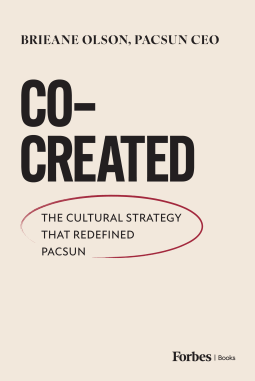
Co-Created
The Cultural Strategy That Redefined Pacsun
This title was previously available on NetGalley and is now archived.
Send NetGalley books directly to your Kindle or Kindle app
1
To read on a Kindle or Kindle app, please add kindle@netgalley.com as an approved email address to receive files in your Amazon account. Click here for step-by-step instructions.
2
Also find your Kindle email address within your Amazon account, and enter it here.
Pub Date May 12 2026 | Archive Date May 12 2026
Talking about this book? Use #CoCreated #NetGalley. More hashtag tips!
Description
In a marketplace defined by change, legacy brands can’t afford to operate on outdated playbooks. In Co-Created, Pacsun CEO Brieane Olson reveals how the brand achieved cultural relevance and business transformation—not by leading Gen Z, but by building alongside them.
Told through Olson’s leadership perspective, this book details how Pacsun embedded co-creation across every level of the business. From creator partnerships and viral content to purpose-driven investment, Co-Created offers a framework for brands to align with fast-moving cultural expectations while maintaining operational focus.
This book shows how cultural fluency can drive long-term growth, whether you’re navigating disruption, repositioning a brand, or launching something entirely new.
Key takeaways include:
- How to operationalize co-creation across marketing, merchandising, and leadership
- Strategies for aligning brand values with community impact
- Lessons from high-growth brand partnerships and Gen Z collaboration
- A framework for turning real-time insights into strategic action
- How to lead transformation without losing authenticity
Advance Praise
"Co-Created by Pacsun CEO Brieane Olson is an intimate description of corporate culture change that has led to the (co)creation of one of the most amazingly successful clothing and accessories brands today. Olson's refreshingly honest writing style describes both early pitfalls (leading to a chapter 11 restructuring) and careful strategic rethinking to go from a surf-and-skate retailer selling other brands to an own-brand company which puts authentic community building front and center. This book details the secrets behind what I call the First Law of Customer Centricity: Build from the outside-in rather than sell from the inside-out. This is a must-read for both legacy brands needing transformation and all companies who seek to understand the power of nextgen audience marketing."
— Rohit Deshpande
Sebastian Kresge Professor of Marketing Emeritus, Harvard Business School
"Co-Created is such an inspiring and insightful look at how culture, creativity, and community can truly transform a brand. Brie’s leadership shines through every page. She shows what it means to listen deeply, to build with purpose, and to lead boldly in a constantly evolving landscape. This book isn’t just about Pacsun’s reinvention, it’s a playbook for any leader who wants to create meaningful impact by putting people and values at the center. I have such admiration for Brie as a leader, and I couldn’t be more excited to celebrate this important work."
— Jennifer DiPasquale
President & Co-Founder, Women in Retail + Total Retail
“Brieane Olson is the rare leader who blends vision with heart. In Co-Created, she shows how courage, community, and creativity can transform even the most legacy-bound brand into a cultural force. This book is a masterclass in transformation, but it is also a love letter to what’s possible when vision meets resilience. Brieane’s courage to challenge the legacy playbook, her relentless pursuit of relevance, and her ability to fuse creativity with operational excellence are the reasons Pacsun stands as a case study in reinvention. As a friend and client, I couldn’t be more proud to stand beside Brieane as she shares this story with the world and witness her redefining what female leadership looks like—bold, inclusive, and unapologetically authentic.”
— Jennifer Prince
Chief Commercial Officer, Los Angeles Rams
"Co-Created captures Brie’s brilliance as a leader who sees what others can’t. With vision, creativity, and a deep understanding of culture, she reimagined Pacsun’s future while inspiring teams to build with heart and purpose. This book isn’t just about brand transformation—it’s a powerful blueprint for how Brie’s unique blend of cultural insight and bold leadership can drive lasting growth."
— Melissa Campanelli
Co-Founder, Women in Retail Leadership Circle
"I know firsthand that collaborating with your community is the secret to building something truly iconic. Co-Created is Brie Olson’s love letter to culture and creativity—showing how listening and co-creation can transform not just a brand, but the world around it. Community as the new couture! That’s hot.”
— Paris Hilton
“In Co-Created, Brieane Olson offers more than a story of Pacsun’s reinvention—she presents a masterclass in authentic, purpose-led leadership. What stands out most is Brieane’s leadership philosophy: she reminds us that when companies are rooted in their values and evolve with intention, they don’t just sell products—they build communities and create lasting impact.”
— Artemis Patrick
President & CEO, SEPHORA North America
“It is a privilege to discuss Brieane Olson and her new book, Co-Created, which highlights her vital contributions and vision for Pacsun’s evolution in recent years.
Today, the company represents far more than a retail brand; it stands as a cultural interpreter and leader within the industry, thanks to its thoughtfully curated designs and innovative marketing strategies.
Throughout her career, Brieane has been an invaluable friend, business partner, mentor and source of inspiration across both creative and business sectors.
As a prominent female leader in the fashion industry, she not only supports emerging designers but also champions established brands, delivering an empowering message to a new generation of young girls and future industry leaders.
Her authentic insights into the intersection of fashion and contemporary culture underscore her strengths, grounded in integrity and a nuanced understanding of today’s landscape.
I consider myself fortunate to be part of her circle and wish her ongoing love, success, and happiness as she navigates her journey."
— Jeff Hamilton
“Pacsun gave me one of my first opportunities as a creator; seeing my casual fit check in my room turn into something way more impactful was incredibly surreal. It showed me firsthand how forward-thinking companies like Pacsun can empower creators to spark change. Co-Created beautifully captures that exact spirit of listening, connecting, and collaboration.”
— Lyla Biggs
Influencer
“Co-Created is a definitive look at business transformation. Brieane Olson shows how Pacsun put community at the center to move forward with resilience, creativity, and leadership. It’s a story of reinvention in a time when culture moves fast and expectations move faster. Every leader, in any industry, will find lessons worth carrying into their own work.”
— Russell Wallach
Global President, Live Nation Media & Sponsorship
"Turnarounds are challenging, each in their own way. Yet, in Olson’s hands, Pacsun’s turnaround is a joyous re-creation that results in a new answer to the most fundamental of questions: Why is this business relevant? Here strategy was forged not in isolation but in co-creation through authentic engagement with customers, purpose-led leadership, and an open and collaborative culture. Olson will convince you that it all is a deeply human endeavor. Get inspired by what she and her team did at Pacsun—then imagine what you could achieve.
— Cynthia A. Montgomery
Charles B. (Tex) Thorton Chair, Advanced Management Program, Harvard Business School
"I have worked closely with Brie for 14 years and have witnessed her leadership skills up close. It is one thing to have a (co)Create strategy in mind (which is brilliant, by the way) but it is another matter entirely to have the leadership skills to bring it to life. Brie and her team have done an exemplary job of infusing the (co)create vision throughout the organization and rallying all of PacSun’s (co)creators to collaborate and propel the PacSun brand forward.
In this book, Brie does a terrific job not only describing the vision of customer centric (co)creation, she also spells out a roadmap that every reader can follow to make it a reality. At Golden Gate Capital, we are delighted to have been along for this tremendous ride and are grateful to be a partner with Brie and her team."
— Neale Attenborough
Managing Director, Golden Gate Capital
“Co-Created is a masterclass in how legacy retailers can reclaim cultural relevance by listening deeply, empowering creators, and inviting communities to help shape the brand. Brieane Olson shows that true transformation isn’t about chasing trends—it’s about building purpose-driven ecosystems where customers feel seen, heard, and inspired to co-create the future.”
— Jill S. Dvorak
Senior Vice President, Content at NRF
“I have had the distinct pleasure of working in partnership with Brie over the past 14 years at PacSun. Brie is a rare talent, whose leadership inspires all around her—from the talented employees at PacSun, to the many creative and collaborative relationships with partner brands, co-creators, and suppliers. I am excited that Brie has put pen to paper to share PacSun’s incredible journey. Co-Created is a 'must read' for any leader aspiring to create an enduring connection with their customers.”
— Mike Montgomery
Managing Director, Golden Gate Capital
"Brie Olson was a classmate with whom I shared both joys and hardships at Harvard Business School’s AMP, and we were the only participants from the fashion industry.
In November 2024, during the collaboration between WILDSIDE—Yohji Yamamoto Inc.’s new project focused on partnerships—and Pacsun, launched at Complex Con Las Vegas, she proposed a market-conscious branding strategy, welcoming Formula 1 to attract new fan bases.
Her business strategy—consistently prioritizing a market-in perspective, including the element of 'good surprise,' while remaining trend-conscious—stems, I believe, from her profound insight and overflowing passion for the market.
I look forward to seeing her continue to spearhead Pacsun in bringing fresh energy to the fashion industry."
— Tsuyoshi Muraki
Available Editions
| EDITION | Other Format |
| ISBN | 9798887508078 |
| PRICE | $32.00 (USD) |
| PAGES | 192 |
Available on NetGalley
Available to Buy
Buy on Amazon Buy on BN.com Buy on Bookshop.orgAverage rating from 14 members

Featured Reviews
 Mae B, Reviewer
This was such an interesting read about PacSun and the road back to stability. I remember they were huge in the 90’s so I was surprised to learn that they were struggling financially. It makes sense given the fashion shift in addition to online stores rising to prominence around that time. The author does a great job of speaking on the challenging financial situation (though she wasn’t running it at that time) as well as how she and her team rebuilt what PacSun is and represents. It was cool to see the different strategies they implemented and what worked. They spoke to the shift to social media and how much of a bet they took to help grow the company. Also, making PacSun a product instead of just a place to get other products was a smart move. This book is a must read to learn about how to right a sinking ship and create a healthy, enduring path forward.
 Calli T, Reviewer
Co-Created is an essential read through the lens of Brieane Olson.
Her perspective brings the brand’s trajectory to life in a way that feels both honest and forward-thinking. What stands out most is the depth behind Pacsun’s co-creation model - it’s not just a strategy, it’s a mindset that shapes culture, community, and long-term growth.
 Amy G, Reviewer
A sharp, timely read for anyone navigating today’s fast-moving market. Co-Created offers a refreshing take on brand transformation, showing how true relevance comes from collaboration, not control. Brieane Olson’s perspective is both practical and inspiring, blending real-world strategies with cultural insight. The focus on Gen Z partnership and authenticity makes this especially valuable. It’s a smart, actionable guide for leaders who want to evolve without losing their brand’s core identity.
 Demetris P, Reviewer
What Looks Like Virality Is Usually Infrastructure
Brieane Olson’s “Co-Created” is most persuasive when it shows that cultural relevance is built long before the algorithm notices
By Demetris Papadimitropoulos | April 28th, 2026
A viral jean is a useful miracle, especially for companies that would like to be seen as prophets. Brieane Olson’s “Co-Created: The Cultural Strategy That Redefined Pacsun” is more persuasive because it resists, at least for a while, the temptation to worship its own good fortune. The Astrid wash of Pacsun’s Casey Low Rise Baggy Jean may be the book’s receipt – eleven thousand pairs sold by Black Friday, tens of thousands more through TikTok, store traffic following platform attention into physical aisles – but Olson treats it less as lightning than as evidence. The jeans went viral because Pacsun had spent years becoming the kind of company that could benefit when a bedroom video became a sales channel. The cute pair of pants is not the revolution. It is the proof of purchase.
That distinction is the hinge: the book is not really about the viral moment, but about the machinery of leases, labels, creators, inventory, and trust that made the viral moment usable. “Co-Created” could easily have become a CEO lap around the track: Pacsun was struggling, Pacsun discovered Gen Z, Pacsun learned TikTok, Pacsun became cool again, please applaud before exiting through the collaboration capsule. Olson’s version is better because it is less flattering. Her best subject is not coolness, or even youth culture, but the stubborn interval between recognizing decline and building the operating capacity needed to answer it. Many companies can identify their own trouble. Fewer can survive the embarrassment of the diagnosis. Fewer still can turn that diagnosis into leases, labels, staffing, incentives, inventory systems, creator relationships, board buy-in, store redesign, and the merchant discipline of not ordering a mountain of untested product because someone senior caught a case of enthusiasm.
The book begins with Astrid, but the less camera-ready beginning is Pacsun’s entrapment inside the image that once made it legible. Founded as Pacific Sunwear of California, later rebranded as Pacsun, the company had thrived on the mall-lit fantasy of SoCal surf-and-skate ease: beaches, board shorts, bikinis, Quiksilver, Roxy, Volcom, and the eternal promise that adolescence might be improved by better lighting and a Huntington Beach parking lot. That fantasy moved product, until it didn’t. Malls weakened. E-commerce reset expectations around convenience. Fast fashion sped up the trend cycle. Youth style became more fluid, more global, and less obedient to the old store map. Pacsun’s assortment skewed heavily male; its stores retained the binary choreography of board shorts over here, women’s swimwear over there; and, most damagingly, the retailer had not made its own name matter on the rack. It carried other people’s names so successfully that its own became a ghost stitched into its own racks.
Olson’s example of Bullhead denim is almost comic in its small retail tragedy. Pacsun designed the jeans, but because the label did not say Pacsun, the customer’s affection accrued elsewhere. A teenager could love the product and still not love the company. In a book crowded with creator summits, celebrity collaborations, social platforms, and horizon-scanning language, this small label problem quietly carries the argument. It turns branding from showroom vapor into a sewn-in fact. If the customer cannot name you when she names what she loves, you have not built much of a brand.
Project Mavericks is the book’s first crack in the comeback myth: proof that a company can name its illness years before it can change its habits. Shortly after Olson arrived from Abercrombie & Fitch in 2007, Pacsun launched the eighteen-month transformation initiative to rediscover relevance. The diagnosis was accurate enough to sting; the organization was not yet built to act on it. Pacsun needed customer centrality, a more covetable identity, brand thinking across the business, a broader fashion point of view, an updated California image that included street as well as beach, and a culture capable of moving differently. The principles were good. The company was not yet built to obey them.
Leadership changed. Consultants could diagnose what insiders had to implement. Teams stayed siloed. Product, marketing, men’s, women’s, stores, and executives did not move in one rhythm. Pacsun wanted to be a maverick, but Olson’s later argument is that the very word contained the flaw. A maverick stands apart. Pacsun’s eventual reinvention would require the opposite: a company porous enough to be altered by the people around it.
The 2016 Chapter 11 filing is where the story stops being a mood board and becomes an accounting. Olson writes about bankruptcy without melodrama, which is wise. The filing does not arrive as thunder; it arrives as arithmetic. Golden Gate Capital, debt conversion, additional capital, expensive leases shed, a store fleet cut down from more than nine hundred locations, vendor relationships preserved, financial discipline restored – these details put ballast under the book’s warmer vocabulary. When Olson later talks about purpose, community, and brand love, the reader remembers that none of those ideas can float above basic retail math forever. A company cannot co-create its way out of bad leases without first getting out of the leases.
From there, “Co-Created” moves through the rehearsal partnerships that pointed Pacsun forward before it had a working grammar for what it was doing. The Kendall and Kylie Jenner collaboration, launched when the sisters were still rising teen celebrities rather than fully established fashion and beauty powers, becomes a study in early social amplification and genuine involvement. Jerry Lorenzo’s F.O.G. line shows Pacsun as a bridge between an aspirational streetwear sensibility and a younger customer who could not access Fear of God pricing. The #BEEN #TRILL orbit, with Virgil Abloh, Matthew Williams, and Heron Preston, gives Olson one of her more persuasive claims: Pacsun was sometimes near the right cultural door before it knew how to build the house around it. These partnerships were not yet a system of shared authorship. They were sparks, not yet structure.
Listening is the book’s discipline and operating procedure. First as research. Then as relationship. Finally as decision system. Early Pacsun listens in the familiar ways: style leaders, consumer panels, store feedback, social comments. The flaw, Olson argues, is that feedback stayed too narrow, often trapped in product and buying. The later shift is to make listening travel. Store associates provide qualitative reports that sales data cannot capture. Style leaders become employees. Students from high schools and colleges join the conversation. Social listening stretches across Instagram, TikTok, Discord, Reddit, and other platforms. The 2025 Youth Report, Purpose Partner Summit, Youth Advisory Council, Pacsun Collective, and PS Hub all formalize the same movement: the customer stops being only a subject under observation and becomes, at least in theory, a participant in the making of the brand.
That “at least in theory” matters. Olson is most persuasive when listening changes an outcome. She is less persuasive when listening becomes the glow of corporate benevolence. Her prose is clear, composed, and almost relentlessly orderly. She writes like an executive who has learned to translate experience into a format sturdy enough for both boardroom and bookstore. Chapters often move from scene to diagnosis to “LESSON LEARNED,” a device that makes the book highly navigable and occasionally too tidily trained. The sentences are mostly medium-length, lucid, sequential. They do not strut. They do not brood in corners. They arrive prepared, with the deck already attached.
That style serves the book’s purpose. “Co-Created” wants to make transformation feel teachable. It wants to show that being chosen is not a mist descending on the lucky, but an operating capacity built through systems. The prose is strongest when attached to objects that can be touched, stocked, mislabeled, returned, washed, posted, or sold through. A first TikTok filmed in Morocco that does not go viral. Creators sitting around a fire with no Wi-Fi. The old Pacsun store divided by gender. Customers asking for “the TikTok Jean.” A mall returning as a place to gather rather than merely buy. Washers and dryers installed in schools after a clothing donation program reveals the deeper problem: new clothes are not enough if students cannot clean them. When Olson writes through these objects and situations, her language earns its confidence.
It is weaker when it enters its familiar fog bank: authenticity, purpose, community, values, relevance, co-creation, brand love. The words are not hollow, but some are weighted with evidence and others mostly echo down the aisle. By the final chapters, one can feel them taking another lap around the store. The strongest examples refresh the vocabulary; the weaker passages let the vocabulary arrive before the difficulty has been faced.
Structurally, Olson knows exactly where she is going, which is both her discipline and her trap. She opens with the outcome – Astrid – then spends the book reconstructing the conditions that made that outcome possible. The movement backward from the viral jean to California heritage, Project Mavericks, bankruptcy, early collaborations, listening systems, creator infrastructure, TikTok Shop, AI forecasting, purpose initiatives, and internal culture gives the book its best causal chain. This is where “Co-Created” separates itself from breezier trend manuals. Astrid is not the beginning. Astrid is the late bloom of financial restructuring, operational readiness, social commerce, creator trust, and a brand willing to be spoken for by someone with five thousand followers filming at home.
The lesson-machine has a cost. Because each chapter resolves into takeaways, contradiction sometimes gets escorted to the exit too quickly. Project Mavericks fails, but it plants seeds. Bankruptcy hurts, but it permits renewal. Celebrity partnerships are incomplete, but they foreshadow co-creation. Purpose risks abstraction, but it becomes an operating framework. AI threatens to complicate human listening, but it becomes “co-intelligence.” There is truth in these conversions; the book would be far less practical without them. Still, one occasionally wishes Olson would leave a problem unsmoothed for another page or two. Not every wrinkle needs a lanyard.
The cleanest test of purpose is the Los Angeles Rams partnership, precisely because it includes correction. Pacsun and the Rams move from a celebrity suite to community outreach, donating more than $5 million in apparel to students across LA County. Then the company learns that some students lack laundry access. The next iteration, Loads of Love, brings in Tide and Thinkwatts to install washers and dryers in schools. This is purpose under pressure: not a slogan, not a seasonal post, not virtue in capsule-collection form, but an action that discovers its own insufficiency and improves. Here, the store floor corrects the theory.
The less examined difficulty is that co-creation is not innocent simply because it is participatory. If Pacsun wants to become, in Olson’s concluding phrase, an “operating system for youth culture,” the ambition is both exciting and faintly ominous. An operating system enables. It also structures, captures, measures, updates, and governs the environment through which other people move. The book celebrates the democratization of influence: micro creators, store associates, young designers, advisory council members, everyday customers, local artists, run clubs, student voices. It is right to see possibility there. But it does not linger long enough on ownership, pay, credit, and control. Who owns an idea uploaded to PS Hub? How are creators paid over time? What protections exist for younger contributors? How does AI-assisted listening differ from cultural prediction at scale? How does a purpose-led fashion retailer reckon with overproduction, textile waste, labor, and the acceleration of trend? Olson’s book does not ignore responsibility, but its most uncomfortable questions sit just beyond its chosen frame, tapping politely on the glass.
This does not hollow out “Co-Created”; it gives the book its useful double life. It is a business book and a strategic artifact, a study of Pacsun’s method and an extension of that method. Like “Onward” by Howard Schultz with Joanne Gordon, it is a comeback story told from inside the company’s preferred moral vocabulary. Like “The Brand Flip” by Marty Neumeier, it understands that customers now participate in the making of brand meaning. Like “The Experience Economy” by B. Joseph Pine II and James H. Gilmore, it knows that stores are no longer merely places where inventory waits for wallets. But Olson’s book is narrower and more specific than those comparisons in the best sense. It is about Pacsun: leases, jeans, creators, malls, TikTok Shop, boardrooms, store associates, streetwear, and the peculiar modern fact that a retailer can learn something essential about itself because customers walk into a physical store asking for an item by the name the internet gave it.
In the conclusion and afterword, the case study puts on its blazer and becomes a pitch. Olson imagines retail as youth culture studio, AI-powered customization engine, social utility, community hub, belonging-based loyalty system, decentralized youth brand collective, and global accelerator. Some of these ideas are intriguing; some are sketches still waiting for strategy. The afterword consolidates Pacsun’s present-day claim: it knows the next generation, is culture-led rather than commerce-led, has financial room to scale, is built for the future, and stands at the sweet spot of disruption. The language is confident, perhaps too confident. It reads partly like an investor deck that discovered feelings, or a brand manifesto that learned to bring receipts.
Yet the receipts exist. Pacsun’s TikTok Shop sales, net-new customer figures, Super Brand Day success, foot-traffic increase, AI tools, PS Hub, Youth Report, and store activations give the book more than well-lit aspiration. Its chief achievement is showing that cultural relevance is built through a sequence of unglamorous capabilities. You do not become youth-native by announcing your fondness for young people. You become more relevant by changing who gets heard, how quickly feedback travels, how inventory is allocated, how partnerships are chosen, what stores are for, what employees can decide, what leadership rewards, and what the company is willing to stop protecting.
This is also why the limitation matters. Olson’s story does not turn the lens far enough back on itself. It knows that old top-down control failed, but it is less curious about how new participatory systems create subtler forms of control. It knows that young consumers want values, but it does not always ask what happens when values become a growth strategy. It knows that creators can be empowered, but it does not fully examine the corporate machinery that turns empowerment into measurable advantage. It knows that community is powerful, but it trusts the warmth of that word more than a reviewer should.
Still, “Co-Created” is more grounded than its glossiest sentences suggest. The book is not valuable because it discovers that young people like being heard; that revelation has been available to anyone who has ever met one. It is valuable because it shows how difficult, expensive, procedural, humbling, and internally disruptive it is for a company to become capable of hearing them. Its strongest lesson is not “use TikTok,” or “lead with purpose,” or “find authentic creators,” though Olson argues all three. Its strongest lesson is that a brand can be correct in theory for years and still fail in practice until its structure catches up with its insight.
My final rating: 78/100, which maps to 3/5 Goodreads stars.
The score may seem cool beside the book’s warm intentions, but warmth is not force, and usefulness is not depth. “Co-Created” is instructive, often sharp, and more candid than its most polished vocabulary suggests. It is also repetitive, polished until some fingerprints disappear, and more persuasive as a Pacsun case study than as a general theory of retail. Its best image remains the one it begins with: a jean moving from a young woman’s bedroom to a company’s sales calls to store floors across the country. What looks like virality is really infrastructure briefly made visible – culture, for one weekend, wearing a barcode.
 Jenni R, Reviewer
A wonderful narrative detailing the turnaround of Pacsun. Listening to the consumer and their needs was transformative for the company as it evolved. The emphasis on community as a strategy for reestablishing a brand that had lost it's touch is a great reminder to all of us. A fascinating story and I was sorry when it ended. A fabulous read and I took copious notes.
Thank you NetGalley and Forbes Books for my advance copy in exchange for my honest feedback.
 Mike M, Media/Journalist
If brands don't click with you, this is the book you need to read, Lots of good identity insights for everyone.
Readers who liked this book also liked:


James Greenblatt, MD; Bill Gottlieb, CPHC
Health, Mind & Body, Parenting, Families, Relationships




Tony Castro
Biographies & Memoirs, Entertainment & Pop Culture, Nonfiction (Adult)



Tim Leatherman; Chris Kornelis
Biographies & Memoirs, Business, Leadership, Finance