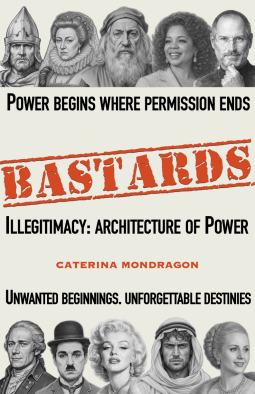
Bastards
Illegitimacy: Architecture of Power
This title was previously available on NetGalley and is now archived.
Send NetGalley books directly to your Kindle or Kindle app
1
To read on a Kindle or Kindle app, please add kindle@netgalley.com as an approved email address to receive files in your Amazon account. Click here for step-by-step instructions.
2
Also find your Kindle email address within your Amazon account, and enter it here.
Pub Date Mar 19 2026 | Archive Date Mar 19 2026
Talking about this book? Use #Bastards #NetGalley. More hashtag tips!
Description
What if “illegitimacy” was never about morality — but about control?
For centuries, societies have divided children into two categories: legitimate and illegitimate. One inherits. One is excluded. One belongs. One is marked.
In Bastards: Illegitimacy – Architecture of Power, Caterina Mondragon dismantles the myth that illegitimacy is a private misfortune or moral failure. Instead, she reveals it as a carefully engineered legal and political tool — designed to protect wealth, consolidate dynasties, and preserve systems of authority.
From royal succession crises and canon law to inheritance codes and modern institutional gatekeeping, Mondragon traces how birth status became one of civilisation’s most enduring mechanisms of power. The label “bastard” was not merely descriptive — it was strategic.
Through historical analysis and psychological insight, this provocative work explores:
• How legitimacy was constructed to control property and bloodlines
• Why institutions codified exclusion into law
• The hidden hypocrisy of elite power structures
• The psychological architecture of shame and identity
• How modern systems still replicate ancient hierarchies
• Why outsiders often become disruptors of entrenched power
But this is not only a historical excavation. It is also a reclamation.
Bastards reframes illegitimacy as intellectual independence — as the condition of those not bound by inherited hierarchy. It asks whether legitimacy should be measured by birth at all, or by courage, capability, and self-definition.
Bold, unflinching, and deeply analytical, Bastards: Illegitimacy –Architecture of Power challenges readers to reconsider the foundations of authority — and who truly gets to belong.
This is not a book about legitimacy. It is a book about power.
A Note From the Publisher
Advance Praise
Power begins where permission ends
From unwanted beginnings to unforgettable destinies
Illegitimacy: the architecture of power
Power begins where permission ends
From unwanted beginnings to unforgettable destinies
Illegitimacy: the architecture of power
Available Editions
| EDITION | Ebook |
| ISBN | 9781919491905 |
| PRICE | $2.99 (USD) |
| PAGES | 98 |
Available on NetGalley
Available to Buy
Buy on Amazon Buy on BN.com Buy on Bookshop.org Buy on KoboAverage rating from 5 members
Featured Reviews
 Rebecca S, Reviewer
This was a great book and would recommend it to not only to any non-fiction reader, but those who regularly read historical fiction. It will give them a greater understanding of why people were treated 'lesser than' for being born out of wedlock (and still are today, although to a lesser extent than they used to).
Thanks so much to NetGalley for the free Kindle book. My review is voluntarily given, and my opinions are my own.
 Dannielle D, Reviewer
Thank you to Netgalley for giving me this e-arc to review.
Quite frankly, I hated how this was written. It reads like one of those Ai videos online that are trying to tell you history.
I can't fully say if it is AI but I couldn't find anything on the author, the book isn't on Goodreads and the images look like they're either Ai or autotuned?
It's a very weird time.
 Chris H, Reviewer
What do William the Conqueror, Elizabeth I, Marilyn Monroe, Leonardo Da Vinci and Oprah Winfrey all have in common? If memory serves, one could also add Ramsay MacDonald, Alec Guinness, Jack Nicholson and Eric Clapton to the list.
The answer is, of course, that they were and are all bastards. In other words, none of their parents were married at the time of their births. All thus had to overcome the social stigma of their being deemed illegitimate, even though this is something they had absolutely no control over whatsoever. Nobody does. It's ridiculous, really.
Elizabeth I, it should be mentioned, is bit of an exception here. She was not generally regarded as illegitimate at the time of her birth and only really qualifies if you regard Henry VIII's marriage to Anne Boleyn to have been invalid as lots of people during Elizabeth's life apparently did.
The book briefly examines the lives of several mostly historical famous names who have all been tainted by the stigma of illegitimacy (including, controversially, Jesus himself). It's a worthy cause, but the book is written in a weird way and I didn't much care for it, to be honest.
 Amna A, Reviewer
"The word bastard was never created to describe a child. It was created to protect adults. It protected inheritance. It protected bloodlines. It protected reputation"
These lines, on the very 1st page, told me I was in for a wild ride. It showed me the author had some major writing chops. The idea and the way she writes was remarkable. She chose her subjects with intention and her method of categorizing them was extremely well crafted.
However, a great idea fell way too short in its execution. As an avid non-fiction reader, I had extremely high hopes. Instead, her treatment of her subjects was very surface level. The narrative never went very deep by the time I was one quarters into the book, her analysis felt repetitive.
I wish the author had delved deeper and given us more background. As praiseworthy as her analysis was, it became preachy. If the author had saved it for the end of the book as opposed to every 3rd page, I believe it would have had a significant impact.
Amazing title, amazing premise but failed to reach its full potential.