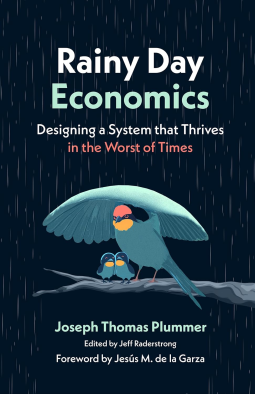
Rainy Day Economics: Designing a System that Thrives in the Worst of Times
This title was previously available on NetGalley and is now archived.
Send NetGalley books directly to your Kindle or Kindle app
1
To read on a Kindle or Kindle app, please add kindle@netgalley.com as an approved email address to receive files in your Amazon account. Click here for step-by-step instructions.
2
Also find your Kindle email address within your Amazon account, and enter it here.
Pub Date Jun 19 2025 | Archive Date Mar 1 2026
Talking about this book? Use #RainyDayEconomicsDesigningaSystemthatThrivesintheWorstofTimes #NetGalley. More hashtag tips!
Description
Rainy Day Economics shows what is possible if we design our economy with rainy days in mind. Covering a wide range of topics and major events - from the aftermath of 9/11 to the unstable early days of the new nation of South Sudan to the chaotic months following the 2024 Election in the United States - Rainy Day Economics offers a robust framework for how we can redesign our economy in pursuit of a more sustainable and resilient future.
Author Joseph Thomas Plummer leverages an autoethnographic approach to analyze major rainy day events of the last 25 years, telling not only his story, but the story of a generation striving to create a better world. He uses first-hand experiences, supplemented with research, case studies, and stories, to build out the framework of Rainy Day Economics offering a clear path forward. He examines principles of design, sustainability, human-centered capitalism, resilience, and the power of the arts to illustrate how we can integrate Rainy Day Economics into our lives, our communities, and the societal systems that we all build, operate, and maintain together.
Available Editions
| ISBN | 9798288754852 |
| PRICE | |
Available on NetGalley
Available to Buy
Buy on AmazonAverage rating from 6 members
Featured Reviews
 Reviewer 1958660
This book stands out for its rare combination of heart and rigor. Plummer grounds big‑picture economic frameworks in real‑world case studies and human‑centred storytelling, making complex concepts accessible without oversimplifying them. Whether he’s reflecting on geopolitical shocks, economic instability, or the lessons learned from the aftermath of major crises, the narrative consistently challenges readers to think differently about how economies are designed and who they truly serve
Readers who liked this book also liked:


Ashton Creed
Nonfiction (Adult), Parenting, Families, Relationships, Self-Help
Kevin Hayes
Children's Fiction, Parenting, Families, Relationships





Jelina Bertow
Historical Fiction, Literary Fiction, Women's Fiction