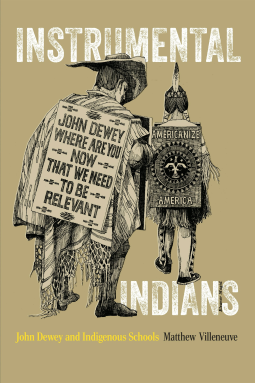
Instrumental Indians
John Dewey and Indigenous Schools
This title was previously available on NetGalley and is now archived.
Send NetGalley books directly to your Kindle or Kindle app
1
To read on a Kindle or Kindle app, please add kindle@netgalley.com as an approved email address to receive files in your Amazon account. Click here for step-by-step instructions.
2
Also find your Kindle email address within your Amazon account, and enter it here.
Pub Date Mar 31 2026 | Archive Date Mar 31 2026
Talking about this book? Use #InstrumentalIndians #NetGalley. More hashtag tips!
Description
An examination of how settler colonialism shaped the thinking of America’s leading philosopher of democracy and education, John Dewey
John Dewey is regarded as a towering figure in the history of American philosophy, widely remembered by educators as an advocate for experiential and child-centered pedagogy, as evidenced by the mantra “learning by doing.” At first blush, such ideas appear to a share strong resonance with Indigenous ways of teaching and learning. After all, Native educators have long emphasized the importance of hands-on learning drawn from close relationships to place. This resemblance begs the question: What might Dewey have learned from Indigenous people?
Instrumental Indians shows that, despite such affinities, Dewey wrote a great deal about Indians as he imagined them rather than as they are. He did so through the lens of the frontier discourse, a pervasive cultural mythology that represented Indigenous people as savage foils and background actors in the settlement of a frontier across North America. Consequently, Dewey’s imagined Indians became both instrumental and instrumentalized in his philosophy, a paradox that reduced Indigenous people to mere evidence for his pragmatism rather than as a contemporary constituency who might have benefited from its application. By instrumentalizing Indians, Dewey’s contributions to American philosophy were made under the shadow of US settler colonialism.
As Matthew Villeneuve demonstrates, Dewey’s disregard for his Indigenous contemporaries was far from harmless. His career coincided with the height of the federal Indian boarding school system, an era when Native families were subjected to the violence of imposed schooling. Where Dewey failed to offer a critique of such antidemocratic schools, a contemporary of his, Oneida philosopher of education Laura Cornelius, succeeded. In 1920, Cornelius offered an Indigenous theory of democracy and education, an alternative the US government failed to pursue. In Instrumental Indians, Villeneuve provides the first comprehensive account of Dewey’s relationship to Indigenous people—one that challenges the philosopher’s place in the canon of democratic education.
Advance Praise
"Instrumental Indians is a monumental achievement. Matthew Villeneuve does not simply indict Dewey for his lifelong instrumental treatment of Indigenous people. He shows how we need to fundamentally rethink Dewey’s pragmatism in light ofthis history."—Elizabeth Anderson, author of Hijacked: How Neoliberalism Turned the Work Ethic Against Workers and How Workers Can Take It Back
"Matthew Villeneuve has done a great service for Indigenous educators and philosophers interested in Dewey’s pragmatism and educational philosophy. Instrumental Indians illustrates that at almost every step in his distinguished career, Dewey’s miseducative view of American Indians was a product of his intellectual entrapment in the frontier discourse. Nevertheless, Villeneuve also notes that a good share of his philosophy, when freed from that discourse, might still prove useful when viewed through Indigenous experiential philosophies and decolonized. This book will be required reading for all educators, philosophers, and historians of philosophy."—Daniel Wildcat, author of On Indigenuity: Learning the Lessons of Mother Earth
"Instrumental Indians presents a convincing and provocative case for how and why Dewey’s ‘pioneering pragmatism’ impacted (and still impacts) America’s understanding of Indigenous Americans. I can’t think of another study so full of philosophical insight and methodological originality."—Thomas Fallace, author of Dewey and the Dilemma of Race: An Intellectual History, 1895–1922
Available Editions
| EDITION | Hardcover |
| ISBN | 9781512829426 |
| PRICE | $45.00 (USD) |
| PAGES | 320 |