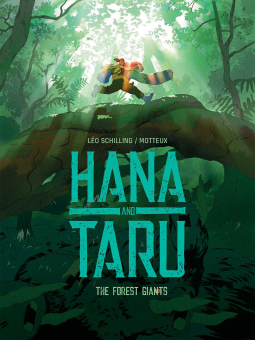
Hana and Taru
This title was previously available on NetGalley and is now archived.
Send NetGalley books directly to your Kindle or Kindle app
1
To read on a Kindle or Kindle app, please add kindle@netgalley.com as an approved email address to receive files in your Amazon account. Click here for step-by-step instructions.
2
Also find your Kindle email address within your Amazon account, and enter it here.
Pub Date May 12 2026 | Archive Date Apr 21 2026
Oni Press | Magnetic Press
Talking about this book? Use #HanaandTaru #NetGalley. More hashtag tips!
Description
This ecological fantasy tale by writer Leo Schilling and cartoonist Motteux unravels an exciting fantasy tale about finding your own purpose and a responsible balance with nature.
Available Editions
| EDITION | Paperback |
| ISBN | 9781962413572 |
| PRICE | $24.99 (USD) |
| PAGES | 224 |
Available on NetGalley
Available to Buy
Buy on Amazon Buy on BN.com Buy on Bookshop.orgAverage rating from 46 members
Featured Reviews
 Millie O, Reviewer
Hana and Taru is one of those stories that really leans into the whole found family vibe, but it doesn’t stop there - it also digs deep into figuring out who you are, what your place is in your family, and how to set boundaries without losing yourself. That part feels especially well handled and honestly pretty relatable.
What stands out the most is how much the story emphasizes empathy. It constantly reminds you to look at people and situations from more than one angle instead of falling into easy stereotypes. Characters feel layered, and even when they mess up, you kind of get why.
The art style fits the tone of the story nicely - it’s soft and expressive in a way that matches the emotional beats. That said, there are moments where the colors and panel compositions feel a bit too uniform, which can make some scenes blend together more than they probably should.
Overall, it’s a warm, thoughtful read that sticks with you more because of its themes than flashy visuals.
 Annie S, Reviewer
If you like Princess Mononoke, you will love Hana and Taru: The Forest Giants. The art is honestly what pulled me in first. It’s so soft and beautiful, and it really gives off that same forest, nature vibe. I kept stopping just to look at the illustrations.
The story itself is simple but really sweet. At its core, it’s about friendship, and I loved Hana and Taru together. Their bond develops so naturally. At the same time, there’s more going on under the surface. It also touches on family, especially through Taru’s relationship with her mother. Her mother truly believes she knows what’s best and that everyone, including Taru, has to listen to her in order to survive. She’s very set in her ways, especially when it comes to the giants, since she wants to kill them without even considering another option.
That’s why I liked Taru and Hana’s dynamic even more. They’re both trying to find another way instead of just following that mindset. It adds a bit of depth to what could have been just a cute story.
Overall, it’s a cozy, emotional read with gorgeous artwork, a lovely friendship, and some nice themes about understanding and choosing a different path.
 Kylie A, Reviewer
4.25 stars
This was a very interesting graphic novel. It kind of gave me Nausicaa vibes.
In this book we follow Taru who is some kind of creature I think. Her people have been attacked countless times but what they call the giants. Most of Taru's people are hunters and they hunt these giants to try to stop them from attacking. Taru is tasked with trying to get information out of a prisoner named Hana. Taru and Hana both think there might be a different way to stop the giants rather than hunting and killing them, but Taru's mother and head of their people will not listen.
First off, the artwork of this graphic novel was quite beautiful. It paints an amazing picture of this fantasy world and these strange creatures.
As it is quite a long graphic novel, the story itself was pretty well fleshed out. I think it worked well as a graphic novel - the visuals were very helpful in picturing the world which was a really important part of the story. The outcome made sense and showed how a different perspective can change everything.
 Amelia S, Librarian
Thank you to Netgalley and Oni Press for an ARC of this graphic novel exchange for my review!
I thoroughly enjoyed this graphic novel. I wasn't sure if the age range would be something I would be interested in or if it would be too childish, but I enjoyed it and thought it would be good for mature preteens and teens. I loved the art style especially of Taru's people, the art was fun to look at in every panel and was so whimsical. It was fun to have a setting with some different looking characters. The story was sweet, although I didn't understand all of the small arguments between the main characters, overall I enjoyed the message and getting to meet all of the characters along the way. I am hoping that this is a series because it would be cool to see what Hanu and Taru find when they head up the mountain!
Adam W, Reviewer
This was a nice story about craving your own path and figthing for what you know is right. I liked the friendship between Hana and Taru and how they helped each other throughtout the unique world. I liked the art style and would like to see more from this world.
 Elizabeth L, Reviewer
"Deep in an ancient forest, young Taru feels like a misfit among her tribe of hunter-warriors. As she tries to make her mark in the adult world, she finds herself marginalized as much for her naïveté as for her radical ideas, which are dismissed by her mother and peers as nonsense. She is responsible for watching a prisoner - Hana, a young human with a mysterious past who has been captured by Taru's own tribe. Hana provides Taru with both solace and an opportunity to find her own way. When Taru's village is once again attacked by giant rampaging forest beasts, the unlikely pair will work together to try to understand the uncontrollable and deadly force that threatens them. What is causing the beasts to rampage? And how can they be stopped?
This ecological fantasy tale by writer Leo Schilling and cartoonist Motteux unravels an exciting fantasy tale about finding your own purpose and a responsible balance with nature."
FernGully for the literary set.
 Melanie S, Reviewer
I always like stories of unexpected friendships and searching and choosing new ways to problem-solving.
So I was immeadiately intrigued by "Hana and Taru" and there wasn't a single page I was disappointed. The themes of the story (intergenerational trauma and neglect of the own wishes, reluctant friendships and trust, never giving up on trying to solve a puzzle) were greaty interwoven.
I especially liked how Hana and Taru were from different places but had ultimately the same wish: To save their homeplace and get to know the reasons why they are getting destroyed. It is interesting how on the one side we see the rising of the sea levels and on the other side giant animals that are regularly "going mad" after a certain degree is reached (I kind of relate with that aspect). The realization of the puzzle parts never felt forced but were naturally built into the story.
I will love to see more by Léo Schilling as this was a very fascinating and beautifully drawn comic.
 Demetris P, Reviewer
A Surprisingly Persuasive Argument for Reading the Tracks Before Reaching for the Spear
Léo Schilling and Motteux give “Hana and Taru: The Forest Giants” the shape of an adventure, then use it to ask why communities so often prefer confidence, noise, and bad timing to evidence.
By Demetris Papadimitropoulos | April 6th, 2026
The most dangerous thing in “Hana and Taru: The Forest Giants” is not a giant, not a stampede, not even the heat. It is a bad diagnosis, and it does not remain private for long. Léo Schilling and Motteux build their graphic novel around an old human reflex that never seems to go out of fashion: people see a crisis, name it too quickly, then fortify that name with watchtowers, bramble barriers, traps, and bruised pride. At first the book arrives in monster-story drag, all siege nerves and beastly silhouettes, before revealing a sterner line of inquiry. This is a story about what happens when fear hardens into explanation, explanation into rule, and rule into fresh damage.
Luckily, the book keeps mud on its boots. It is brisk, lucid, and funny in the manner of someone too busy surviving to announce a joke. People squabble. Mothers snap. Girls limp through undergrowth. A plant with a smell strong enough to clear a room turns out to be handier than a spear. The best thinking here hides in the load-bearing places, where a smell, a root, or a scrap of fur can quietly become fate.
To the tribe, Taru has already been filed under nuisance. She is too restlessly nosy to become the approved huntress her mother Vesa, the chief, would recognize as her own, and too unconvinced by custom to repeat what everyone else has agreed to call wisdom. The giants have been attacking for years. Taru keeps proposing a modest heresy: perhaps the tribe should study them, appease them, or at least try something more imaginative than hurling spears at a problem until it swells. The tribe hears this the way people register splinters and rashes: annoying, persistent, and best ignored until they worsen. Every community produces a Taru sooner or later. Most then get busy teaching her silence.
Her assigned usefulness is to watch Hana, a human prisoner found unconscious in the forest. In their early scenes, the book finally stands up straight. Taru brings food; Hana, caged but sharp, asks the questions the tribe has long since stopped asking. Taru, who has spent much of her life being treated as if curiosity were a defect in breeding, discovers the unnerving pleasure of being taken seriously. That small social miracle gives the opening its pulse. “Hana and Taru” understands that friendship can begin not in instant affinity but in the relief of finding another mind willing to stay with your thought until it reaches its awkward end.
During an attack, Taru notices something small and decisive: one giant stops short when it sees Hana. The others register danger and little else. Taru registers mismatch. That is the book in miniature. Its plot does not turn on prophecy or secret lineage. It turns on the plain fact that one person notices what does not fit the approved story.
Once Taru learns Hana may soon be executed in the name of discipline and utility, she breaks her out. They flee through an abandoned village and into the forest, and once outside the comic stops proclaiming and starts observing. The early pages are crowded with barked exchanges, obligations, enclosure, and command. Beyond them, the land starts keeping records. The forest no longer decorates the action; it records it in fur on bark, blood in mud, and plants flattened by passing weight.
These pages trust tracks, scratches, and mud more than speeches. Taru and Hana do not solve this by finding a better slogan. They solve it by reading the land the way hunters should and do not. They compare tracks in mud, fur caught on bark, blood mixed with water, the timing of attacks, the pressure of seasonal heat, the shape of routes. Taru’s real gift is not innocence, softness, or mystical intuition. It is method. She notices, compares, revises. The notebook is not a charming accessory. It is where the book teaches both girls, and us, how to look. To know the world, these pages argue, you must stare at it long enough to let it make you change your mind.
That formal commitment is the book’s real distinction. Motteux’s panels do not merely lay in atmosphere. They reason in public. The palette – swamp green, ink-blue hush, bruise purple, flare-bright red – is too tightly governed to be merely pretty. It separates panic from inquiry. Red seizes the page in moments of attack; cooler hues settle over hesitation, refuge, and watchfulness. Scale does its own argumentative work. Taru and Hana are repeatedly dwarfed by trunk wall, ravine, canopy, cliff, and herd. These are not sovereign observers surveying nature from above. They are bodies inside weather, topography, smell, and consequence. The comic is interested in smallness, and not sentimentally. Smallness here is epistemological before it is emotional. You do not know the world because you stand above it. You know it, if you know it at all, because you kneel in the mud long enough to notice what everyone else has stepped over.
The book is just as exact about pace. It knows when to cut, and when to wait. Revelation does not pounce. It gathers. We see signs before we can read them properly: a giant halting at Hana’s face, maelisse first arriving as comic stink and only later as tactic, repeated mention of hot weather before heat becomes explanation, the rooted tree before it becomes a solution. A weaker book would hide the answer. This one leaves the answer lying in the landscape until the characters have learned how to read it.
Here the gears finally bite. Taru and Hana discover a ravine filled with dead giants, and the image reverses the book twice over. First it supplies horror: these creatures are no longer mythic threats charging in from elsewhere, but piled bodies, failed crossings, a history of interrupted movement written into stone. Then it converts terror into proof. The giants are not attacking because violence is their essence. They are trying, season after season, to cross a gap. Summer pressure drives them frantic. Their homeward route is gone. What the tribe calls madness is, at least in part, a blocked return route mistaken for aggression.
Its tragedy is made of heat, stone, and a human habit of filing first and thinking later rather than of sorcery. No curse. No dark enchantment. Just overheated herbivores, trapped migration, panic, and pain. The book has the good sense to make that diagnosis ugly rather than soothing. When Taru and Hana encounter a giant eating an animal, the shock lands because the comic has already taught us the creatures are herbivores. Distress does not ennoble the displaced. It deranges them. That refusal keeps the book honest. Plenty of stories that ask us to sympathize with the nonhuman cannot resist polishing it into innocence. “Hana and Taru” is better than that. It understands that suffering can produce damage without producing virtue.
Ploup, the former hunter living in exile-by-choice among paintings, memory, and an almost weaponized quantity of maelisse, is the book’s sharpest, and best-scented, rebuke. She has not been attacked because she does not make war on everything she meets. More important, she complicates the comic’s tidiest binary. The conflict is not simply between old ways and new ideas. It is between one hardened tradition and another, between a tribal culture that mistakes force for realism and a nearly lost practice of attention, restraint, and cohabitation. Ploup gives the book history where it might otherwise have settled for allegory, and family damage where it might otherwise have settled for thesis. She is not a glowing lantern of wisdom dropped into the story to straighten everybody out. She is a reminder that better knowledge often survives in shabby, eccentric, half-ignored places.
The script is where the comic occasionally blinks. Schilling writes in short, declarative exchanges built to expose positions quickly. For a long stretch, the plain style does exactly the work required of it. The story remains readable without turning to paste; Taru sounds different from Hana; Vesa’s clipped authority is distinct from Ploup’s tart sidelongness. But plainness helps until it does not. In confrontation scenes especially, the dialogue can clamp shut too fast. Characters state conclusions the panels have already made visible. Vesa, in particular, can seem less at war with herself than arranged as the embodiment of a method: defend, control, escalate, repeat. The book gives her pressure and injury, which keeps her from flattening into a mere thesis, but the speech bubbles occasionally explain conflicts the panels had already rendered more subtly.
That is the price the book pays for making every path so well marked. “Hana and Taru” wants to be accessible, and mostly that is to its credit. But its verbal writing is not always as interesting as its architecture. The panels trust silence, recurrence, and residue; the dialogue sometimes arrives a beat later to underline the point in red pencil. The panels often trust the reader more than the script does. That gap is the book’s central limitation, and it is a real one. The comic is often smarter in image than in declaration.
Still, what the book does structurally is impressive enough to carry real weight. It has no interest in formal showboating, but it seeds details with care and cashes them with discipline. So when the final crisis arrives – Vesa ready to use fire, scent, and sheer stubbornness to drive the giants toward catastrophe – the solution feels assembled from parts the book has already laid out. Maelisse, first a smell, becomes a tool. The rooted tree above the ravine, first terrain, becomes passage. The ending patiently builds what a weaker book would merely proclaim. The giants are not slain. A route is made passable again. Fantasy does love a weapon; this book has the nerve to make a bridge the more radical object.
That choice reveals the comic’s sterner claim. A lazier fantasy would stop at the notion that compassion beats brutality. This one is less willing to let itself off easy. Compassion matters, but not by itself. Taru and Hana succeed because they track, compare, infer, and revise. They do the slow, unglamorous work of diagnosis. The comic’s deeper claim is not that nature is pure, or that people become wise the moment they listen to their hearts. It is that institutions cling to bad readings with frightening efficiency, and that force applied to a misread problem only makes the mistake louder.
There it brushes the present cleanly, without powdering itself in topical fuss. The pattern is grimly familiar: structural strain gets described as moral failure, old methods keep being deployed because they are old methods, and authority would rather escalate than admit the map is wrong. “Hana and Taru” does not preach any of this. It builds a world in which the habit is visible in bramble barricades, hunt plans, and the catastrophic confidence of a chief who would sooner light the forest than revise her diagnosis. The book does not need to flatter itself with current importance. Its relevance comes from how quietly exact it is about a recurring human embarrassment.
What lingers is not a speech but a chain of corrections: the giant stopping at Hana’s face; the ravine of bodies turning fear into proof; the stink of maelisse becoming salvation; Taru refusing the life her mother mistakes for destiny; the mountains at the end not as utopia, but as the possibility of living under other terms. The ending refuses the sweet little lie that one good insight can sew every wound shut. There is damage on both sides. No village is remade by revelation alone, and this one knows it. Taru does not return simply because apology has finally caught up.
At 85 out of 100 – a firm 4 stars on Goodreads – “Hana and Taru: The Forest Giants” is a smart, hard-earned graphic novel whose highest achievement is architectural. Its prose is clear and often affecting, though sometimes too eager to state what the art has already made plain. Its structure is where the book is most exacting: details introduced as texture return as instruments, and clues planted early ripen into a solution that restores passage rather than rewarding aggression. Sometimes the distance between a trap and a bridge is nothing more glamorous than whether anyone bothered to read the land before building.
 Lydia A, Bookseller
I really enjoyed how the story wove in themes of self reflection and how not all problems can be solved by violence. Hana and Taru had medium pacing with some enjoyable action sequences. I think it conveys some great themes about working together with others and trying to see a situation from another view point. Something we need more of in the world today! I loved the style of this cover, but I did find the inner style not as satisfying. Although I think it will appeal to many graphic novel/comic readers. I recommend as a unique fantasy read.
Kebs B, Librarian
I'll try to put down some already existing media pieces this reminds me of: Princess Mononoke, Raya and the Last Dragon, Jules Verne, Where the Wild Things Are, Golem.
I loved the art style. It's very earthy, lush, there were moments I was sure I could smell the humid climate, the rain, the sun, the forest (and the blood). I enjoyed how the author didn't shy away from depicting violence yet did it in a way I found appropriate for primary/middle school kids.
The story itself was hopeful. I believe it could show the reader the importance of caring for each other, listening to other people's dreams, ideas, goals and intentions, as well as caring for nature, the animals, searching for other way when something isn't working out.
Amanda W, Reviewer
A village of hunters/warriors are being overrun by madden animals from the fores; the future of both species lies with Taru, a misfit hunter, and Hana, the prisoner Taru befriended.
I'm going to go out on a limb and say author Léo Schilling is a fan of Hayao Miyazaki. <i>Hana and Taru</i>'s story and its emphasis on empathy, environmentalism, and understanding are strongly reminiscent of <i>Princess Mononoke</i> and <i>Nausicaä of the Valley of the Wind.</i> Fans of Studio Ghibli films will probably like this book.
Three and a half stars.
 Reviewer 1563241
“Hana and Taru” is both a coming-of-age story and a short ecological fable with a pacifist message, reminiscent of the world of certain Studio Ghibli films. We follow Taru, the main character, who breaks away from her mother’s ideals and, with the help of a friend, seeks to understand and respect others despite their differences.
I really liked the artistic style of the tribe of hunter-warriors, which is different from what we’re used to seeing.
Also, this wild landscape is really fun to explore, especially since the giants look like enormous capybaras with tusks.
Librarian 1669487
I absolutely loved this!!! I had honestly forgotten I had requested it and then I was looking through my Netgalley shelf and saw it and read it all in one sitting!
I loved the story so much! I thought the messaging was great! I really loved the characters and relationships! I thought that the characters were really good and interesting! I love that we got some generational trauma going on in this too, and breaking the cycle!
I also LOVED the character designs!! I thought they were super cool and unique! The art was so gorgeous and fun!
A gorgeous story about nature and the relationships between animals and people!
 Ella J, Bookseller
First I would like to thank NetGalley, the Author, the Artist and the Publisher for this ARC.
I really like this story.
The world and the creatures are something different and so is the art style.
It's a story about trust, friendship, disbelieve, misunderstanding and how harmful one's believes can be.
There is a lot of "violence" and some scene's are gruesome, but overall this is a sweet story. I personally don't mind the "gore" but I would like to advise young readers to be cautious.
Tale as old as time:
Léo Schilling and Motteux build their graphic novel around the old human reflex that never seems to go out of fashion: people see a crisis, name it too quickly, fortify that name with watchtowers, bramble barriers, traps, and bruised pride and murder. At first the book arrives in monster-story, all siege nerves and beastly silhouettes, before revealing a deeper line of inquiry. This is a story about what happens when fear hardens into believe, believe into rule, and rule into damage. There is the lack of trust, misunderstanding, the all consuming thought of being right when others are wrong, not listening to others or other views and putting the blame elsewhere.
In the end the story has a "happy" ending but a lot of bloodloss had to precede that happiness.
The art is beautiful and both the story and the art are different from what is currently mainstream.
This is truly a graphic novel you would want in your collection.
Readers who liked this book also liked:

We Are Bookish
LGBTQIAP+, Romance, Sci Fi & Fantasy
Ransom Riggs
Sci Fi & Fantasy, Teens & YA

Melinda Taub
General Fiction (Adult), New Adult, Sci Fi & Fantasy




United States Postal Service; Gail Anderson; Brian E. Smith
Arts & Photography, Crafts & Hobbies, History