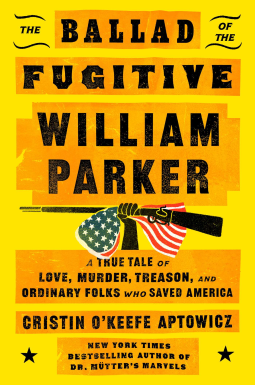
The Ballad of the Fugitive William Parker
A True Tale of Love, Murder, Treason, and Ordinary Folks Who Saved America
This title was previously available on NetGalley and is now archived.
Send NetGalley books directly to your Kindle or Kindle app
1
To read on a Kindle or Kindle app, please add kindle@netgalley.com as an approved email address to receive files in your Amazon account. Click here for step-by-step instructions.
2
Also find your Kindle email address within your Amazon account, and enter it here.
Pub Date Sep 8 2026 | Archive Date Sep 22 2026
Description
For fans of Master Slave Husband Wife and Django Unchained comes the extraordinary forgotten story of an event known in its day as “the first shots of the Civil War,” from the New York Times bestselling author of Dr. Mütter’s Marvels.
The year, 1851. The place, a Quaker farming community turned Underground Railroad stronghold, where a Maryland enslaver had journeyed in pursuit of four men who’d fled his plantation years before. In a few hours, he’d be dead…and twenty-seven men from the village of Christiana would be rounded up and put on trial. Not for his murder, but for treason—for waging war against the United States, at a time when it was a crime against the government to obstruct an enslaver looking to reclaim his “property.”
This is story of what happened in Christiana that September morning—and in the ensuing “trial of the century,” which saw the president himself advise the prosecution on strategy and a sitting congressman serve as lead attorney for the defense. But The Ballad of the Fugitive William Parker is also a much larger tale, one spanning decades, following a whole startlingly diverse community of abolitionists in their fight to convince their fellow Americans of the subversive idea that now found itself on trial: that the nation ought to live up the ideals it was founded on, and respect all men as equals.
It’s a story that whisks readers from the quiet farmlands of Lancaster County—where a self-emancipated man named William Parker, whom legend had it bullets could not kill, rallied his neighbors to ride out each night to battle the slavecatchers who stalked their countryside—to Philadelphia’s genteel Society Hill, where socialite Harriet Forten Purvis had the ear of the mayor (and a cellar filled with fugitives). It’s stylish, propulsive, intimately human tale of bravery, ingenuity, and hope—and of ordinary people with little in common who came together to stand against injustice…and won.
Available Editions
| EDITION | Other Format |
| ISBN | 9781668035931 |
| PRICE | $31.00 (USD) |
| PAGES | 448 |
Available on NetGalley
Available to Buy
Buy on BN.com Buy on Bookshop.orgAverage rating from 30 members
Featured Reviews
 Reviewer 1168388
The Ballad of William Parker is history writing at it best. I made the mistake of trying to read it at bedtime, but it was so riveting that I couldn’t put it down. At times, it reads like a novel. It is meticulously researched and beautifully written. It is fascinating to read William Parker’s story with many of his own words, and those of the Forten and Purvis families too. If you were moved by the Narrative of the Life of Frederick Douglass and want more stories of Black Americans who are portrayed as powerful agents and not just helpless victims, this is the book for you! History buffs interested in 19th century America, don’t miss this book!
Thank you to NetGalley and Simon and Schuster for the free eARC. I post this review with my honest opinions.
This review is crossposted to Goodreads and will be posted to Instagram and Amazon within one week of the book’s publication.
Content notes: peril, violence and death, some profanity; period-typical racism expressed from enslavers
 Steven C, Reviewer
The Ballad of the Fugitive William Parker is one of those books that should be required reading in American History classes. I am a Civil War buff, and would consider myself fairly knowledgeable about the subject, but I got schooled by Cristin O'Keefe Aptowicz. Reading and hearing history from a fugitive slaves perspective was eye-opening. I think what I appreciated the most, was learning the real cost to the Compromise of 1850, especially the Fugitive Slave Act.
This is not an easy read! And many people today will want to ignore or suppress it because it does not fit the narrative that one political party is trying to promote. But knowledge is power, and I would argue, freedom, and this book will open your eyes to some of the problems that continue to this day. This book is worth the read!
I finished the book wanting to know even more about William Parker. I am thankful for the opportunity to read an advance copy of this book. Thanks to NetGalley and Simon & Schuster for this ARC for my unbiased opinion.
Reviewer 1231554
“The Ballad of the Fugitive William Parker” shines a light on an incredible piece of American history that deserves to be far better known. Cristin O’Keefe Aptowicz combines meticulous research with engaging storytelling to bring William Parker and Christiana Resistance to life, making the people behind these events feel real and deeply human.
I especially appreciated how the book explores the far-reaching impact of the Fugitive Slave Act and courage of ordinary people who chose to stand against injustice. While the subject matter is difficult, the writing keeps the story compelling and accessible, balancing historical detail with a strong narrative.
This is a thoughtful and eye-opening read that introduced me to a chapter of history I knew very little about. If you enjoy well-researched narrative nonfiction or American history, this is definitely worth picking up.
 liz w, Reviewer
I’m betting this is going to be one of the best nonfiction books of 2026.
The Ballad of the Fugitive William Parker was an excellent retelling about a little known uprising in Christiana, Pennsylvania. A Maryland slave owner crossed the Mason Dixon line looking for four escaped slaves. Within 24 hours, he was dead and 27 men were later arrested for treason. The incident has been called the “first shots of the Civil War”.
Each part was engaging in its own right. First, Aptowicz walks the reader through the political and social situation in Pennsylvania throughout the first half of the 19th Century - the Black community of Philadelphia, the Underground Railroad, the slave catchers, the abolitionist movement and the pro-slavery contingent. It doesn’t just explain the impact of the Fugitive Slave Act but truly impresses the reader with the gut wrenching impact it had on Blacks in the north. Part One was chock full of information but was easy to read. Then, in Part Two, Gorsuch’s attempt to reclaim his “property” and the “riot”, which was finally renamed the Christiana Resistance in 2001 are detailed. And in Part Three, she takes the reader through the escape of William Parker and the treason trial against Castner Hanway, a white man at the scene. At times, it literally read like a novel.
As a transplant to York County, PA (one county west of Lancaster) I was thrilled to learn so much about the area. The area was a mix of anti- and Pro-slavery contingents, but favored the anti-slavery sentiments because of the number of Quakers. I knew a little about Thaddeus Stevens but got the full measure of the man with this book.
This book is literally so compelling I can see Netflix buying up the rights for a mini-series.
My thanks to Netgalley and Simon & Schuster for an advance copy of this book.
 Roslyn B, Reviewer
This was my first read by Cristin O’Keefe Aptowicz, and I got The Ballad of the Fugitive William Parker as an ARC from NetGalley in exchange for an honest review of the book. I went in knowing basically nothing except that it was rooted in real history and honestly, the story surprised me in a lot of ways. The book centers on the Christiana Resistance of 1851, an event I somehow never learned about in school, even though it was once called “the first shots of the Civil War.” The plot kicks off when a Maryland enslaver comes to a Quaker community to reclaim four men who escaped his plantation years earlier. Within hours, he’s dead, and twenty‑seven men from the town are arrested, not for murder, but for treason. That alone is wild enough to pull you in. The character dynamics were one of the strongest parts for me. William Parker is such a compelling figure, a self‑emancipated, brave, strategic, and deeply committed to protecting his community. The way he rallies his neighbors to defend themselves against slavecatchers gives the book this almost cinematic tension. Then you have Harriet Forten Purvis in Philadelphia, whose world is completely different but just as vital to the movement. Her social influence, her connections, and her literal cellar full of fugitives add this fascinating contrast to Parker’s rural resistance.
The broader cast of abolitionists, neighbors, politicians, lawyers create a web of relationships that shows how many different kinds of people were involved in fighting slavery. Some of the dynamics are tense, some hopeful, some heartbreaking, but they all feel grounded in real human stakes. Plot wise, the book moves between the Christiana incident, the massive treason trial that follows, and the decades long ripple effects of what happened that morning. It’s part courtroom drama, part historical reconstruction, part character study. The “twist,” if you can call it that, is more about uncovering forgotten history, realizing how much of this story was intentionally buried or minimized over time. The ending lands with a mix of triumph and heaviness. You feel the victory of ordinary people standing up against injustice… but also the cost, the danger, and the way these battles echo through generations. It’s not a neat ending, but it’s a meaningful one. I would love to see this story played out on the big screen. This is such an important story in our history and more should know about it. I loved the book! #netgalley #theballadoffugitivewilliamparker
 Jean S, Reviewer
The Ballad of the Fugitive William Parker is a brilliantly rendered, deeply compelling account of a pivotal moment in American history. With vivid storytelling and meticulous research, the narrative plunges readers into the tense atmosphere of 1851 Christiana, where ideals and lives hang in the balance. The book deftly captures not only the dramatic events of that fateful September morning and the sensational “trial of the century,” but also the broader, decades-long struggle to define the soul of a nation.
Through unforgettable characters like the indomitable William Parker and the courageous Harriet Forten Purvis, the story comes alive with energy and heart. The author skillfully weaves together the personal and the political, revealing the courage and conviction of ordinary people who risked everything to resist injustice. Moving from Lancaster’s fields to Philadelphia’s parlors, the book paints a rich portrait of a community bound not by background, but by shared purpose and moral clarity.
What makes this account truly exceptional is its ability to humanize history without sacrificing complexity. The Ballad of the Fugitive William Parker reminds us that the fight for freedom and equality was waged not only by famous leaders, but by everyday men and women who dared to believe in a better future. Stylishly written and driven by a palpable sense of urgency, this is an essential read for anyone interested in the roots of American liberty—and the enduring power of collective action.
Thank you, Cristin O’Keefe Aptowicz, Simon & Schuster, and NetGalley for the ARC.
 Zachary L, Reviewer
Ballad of Fugitive William Parker tells the remarkable true story of William Parker, an escaped slave whose determination to protect his family and fight for freedom made him a central figure in one of the most dramatic resistance efforts before the Civil War. I knew very little about Parker before reading this book, so I appreciated learning about an often-overlooked chapter of American history.
The author does an excellent job explaining the events leading up to the Christiana Resistance and the difficult choices Parker and others faced. Rather than portraying history in simple black-and-white terms, the book shows the courage, fear, and sacrifices of those involved. I found myself admiring Parker’s resilience and his unwavering commitment to freedom.
If you enjoy well-researched historical nonfiction that shines a light on lesser-known figures, this is a worthwhile read. It gave me a greater appreciation for the people who risked everything in the fight against slavery.
 Deirdre B, Reviewer
The Ballad of the Fugitive William Parker by Cristin O'Keefe Aptowicz is a powerful and gripping piece of history that reads like an intense thriller. Learning about the 1851 Christiana Resistance and how ordinary people risked everything to fight back against slave catchers was incredibly inspiring. Aptowicz does an amazing job bringing figures like William Parker to life, making the complex legal battles and high-stakes trials feel deeply personal and relevant. While the massive cast of historical figures can be a little overwhelming to keep track of at times, the storytelling is super fast-paced and well-researched. It’s a 4-star read that I’d highly recommend to anyone interested in little-known stories of American bravery and the Underground Railroad!
 Janine S, Reviewer
“The reasonable man must adapt himself to the world, the unreasonable one persists in trying to adapt the world to himself, therefore all progress depends on the unreasonable man” is a great quote from Irish playwright George Bernard Shaw and this is borne out in this true account of a Pennsylvania town, Christiana, being unreasonable to the reasonable in its stance to protect their neighbors against enslavers.
The Christiana Riot of 1851 was a pivotal moment in the abolitionist movement in America. A self-emancipated man, William Parker, garnered his friends and neighbors to a standoff with men seeking to return Parker and others to his enslaver. The enslaver, Edward Gorsuch, a wealthy Maryland plantation owner (and a relative of Supreme Court Justice, Neil Gorsuch) had trailed Parker to his home where he ended up dead and Parker escaping to Canada. The result of the riot led to federal charges for treason against a white man, Isaac Castner Hanway, for refusing to follow a legal warrant under the Fugitive Slave Act and help capture the runaway slaves, because he believed that Black people had the right to defend themselves. Twenty seven other men were indicted as well. To find out what the verdict was you have to read the book.
The book is well researched and gives a lot of detail about the events leading up to and after the Christiana riot. Most interesting to me was that at the end of the Civil War James Gilmore, editor-at-large for the new magazine, The Atlantic, had received a manuscript about Parker’s story. This the perfect place to tell this story as The Atlantic had published “The Battle Hymn of the Republic” and other anti/-slavery articles. Lincoln even noted “a well-placed article in The Atlantic was ‘worth as much to us as a half dozen battles.’”
The book is an easy read as it’s written simply but still feels authoritative in the telling. The author draws parallels with today and seems to be asking what would you do for your neighbors.
I gave this book five stars because it brought to life an event in history that is important to remember - never knew of it until I read the book - and should not be erased; because the event given in the book has a bearing on us today as we witness the sad things white supremacy is doing in our country and because I had a great time reading this book.
My thanks to NetGalley and Simon & Schuster for granting me access to this ARC.
Annabelle F, Reviewer
This book had me hooked from page one. Cristin O'Keefe Aptowicz kept me guessing the entire time of where we were going and how many wonderful (and not-so-wonderful) people we were going to meet along the way. I enjoyed how tactful and honest the humor was in this book. Normally I read non-fiction in bites around fiction books because normally I cannot binge non-fiction, I did not have to do that with this book, it was so compulsively readable that I could not and would not put it down. I have thought about this book and the stories surrounding it every day since I finished reading it. This is by no means a happy story, but it does have sprinkles of hope in it.
5 stars.
(Thank you to the publisher for the e-arc)
 Guadalupe H, Librarian
A gripping, well researched account that turns one explosive morning in 1851 into a bigger story about resistance, justice, and an unlikely community banding together. There's real narrative drive in how it moves between the courtroom drama and the everyday courage of folks like William Parker and Harriet Forten Purvis. Vivid and absorbing, this one's a solid pick if you're into American history that reads almost like a thriller, with real people at the center of it.
kATHLEEN G, Reviewer
A page turner. This well researched and approachably written tale of William Parker will remind the reader that truth is often more dynamic than fiction. Aptowicz brings Parker and others to life in way we seldom see in this sort of book. She expands the reader's knowledge of the period and of events that have been lost in the mists of time. Thanks to Netgalley for the ARc. This one surprised me. It's a very good read.
 Donna K, Reviewer
The Ballad of the Fugitive William Parker is absolutely riveting! I just could not put it down. I loved the book and learning about the history I never knew, despite living in Lancaster County for most of my life. The author brought all of the actual individuals involved in these events, vividly to life in this book. Cristin O'Keefe Aptowiz has written an amazing, well researched book, based on the true story of the life of William Parker, a self-emancipated slave, who embarked on a treacherous journey north. He hoped, if he could make it to Pennsylvania, he might be able to build his life as a free man. The book recounts not only William's life but also delves into the lives of the prominent Black citizens, abolitionists and Quakers in Pennsylvania at that time, as they came to the aid of slaves like William, who risked their lives for freedom. William was able to build a life in Pennsylvania and continued to work so that other slaves could find freedom. He worked tirelessly on behalf of Underground Railroad. When the Fugitive Slave Act was passed, the work of all of the abolitionists, Free Blacks and former slaves became extremely dangerous. In 1851, a Maryland enslaver sought to reclaim his property of 4 slaves, and the violent encounter resulted in a death, and 27 men being imprisoned. This became known as the Christiana Riots, and it is also considered to be the first shots fired in the Civil War. The author brings the story full circle, to the events at the trial, and William's later life. I would absolutely love to see a miniseries made of this book; it is that good! Thank you to the author, the publisher and Netgalley for my advance copy. The opinions of this review are my own.
 Kimberly K, Reviewer
"The Ballad of the Fugitive William Parker" by Cristin O'Keefe Aptowicz is the extraordinary true story of antebellum Pennsylvania and the people, both black and white, who fought against this country's greatest evil, the institution of slavery. I have lived in Pennsylvania all of my life and, though I was aware of its Quaker abolitionists and their role in the Underground Railroad, I had never heard of the self-emancipated William Parker, nor of the prominent Black Philadelphians whose bravery and resources both helped to fund the Abolitionist movement and propelled the country toward the war that would end slavery for good. Not only were the events surrounding the standoff between a Maryland slaver and William Parker at a Lancaster County farm fascinating, the in depth look at the politics of the era made this book an educational and captivating read. This book, once again, shows that the education I received was a whitewashed one and neglected to include some very important Black history (and Black history is all of our history-American history) that occurred mere hours from where I grew up.
Many thanks to NetGalley, the author, and the publisher for the privilege of reading an advanced copy of this informative and eye-opening book!
Readers who liked this book also liked:
Marie Bostwick
Historical Fiction, Literary Fiction, Women's Fiction

James McBride
General Fiction (Adult), Historical Fiction, Literary Fiction

Publishers Lunch
General Fiction (Adult), Nonfiction (Adult), Teens & YA