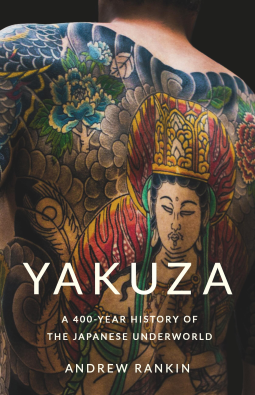
Yakuza
A 400-Year History of the Japanese Underworld
This title was previously available on NetGalley and is now archived.
Send NetGalley books directly to your Kindle or Kindle app
1
To read on a Kindle or Kindle app, please add kindle@netgalley.com as an approved email address to receive files in your Amazon account. Click here for step-by-step instructions.
2
Also find your Kindle email address within your Amazon account, and enter it here.
Pub Date Sep 15 2026 | Archive Date Sep 15 2026
Description
“The best book in English on this fascinating and misunderstood subject.” ―Richard Lloyd Parry, author of People Who Eat Darkness
“Gripping.” —Ian Buruma, New Yorker
Japan’s gangster groups, known collectively as the yakuza, are among the oldest underworld societies in the world. With military-style organization and a code of absolute obedience, they have run Japan’s black markets for centuries. They have remained strikingly conspicuous in Japanese society and as a cultural force beyond Japan, with movies and video games celebrating their exploits globally.
Andrew Rankin offers the first comprehensive history of the yakuza, from their emergence out of seventeenth-century samurai gang culture to the present day. Though their activities have always encompassed illegal gambling and sex trafficking, the yakuza have also aggressively maintained business interests in private security, the construction industry, the entertainment industry, and debt collection. Yakuza bosses acquired a degree of legitimacy by styling themselves as peacekeepers maintaining order at society’s bottom end. Yet that legitimacy has come into doubt in recent years as Japan’s contracting economy has pushed the yakuza into increasingly predatory criminal activities.
Featuring a lively cast of extortionists, smugglers, hit men, and corporate crime lords, Yakuza is a fascinating tour of Japan’s sprawling mob syndicates and the cultural traditions with which they are so deeply intertwined.
Available Editions
| EDITION | Other Format |
| ISBN | 9781541607675 |
| PRICE | $32.00 (USD) |
| PAGES | 400 |
Available on NetGalley
Available to Buy
Buy on BN.com Buy on Bookshop.orgAverage rating from 32 members
Featured Reviews
 Ana S, Reviewer
I really liked this book.
I'm a person that loves true crime and learning more about things and this book captivated me from the start. I really liked to know how the Yakuza came to be.
This book is very rich in knowledge and I was also very fascinated by somethings I learned.
I want to thank Netgalley,the author and the publisher for sending me an ARC
 Librarian 186177
Wonderful book. This book was very interesting as well as being informative I very much enjoyed opening about this segment of history and culture!
Media/Journalist 188366
Andrew Rankin’s Yakuza: A 400-Year History of the Japanese Underworld is an impressive work that provides a sweeping overview of Japanese organised crime, tracing its origins in gambling houses to the astonishingly large syndicates of today. The Yakuza, one of the most well-known underworld societies, are tantalising “due to its injunctions toward chivalry and self-control, the military-style chain of command, the warrior-like ethos of loyalty and fearlessness, the strict regime of discipline and punishment.” One may talk about the organisation, but not reveal its secrets. This has allowed Rankin to conduct research and interviews, with assistance from experts and analysts who provided family histories and other print sources compiled by Yakuza families and the syndicates themselves. Much of this material is available in English for the first time, and Rankin truly provides an opportunity to clear longstanding misconceptions about this aspect of Japanese society. Rankin studied and worked in Tokyo for decades before earning a doctorate in Japanese literature from Cambridge University, and he writes about Japan with precision and careful consideration.
There is a paucity of criminology research on Japanese organised crime outside Japan, with most scholarship focusing on the mafia or cartels elsewhere. The introduction stresses that the term “Japanese mafia” is disliked by Japanese experts, who regard the Yakuza as a uniquely Japanese phenomenon. It does seem fair to say that much of their activity centres around protection rackets, even if they generally refrain from armed robbery, kidnapping for ransom or murder for hire. Ultimately Yakuza shows us how loosely connected outsiders on the margins of society became large, structured organisations that operate with businesslike efficiency.
This book chronicles the evolution of the yakuza across centuries. Each chapter focuses on one area and then describes underworld activities there during a specific historical period. It is often said that the Yakuza first entered the corporate world after World War II, especially during the Bubble Economy. Rankin shows that the Yakuza began slipping into mainstream Japanese businesses practices long before that. What changed after the war was the scale of their racketeering efforts and ambitions, not their essential practices. I especially enjoyed the way certain anti-crime measures only boosted crime, such as “chivalry gangs” arising from young Japanese men excluded from the Tokugawa administration. The rigid social classes and strict peace, which was meant to foster security, unexpectedly gave rise to groups of innovative young men existing outside the system through crime. Rankin shows how this history echoes in modern policing, where “Instead of persecuting the pimps and brothel keepers, or trying to eradicate their business outright, the policy was to segregate and regulate. This attitude would be reflected again and again over the years in Japanese policing strategies toward gangster groups and their activities and toward the criminal underclass in general.”
The ambiguous status of the Yakuza within Japanese society has been somewhat due to the ambiguous status of gambling itself. The Yakuza have always been able to thrive in grey areas, or in spaces where police and politicians preferred not to be seen. Awareness of extortion and protection rackets as distinct offences was still low in Japan at this time and certainly not reflected in the law. Police usually stated only that the gang was “preying on” local businesses or “infesting” the local community. Even today, Rankin tells us, Japanese police officials are known for favouring vague language in their ordinances, enabling them to spread their powers broadly. There is an amusing section when he tied this back to a viral video, where netizens tried to guess whether the belligerent people in the video were Yakuza or the police. Police recruiters and Yakuza recruiters often targeted the same working class high schools, youth centres, sports clubs and dojos, so perhaps this shouldn’t be a surprise.
As one might expect, the book covers much of the postwar black markets, gambling and sex trades. The Yakuza also aggressively maintained business interests in private security, labour supply chains, construction, real estate, mediating, shipping and the entertainment industry. I have not read much immediate postwar Japanese history, and it was disheartening to learn how little support Japanese soldiers had when they returned home. Such instability naturally led to organised crime. Gang members who survived the war (their tattoos originally prevented them from joining up, but the military became less picky as things progressed) faced the prospect of rebuilding their underworld territories in a defeated nation occupied by a foreign military. Returned soldiers committed robberies and muggings, or fought against each other in civil wars for territory. Others worked as pimps and bodyguards for Japanese women working in prostitution. I was shocked to read how “The bosses’ underlings would lure demobilized soldiers and other unemployed men in the cities by getting them drunk and then transport them by train to a workplace in a distant location. The men were forced to work in coal mines during the day and otherwise locked up inside prison barracks. An investigation by US occupation authorities had discovered that as many as twenty thousand labourers in Hokkaido were being kept in such slave-like conditions.”
After the war, as flourishing crime families spread from their hometowns, they joined together with other families (often in elaborate ceremonies, occasionally with a media presence!), formed large syndicates and went to war with rival syndicates. The more massive these syndicates grew, the more entrenched in Japanese industry and society they became. As these groups fought against one another or people died in leadership disputes, the Yakuza moved once again into the political arena. I was familiar with some right-wing and left-wing protests and violence, mainly from reading about Yukio Mishima and fiction novels from that time, but the overview of Yakuza involvement and their shifting symbiotic relationships with government officials and police just made everything click. I suddenly understood why Japanese friends had given a word of warning about certain areas or places. Many important moments of Japanese modern history unexpectedly had a Yakuza element. I had read internet commentary scoffing at books or articles that suggested off the books money might involve Yakuza, and at the time I did not know what to think. As someone who works in organisations in the Asia region and in risk management, I found it striking that protection money or payments to smooth things along seems almost routine. At the start of this book, I thought the Yakuza were being spoken about like a bogeyman, but their influence really does seem everywhere, particularly in white collar crime.
Some of the crimes were entirely new to me, such as stock manipulation and threatening to publish reports of companies’ secrets or the personal secrets of their CEOs. Public humiliation seems to be a long-standing method of the Yakuza, either as punishment for members (in addition to chopping off fingers) or as a way to extract money or support from business leaders or government officials. Posing as management consultants, they invited corporate executives to parties, lectures, seminars and golf tournaments. Payoffs were disguised as fees for such events, or as rental payments or advertising space. I really felt my own ignorance when reading about all of this, and I realised how difficult it would be for me to spot the fingerprints of Yakuza involvement, even with an academic background in criminology and some Japanese language ability. Perhaps this is why so many outside commentators were so derisive of accusations of Yakuza involvement, because to them Yakuza involvement is a thug in Kabukicho, and not a boss who looks like a quiet accountant. Many of these schemes were appreciated by corporate clients, whose financial greed seemed to override concern for victims, particularly during the bubble economy and its real estate schemes. And may I just say, much of this reminded me of the real estate situation in Australia, and my fellow Australians may be delighted or appalled to read how often the Gold Coast features in this book.
Yakuza involvement in civil disputes was similarly often a response to consumer demand. The slowness of Japan’s judicial system meant that the Yakuza could often provide better service than courts. In this period, Rankin notes that the number of lawyers in Japan was still low, and many problems that might have been resolved legally ended up being handled by the Yakuza. Many standard problems, such as insurance and compensation claims, bankruptcy cases, and basic contractual issues, went to the Yakuza. One realises that perhaps there would be no Yakuza, or at least not such a strong one, if regular people were not reaching out to them quite so much. Since The Godfather is mentioned more than a few times in this book, the reader may be reminded of this: “You found paradise in America. You had a good trade, you made a good living. The police protected you and there were courts of law. So you didn’t need a friend like me. Now you come and say ‘Don Corleone, give me justice.’”
An important function of the frequent rituals and ceremonies that make up formal Yakuza life is to maintain good relationships among members. Gift giving and pseudo religious ceremonies run throughout their history, creating bonds between young men who may have few strong family connections of their own. I really loved the wild sections how the best-known features of Yakuza culture derive from the practices of Tokugawa fire brigades. Many of the noticeable symbols of the modern Yakuza, including family crests, insignias, and flags, come from the paraphernalia of those brigades.
Unexpectedly, this book would be a delight for those interested in Japanese media studies. Whether it is Kabuki, classic Japanese films or folktale heroes with Yakuza origins, these stories of the noble gangster are boys’ adventure novels of their time. The Yakuza were very media savvy, whether operating directly in the entertainment industry or moving into media relations, inviting newspapermen to ceremonies and cultivating experts in media manipulation and PR. The Yakuza of the media had a nostalgic and romanticised depiction, which often stressed their unique connection to traditional Japanese culture. The reality, meanwhile, was syndication, corporatisation, drugs, weapons and the prioritisation of money above all else. I especially enjoyed how the Godfather films, and later Yakuza films inspired by them, began to influence the mannerisms of Yakuza members themselves. I believe I noticed a few things from Tarantino films as well. Rankin is so adept at highlighting the Yakuza’s hypocrisy when it comes to class issues. At the start of the book, he shows how Japan’s hereditary warrior class with no wars to fight created a vacuum, and then that vacuum created a myth, which modern Yakuza bosses later adopted in their own propaganda. It really was like the Yakuza’s PR team watched Joseph Campbell and the Power of Myth and took careful notes.
When challenged, they said they were protectors of the underclass, helpers of the weak and the marginalised. Their public acts of generosity, a sort of reputation washing, ranging from disaster relief to building shelters, funding orphanages or organising festival days, became the local community’s experience of Yakuza humanitarianism. Many Yakuza groups enjoyed success and legitimacy, despite later increasing the suffering of the working classes in their own communities. Many Yakuza groups began as working-class organisations, but later became tools to break up strikes, operated by well-off right-wing bosses. As Japan slid closer toward totalitarianism and fascism, a more politically radicalised cadre of Yakuza emerged to provide muscle for the rising fascist state, one which loved notions of Japanese purity and exceptionalism. It is heartbreaking to read how many students were caught up between Yakuza, the police, and strikers. Japanese police officials learned many lessons from the riots, which led to increased manpower and modernised riot responses and equipment.
Amongst these discussions of complicity between the Yakuza and the police, the book discusses class and race at length, particularly regarding Koreans and the Burakumin. Some one hundred thousand Koreans lived in Osaka, most without stable employment, and unsurprisingly then had a disproportionate involvement in criminal organisations. The Burakumin are not an ethnic minority but a caste, which supposedly descend from feudal outcastes who did jobs deemed spiritually unclean, such as leatherwork or undertaking. I had heard that the Yakuza had higher levels of Burakumin members, which I assumed was because they were outsiders cut off from other work, similar to some of the Koreans. What I did not realise was that the Yakuza actively recruited Burakumin so they could benefit financially from the government’s well-intentioned but poorly managed initiatives to include them in society. This in turn shifted public perception of Burakumin from people with unfortunate ancestry to people associated with the Yakuza. It is a tangle to unravel the roots of discrimination, and how anti-discrimination policies carelessly fostered more negative sentiment toward already disadvantaged groups.
This book has moments of dark humour and the absurd, but it is never disrespectful to victims of crime. Rankin often pauses to describe how bystanders might have been harmed, or how Yakuza involvement in real estate might drive up costs and difficulties for the average renter. He also writes with sensitivity and respect toward Yakuza members themselves. While some came from privileged backgrounds or historic crime families, many came from war, unstable homes or cruelty at the hands of the state during their youth. Their experiences are shared not to excuse, but to explain. One of the hardest chapters to read covered sex trafficking, and it also shows the international element of the Yakuza. Many of the unscrupulous methods used to procure women and girls for military brothels were devised and perfected by Yakuza bosses and early international traffickers. Rankin shows how their international trafficking networks helped create the infrastructure of the Japanese military comfort women system. There is one story of a seemingly patriotic man who freed Japanese women from sex slavery, only to enslave them again when tempted by money. The entire chapter is an upsetting and familiar story of women and girls stolen or tricked from their homes, exploited and disappeared by absolute monsters. As Rankin describes, “To anyone familiar with the human-trafficking industry that operates in Asia today, his methods will sound depressingly familiar. Muraoka’s men visited poor households in rural areas of Japan and lured teenage girls with stories of high-paid jobs and luxurious lifestyles overseas. The men promised the girls that they could work as housekeepers or maids and that they would be able to send large sums of money back to their families. Many girls willingly followed the traffickers, while others were sold against their will by their parents. A few, including girls as young as eight, were abducted.” While much of the book has moments of eerie beauty and glamour in its ceremonies and honour codes, there is no hiding the loss and misfortune of those who fall into gambling debts, extortion, trafficking and murder.
For anyone interested in global crime and Japanese history, this book would be a valuable addition to your collection. Indeed, those interested in conducting business in Japan might do well to pick it up. Overall, this history does a splendid job of weaving a thread of social change through the entire book, acknowledging the uniqueness of the Yakuza without fetishising their image, and never losing sight of victims of crime and the human suffering involved. It beautifully utilises visual writing, describing Shinto ceremonies and bloody chases in such an engaging manner, that you feel like you could just about see it with your own eyes. Rankin covers an enormous span of time while connecting pivotal moments in the development of the Yakuza to national moments such as the Olympics and the Tokyo Subway Sarin Attacks. He writes with empathy about racial tensions, police brutality and the gap between reality and Japan’s preferred self-image. He also explains how modern policing and laws in Japan have developed alongside these changes in its self-image. At times, the author assumed the reader could guess the year from context, and I often could not, and while he frequently described how the Yakuza flourished when politicians and police officials needed them to do work that agents of the state could not do or be seen to do, I was not always sure why that hesitancy existed. Perhaps a few lines explaining the cultural context would have been helpful.
These reflections lead naturally to Rankin’s closing argument. “When society needed them, they became tigers, but when society no longer needed them, they became rats.” Yakuza sympathisers argue that the weakening of the nation’s traditional underworld structure is making Japan less safe and more violent. There is a tinge of anti-immigrant sentiment here, as crime coming from outsiders is perceived as lacking the gentlemanly rules of Japanese Yakuza, regardless of whether the Yakuza members themselves were or were not Japanese. Rankin ties many of the threads woven through this history to reveal how moments of national crisis have tended to revitalise the underworld, granting them renewed legitimacy and prominence. Readers will be shocked and rather impressed at how the Yakuza and their methods rise again and again, and always seem to reflect back the realities of contemporary Japan. How does today’s Japan adapt its Yakuza to cybercrime and globalisation? How does this new criminal landscape coexist with ancient crime families? As Rankin notes, “A few Japanese commentators have even lamented the decline of the Yakuza as a symptom of national decay, another piece of traditional Japan fading into extinction.” This page-turner shows that the Yakuza have fallen and risen before, often in times of upheaval. Perhaps this is only a rest before a rebirth.
This title was provided by Basic Books for review.
 Jeff F, Media/Journalist
A fabulously detailed and rich telling of the centuries old yakuza tradition, A must read! Kudos to the author.
Mark S, Librarian
I thoroughly enjoyed this history of the yakuza from the seventeenth century to the present. I have a modest understanding of Japanese history and a lot of interest in Japanese culture, so even though I tend not to gravitate to true crime titles, I was excited to read and dive into this title.
Unlike comparable organizations, such as the mafia in the United States, the role of the yakuza has been intertwined with Japanese culture and even the Japanese government at times to such an extent that knowledge of one helps to inform knowledge of the other. The book is divided into fourteen chapters, starting with development of the precursors to the modern yakuza that came about in the early Tokugawa, eventually leading to the establishment of many crime families, some of which have continued to the present day, in the tumultuous period in the late 19th century when the Tokugawa ended and the Meiji period began.
Many former samurai wound up joining these organizations and these organizations clothed themselves in the chivalric code they inherited from that class. This created a complex dynamic where leaders of crime families led public lives, cooperating at times with police and engaging in activities to make them look like benefits to society, while at the same time running protection rackets and prostitution rings. Rankin traces the shifts in fortune of these groups, as well as many key anecdotes about individual characters, reaching their high point when yakuza were actually contracted by the Japanese government to provide security for a planned visit of Dwight Eisenhower.
Rankin's style is engaging, often acknowledging wryly the contradictory nature of an organization claiming to provide benefits to society while benefiting from so much predatory criminal behavior. I would highly recommend this title to anyone interested in Japan or interested in the history of criminal organizations.
 Katie K, Reviewer
Wow! Im fascinated by Japanese culture but am only familiar with their history from WWI on. Japanese recorded history goes back so far it’s daunting to jump in. I love using the lens of the Yakuza as an entry point to start engaging with their larger history. Rankin has a depth of knowledge that makes it easy to take it all in. If you love learning about organized crime or a passion for Japan I highly recommend this book!
It takes about 100 pages to speed through the origins of the yakuza. This was the most difficult section to get through. The Yakuza’s early beginnings are fascinating but the material is dense. The last 200 pgs take us from the early 1900s to present day and the book really starts to whip along. The Yakuza are so deeply embedded in Japan that they are just a part of everyday life. Theres a completely different level of acceptance vs how the US approaches organized crime. Only by tracing the Yakuza’s history can we understand how this evolved over time.
 Jeannette W, Reviewer
I went into this book knowing very little the yakuza other than the taboo regarding tattoos in Japan is centered largely around them. When I saw this title I was instantly intrigued to learn more about this organized crime syndicate that is so shrouded in misconception and lore.
This book covers 400 hundred years of history of the yakuza so you will learn not only about the origins of the yakuza but also much about Japanese history in general. As you go through the years you continue to learn more about Japan, the culture most of us know and the side we don’t often see in the media.
This book was clearly well researched and had a tone that I look for in all my true crime and non fiction books. It is written in a matter of fact style that isn’t dry or overly academic. It is the style that is easy to read and follow but also isn’t editorialized. There are a lot of names and terms that come up in this book and if you are not a Japanese speaker it can be particularly hard to track all the key players but the author does a fantastic job of reminding you throughout who these people are and what some of these terms mean.
While this is a historical non fiction book it is also a true crime book. I would recommend this book to anyone with an interest in Japanese history or the history of organized crime. If you are somewhat familiar with the yakuza primarily from popular culture, pick this one up for a fascinating discussion on the accuracy of the myths and perceptions floating around and what is fictional and what has been sensationalized.
Readers who liked this book also liked:




Ally Carter
General Fiction (Adult), Mystery & Thrillers, Romance



Lexi Davis
General Fiction (Adult), New Adult, Romance


Osamu Tezuka
Comics, Graphic Novels, Manga, Entertainment & Pop Culture, Mystery & Thrillers