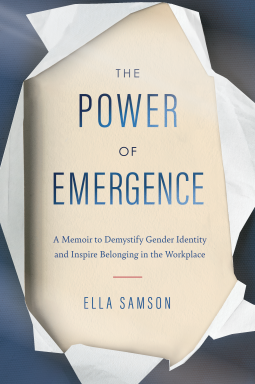
The Power of Emergence
A Memoir to Demystify Gender Identity and Inspire Belonging in the Workplace
This title was previously available on NetGalley and is now archived.
Send NetGalley books directly to your Kindle or Kindle app
1
To read on a Kindle or Kindle app, please add kindle@netgalley.com as an approved email address to receive files in your Amazon account. Click here for step-by-step instructions.
2
Also find your Kindle email address within your Amazon account, and enter it here.
Pub Date Apr 28 2026 | Archive Date May 5 2026
River Grove | River Grove Books
Talking about this book? Use #ThePowerofEmergence #NetGalley. More hashtag tips!
Description
A deeply personal story that illuminates gender identity, builds compassion, and inspires leaders to demonstrate meaningful enterprise allyship.
Ella knew from a young age that her lower anatomy seemed wrong, feeling a disconnect between her assigned gender and her actual gender. Though at the time, she lacked the language to understand what was happening inside of her. For years, she resigned herself to living with what felt like an irreparable divide between her inner truth and external reality.
Eventually, with purposeful internal work and corrective lower surgery, Ella fully emerged as herself—a woman, aligned with who she’d always been. Her emergence led to an unexpected and welcome calling as a leader in workplace gender equity. Ella’s story combines the journey of honoring one’s truth with the transformative power of acceptance and love, emphasizing the need for increased allyship and belonging in the workplace.
The Power of Emergence offers profound insights into the innate nature of gender identity with the goal of increasing understanding and promoting enterprise belonging.
Advance Praise
“A memoir that’s persuasive in its clarity, restraint, and steady sense of dignity.”—Kirkus Reviews
“Brave, brilliant, and deeply human, The Power of Emergence tells a raw, often painful, but ultimately beautiful and uplifting story that demystifies gender identity. Ella Samson’s courageous storytelling will move readers, deepen empathy, and help most people learn something new, creating many new allies for the transgender and gender-diverse community. Every executive who cares about workplaces and economies where everyone can contribute to their fullest potential should read this book.” —Ken Janssens (he, him), CEO, Open for Business
“My own lived experience has taught me that inclusion is not abstract—it is built when people are seen and valued in their full humanity. In The Power of Emergence, Ella Samson offers leaders a powerful and compassionate lens on gender identity that elevates belonging as a strategic and moral imperative for organizations.” —Juan Fernando Lopera (he, him, él), Chief Community and Health Impact Officer, Beth Israel Lahey Health
“This memoir does something rare: it deepens understanding without simplifying complexity. Ella Samson invites leaders to move beyond policy and toward genuine recognition—the kind of understanding that makes belonging real rather than aspirational.” —Dallas Ducar (she/her), Executive Vice President of Donor Engagement and External Relations, Fenway Health
“Knowing Ella personally and reading her story are two different things—this memoir changed me. It deepened my understanding of gender identity and sharpened how I lead, pushing me to build cultures rooted in empathy, authenticity, and true belonging.” —Curtiss Barnes (he, him), CEO, 1EdTech
“An insightful memoir that not only shares a courageous personal journey but also equips business leaders with a deeper understanding of gender identity—empowering them to cultivate belonging and create workplaces rooted in empathy, openness, and inclusion.” —Jack Mitchell (he, him), Executive Vice President in Financial Services
Available Editions
| ISBN | 9798900520278 |
| PRICE | $21.95 (USD) |
| PAGES | 278 |
Links
Available on NetGalley
Available to Buy
Buy on Amazon Buy on BN.com Buy on Bookshop.orgAverage rating from 1 member
Featured Reviews
 Demetris P, Reviewer
The Permission Slip From Every Room
In “The Power of Emergence,” Ella Samson turns gender identity, family inheritance, medical history, and workplace belonging into a memoir about the exhausting labor of becoming ordinary.
By Demetris Papadimitropoulos | April 19th, 2026
Most people do not experience recognition as a system. Their name, body, papers, bathroom, family role, and romantic legibility more or less align, so the fit fades into the soft machinery of the day. Ella Samson’s “The Power of Emergence” begins from the reverse condition: the self is present, but the world keeps filing it in the wrong drawer of reality. The wish driving the book is not flamboyant transformation. It is ordinary access – the right to move through a morning without translating oneself at every doorway.
Ordinary, here, is not diminishment. It is unremarked coherence. A name that fits. A body that does not require mental footnotes. A restroom that does not become a legal argument with hand soap. A lover who does not turn one’s private medical history into a referendum on his own identity. A workplace where arrival does not have to pass through gossip control, policy review, and the fluorescent indignities of being misread. The book is sharpest when it understands that recognition is not only emotional. It is load-bearing.
The subtitle arrives wearing work shoes. “A Memoir to Demystify Gender Identity and Inspire Belonging in the Workplace” sounds, at first, like a promise to act beyond the page. It does. Sometimes stubbornly. But the use is not tidy. This is a memoir of anatomy that keeps discovering paperwork in the bloodstream, and a workplace book that keeps being interrupted by skin, sex, fathers, and fear. Samson tells the story of a Dutch Jewish immigrant child, assigned male at birth, who knows with early and violent certainty that something about her lower anatomy is wrong, though she has no language for what she knows. The child at the sink, sobbing to her mother that “my thing is wrong,” becomes the memoir’s first great scene of knowledge before vocabulary. The body, or at least the body as it has been read, has become a bad translation imposed from outside.
At first the route is geographical – the Netherlands to California – but the deeper journey is procedural: school, work, therapy, hormones, surgery, documents, disclosure. Her life becomes a succession of gates that must be entered, corrected, or survived. Papa, Samson’s father, supplies much of the domestic weather. He is funny, volatile, industrious, generous to friends, stingy with tenderness at home, and rigidly invested in masculinity. He can repair a damaged camper roof with garbage bags, duct tape, and a meat cleaver, which gives us his whole repairman theology. His emotional toolbox appears to contain one hammer and no instructions.
He mocks gender-nonconforming people on Polk Street. He crushes his child’s hand in tests of strength. He explodes over a sweater tied preppily around the shoulders. He abandons milestone birthdays, disappears into grievance, then later surprises Ella with pride, jewelry, and an offer to buy her a dress. Samson does not make him tidy, and that restraint matters. Affection does not launder the harm; harm does not erase the affection. Papa remains what many parents are in memoirs worth reading: weather system, wound, inheritance, and occasional provider of sausages.
The Holocaust inheritance keeps him from hardening into a mere villain and keeps gratitude from looking like moral purity. Samson’s Jewish grandparents survived; much of the extended family did not. From that inherited catastrophe come vigilance, work ethic, mistrust, and a fierce appreciation for safety. Samson grows up understanding that a life with food, health, education, family, travel, and financial stability is not to be complained about lightly. Gratitude becomes a ledger of permissible pain. If the columns look full enough, perhaps pain should stop asking for admission.
One of the memoir’s quietest sorrows is that Samson spends decades trying to be grateful enough to make an unlivable misalignment livable. She has family, friends, work, exercise, dogs, food, competence, achievement. Surely, she seems to tell herself, this should suffice. But the body keeps its own books. No amount of professional excellence can make nausea disappear from sex that feels molecularly wrong. No amount of gratitude can turn being called “my boy” into recognition. The sadness of Samson’s early question – will this make me a little less sad? – lies in its modesty. She does not initially imagine joy. She asks only for a reduction in pain.
That modesty gives the book its shape. “The Power of Emergence” is not built around one great disclosure, one theatrical staircase of arrival, one applause-ready speech in which the right shoes meet the right floor. It is built around steps: hair, red toenails, electrolysis, voice work, therapy, name changes, medical letters, hormones, clothing, court orders, social media cleanup, workplace emails, bathroom use, surgery, dilation, dating disclosures. The chronology is plain, but not inert; its incremental design is the argument. Emergence, in Samson’s telling, is not an announcement. It is an accumulation.
The pages quicken around the steps that refuse to behave politely. The Green Dream, with its dingy pea-green apartment, isolated transgender woman, white curtain, and silent man in a beige raincoat, compresses stigma, poverty, sex, danger, and internalized fear into a nightmare with the efficiency of a one-room stage set. The O’Hare tunnel scene, where Samson breaks down while moving through neon, music, mirrored ceilings, airport panic, and professional exhaustion, is almost too exact an emblem: a life in transit, lit up, overstimulated, and not arriving anywhere. The red toenails at the beach, unveiled to friends with comic shock and delight, are a tiny red flag of self-recognition. The first “ma’am” at a gas station nearly detonates the day with joy. Later, after she falls down the basement stairs and two Best Buy technicians ask, “Ma’am, ma’am, are you okay?,” the joke is not that she has fallen. It is that even bleeding on concrete, she is, in one essential sense, more than okay.
Samson’s prose is clearest when it stays with material facts: pills in a palm, plastic wrap over numbing cream, gaffs, lipstick, bruising, dilation, corrected diplomas, a father’s sausage, a lover’s silence. Her sentences tend to be medium-length to long, orderly, explanatory, and sequential. She writes like someone who has survived by reducing ambiguity, managing risk, and keeping the exits visible. This is not a style of compression or shimmer. It is an escorting style. The reader is rarely abandoned. Occasionally, the reader is perhaps too carefully accompanied.
That carefulness becomes both virtue and tax. Samson often explains the meaning of a scene after the scene has already done the work. The habit is understandable. Misunderstanding has cost her too much for her to leave every implication unattended. But the art sometimes pays for that vigilance. Words such as emergence, truth, authenticity, gratitude, love, alignment, and belonging matter deeply to the book’s private lexicon, yet they recur until some lose their edge. The sink, the tunnel, the gaff, the first “ma’am,” the dilator, the bad kiss, the healed scar – these know more than the abstractions that follow them.
The Deloitte chapters are where the memoir becomes most unmistakably itself. Samson does not treat workplace belonging as atmosphere, slogan, or lanyard sentiment. She treats it as design. She segments colleagues into communication tiers. She coordinates senior-leader sponsorship, Talent support, confidentiality, bathroom policy clarity, pronoun expectations, timing, follow-up notes, and audience-specific messaging. An email plan develops office suspense. Outlook, unexpectedly, becomes an instrument of the soul.
That sounds dry. It is not. It is the book’s theory of recognition made practical. A person can know herself fully and still be undone by a payroll system, an old photograph, an insurer, a bathroom door, a careless colleague, or a manager who confuses kindness with silence. Samson understands that the self may be internal, but the conditions that let it breathe are social, legal, medical, erotic, familial, and professional. The firm’s handling of her emergence gives the memoir its strangest and most useful gift: belonging is not niceness. It is architecture with consequences.
The surgical chapters trade procedural suspense for bodily candor. Samson writes about lower surgery, dilation, bruising, swelling, urinary changes, granulation tissue, pelvic-floor therapy, vibrators, scars, pain, and pleasure with a frankness that is neither coy nor sensational. The tone is practical, funny, and almost defiantly unembarrassed. Papa’s “starter button” joke, offered during a family dinner about surgical technique, is outrageous, affectionate, unbearable, and perfect. The later declaration that the starter button works, though she does not tell Papa, is a comic exhale. Here the memoir finds a tonal balance it does not always maintain elsewhere: anatomy, joy, and wit moving together without apology.
Later, the coaching register matters to Samson’s healing, but it is less charged on the page than the messy precincts of toilets, lovers, scars, hormones, and fathers. After surgery, the book wisely refuses to pretend that bodily alignment solves the whole problem of living. Samson still has to learn desire, disclosure, heartbreak, and vulnerability. The relationships with Scott and Derek are painful because they are not ruined by cruelty. They are undone by guardedness, inexperience, timing, and the old habit of protecting oneself before one has learned how to stay present. She has become physically able to be met; intimacy still requires another education.
Still, the language of gratitude practices, vibration, abundance, love coaching, and affirmations sometimes smooths out the rough edge that makes those lessons compelling. These practices belong to Samson’s life. They are part of her recovery and later growth. On the page, though, they can feel more stated than dramatized. The memoir is most alive when Samson is not announcing growth but discovering, with some alarm, that growth has consequences: she can be heartbroken now; she can flirt now; she can disappoint men now; she can be wounded by a mother’s incomplete recognition now; she can choose not to rescue Papa from the wreckage of his own behavior now. Freedom is not always serenity. Sometimes it is having new and better ways to make a mess.
Samson’s chosen terms will divide readers. She rejects “transition” because she does not believe she moved from male to female; she understands herself as having always been female and therefore as having emerged. She dislikes “passing,” resists “dead name,” describes her lower anatomy as a birth defect, and argues that after lower surgery she no longer uses transgender as an adjective for her current state, though her transgender medical history remains essential to her story. As self-definition, these claims have force because they sound earned, not borrowed. They are also the book’s riskiest intellectual pressure.
Samson repeatedly says she speaks only for herself, and that caveat matters. Still, some formulations press toward broader frameworks that other readers, including some transgender and gender-diverse readers, may find too anatomically weighted, too surgically resolved, or too particular to bear collective weight. The tension should not be flattened into either bravery or error. It is part of what makes the book alive. Samson is not offering settled communal language. She is insisting on the terms that made survival intelligible to her.
Placed beside Janet Mock’s “Redefining Realness,” Meredith Talusan’s “Fairest,” and Thomas Page McBee’s “Amateur,” Samson’s memoir looks less formally inventive but unusually procedural. Like Mock, she claims the authority to narrate herself against inherited misunderstanding. Like Talusan, she writes candidly about beauty, visibility, privilege, and being looked at. Like McBee, she uses embodied experience as a method of inquiry. But Samson’s imagination is more operational. She is the rare memoirist who can make a court order, a workplace memo, and a corrected diploma feel like artifacts of the soul.
The epilogue sharpens the book by threatening to undo its hard-won coherence. When federal policy turns hostile to gender-identity recognition, Samson’s corrected records, access to care, consulting business, finances, and emotional safety all become newly exposed. This does not feel like topical garnish. The world that misread her at birth returns in bureaucratic form. If recognition is load-bearing, policy can become a demolition order.
Samson eventually decides to relocate to the Netherlands, a move layered with painful irony given her family’s European trauma and their earlier migration to the United States in search of safety and opportunity. The memoir, which begins with a child leaving the Netherlands for California, ends with a woman crossing back toward Europe because the country that helped her emerge has become less stable for the truth she fought to live. The circle is not neat. It is more like a flight path redrawn under pressure.
The afterword puts on a blazer, straightens its notes, and addresses senior leaders directly. It is the least graceful stretch of the book, but not an accidental one. Samson asks enterprises to examine the policies, processes, systems, and cultural habits that shape daily life for gender-diverse and transgender employees. Some readers will feel the tonal seam. The memoir briefly becomes a pitch deck with a pulse. Yet dismissing that turn would be too easy. The business-facing material is rooted in the book’s lived argument. Samson knows, because Deloitte showed her, that institutions can either multiply harm or reduce it. Goodwill without process is a scented candle in a server room: pleasant, doomed, and not remotely up to code.
The deepest force of “The Power of Emergence” is that it makes being seen feel concrete. It refuses to leave gender identity in the realm of attitude, belief, or debate. It shows what misrecognition does to a child, a body, a sex life, a family, a career, a passport, a dating profile, a Tuesday morning. It also shows the opposite: what happens when a name is corrected, a pronoun lands, a manager protects confidentiality, a surgeon does her work well, a friend sees the woman in front of him, a stranger says “ma’am,” and the day opens instead of closing.
The cost is that Samson’s clarifying impulse sometimes makes the book less sharp than its best pages. It can over-explain, repeat, and turn volatile scenes into lessons too quickly. But that limitation is inseparable from the book’s urgency. Samson is writing for readers who may not know what gender identity feels like from the inside, and for leaders who may not understand how many small structures hold a person in place or push her out. She is also writing against the terror of being misread. The prose’s steadiness, its occasional over-management, its repeated return to gratitude and love – all of it belongs to a narrator who has spent decades trying to make herself safe in language.
I would rate “The Power of Emergence” 83/100, which corresponds to 4/5 stars. It is a valuable, uneven, unusually concrete memoir whose excellence is emotional, intellectual, and practical rather than chiefly stylistic. It does not reinvent memoir form, and at times it underlines what its scenes have already lit. But it has something more consequential than polish: a precise account of the labor required to become recognizable without becoming reducible.
What lingers is not a slogan about authenticity, but a sequence of ordinary thresholds brightened by how hard-won they are: a child at a sink, a woman in a green dream, three tiny pills in a palm, an email sent, a body healing, a name corrected, a father handing over sausages like an apology he cannot quite pronounce. Samson’s memoir asks readers to understand that the miracle is not transformation.
The miracle is a life no longer requiring a permission slip from every room it enters.